Flag Day — June 14 — is, of course, the day when American citizens are asked to take more than a moment to remember “Old Glory.”
Yet, it is also a day in which to remember where the day and nickname came from and answer the question, “Just who made the first flag?”
Hint: There is major connection to central New Jersey.
But first things first: Flag Day is the merging of two dates: June 14, 1777, and May 30, 1916.
On the first date, the Second Continental Congress in Philadelphia wanted a flag to unite the 13 colonies waging war with England and passed a resolution to create one that very specifically noted that “the flag of the United States be 13 stripes, alternate red and white,” and that “the union be 13 stars, white in a blue field, representing a new constellation.”
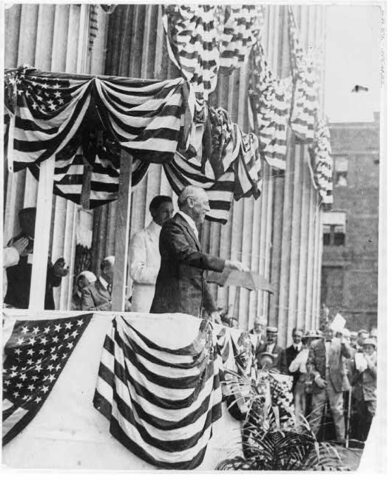
On the second date, President Woodrow Wilson designated June 14 as the day to honor the flag and nation.
He may have also been preparing to brace the nation for its entry into World War I.
“My Fellow Countrymen,” the former Princeton University president and New Jersey Governor wrote in his proclamation, “Many circumstances have recently conspired to turn our thoughts to a critical examination of the conditions of our national life, of the influences which have seemed to threaten to divide us in interest and sympathy, of forces within and forces without that seemed likely to draw us away from the happy traditions of united purpose and action of which we have been so proud. It has therefore seemed to me fitting that I should call your attention to the approach of the anniversary of the day upon which the flag of the United States was adopted by the Congress as the emblem of the Union, and to suggest to you that it should this year and in the years to come be given special significance as a day of renewal and reminder, a day upon which we should direct our minds with a special desire of renewal to thoughts of the ideals and principles of which we have sought to make our great Government the embodiment.”
Less than a year after the proclamation, the United States had entered World War I, and Wilson gave a Flag Day speech in which he said, “We meet to celebrate Flag Day because this flag which we honor and under which we serve is the emblem of our unity, our power, our thought and purpose as a nation. It has no other character than that which we give it from generation to generation. The choices are ours. It floats in majestic silence above the hosts that execute those choices, whether in peace or in war. And yet, though silent, it speaks to us —speaks to us of the past, of the men and women who went before us and of the records they wrote upon it.
“We celebrate the day of its birth; and from its birth until now it has witnessed a great history, has floated on high the symbol of great, events, of a great plan of life worked out by a great people.”
After announcing, “We are about to carry (the flag) into battle, to lift it where it will draw the fire of our enemies,” Wilson went on to describe the actions of the “military masters of Germany, who proved to be also the masters of Austria-Hungary” as aggressors that disregarded other nations as “men, women, and children of like blood and frame as themselves.”
He then concludes his nearly 30-minute speech by arguing that “for us there is but one choice. We have made it. Woe be to the man or group of men that seeks to stand in our way in this day of high resolution when every principle we hold dearest is to be vindicated and made secure for the salvation of the nations. We are ready to plead at the bar of history, and our flag shall wear a new lustre. Once more we shall make good with our lives and fortunes the great faith to which we were born, and a new glory shall shine in the face of our people.”
It’s a pretty good bet that Wilson slipped in the phrase “new glory” as a way of evoking the American flag as “Old Glory” — another story in itself.
“Old Glory” was actually a specific flag that flew on a specific ship, the Charles Doggett. Its captain was Salem, Massachusetts, sea merchant William Driver.
When Driver launched his international trading business in 1824, his mother and her circle of friends presented him an American flag that they had sewed and he flew over his ship for decades.
He also gave it is famous nickname. In a note, Drive says the flag “has ever been my staunch companion and protection. Savages and heathens, lowly and oppressed, hailed and welcomed it at the far end of the wide world. Then, why should it not be called Old Glory?”
Driver’s seafaring ended when he returned home to aid his dying wife. When he remarried, he, his wife, children, and Old Glory moved to Nashville, Tennessee.
There the staunch Unionist proudly displayed the flag that eventually became a problem during the Civil War. When a Confederate gang came to his house and demanded he hand the flag over to them, Driver replied, “You’ll have to take it over my dead body.”
While the Confederates didn’t take Driver up on his offer, the retired merchant decided it was probably a good idea to protect the family heirloom that had been updated with new stars as new states joined the union.
With the help of friendly seamstress, Driver hid the flag in a bed quilt, where it slept quietly until the Union Army marched into town and it ended up flying at the state capitol building.
Driver, who died in 1886, had given Old Glory to one of his daughters, who managed to present it to President Warren G. Harding. He, in turn, gave it to the Smithsonian and the nation.
But what about that first flag?
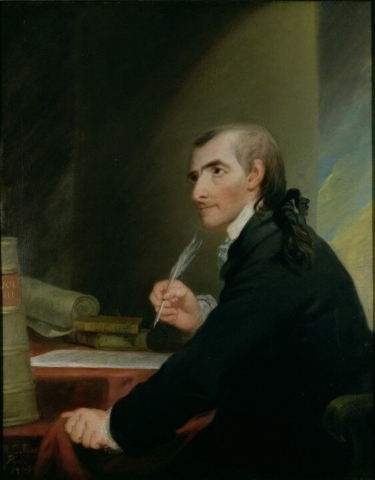
While public opinion and legend gives it to Philadelphia seamstress Betsy Ross, the evidence points to Bordentown lawyer, congressional delegate, and Declaration of Independence signer Francis Hopkinson.
The popular Ross story goes like this: Elizabeth Griscom Ross was George Washington’s Philadelphia seamstress.
When Congress resolved to have a flag, Washington, along with Robert Morris and Ross’s husband, congressman George Ross, told Betsy they were instructed to get the flag made and gave her a design that she embellished.
While Ross did sew flags during the Revolution, there is no documentation regarding her and the original flag.
Nevertheless, the Ross family retold the Washington and Betsy tale for generations — probably adding their own embellishment.
The oft told-tale went public in 1870 when family member William Canby shared it with the Pennsylvania Historical Society. Three years later the story appeared in Harper’s New Monthly Magazine and was accepted as fact.
Meanwhile, Hopkinson’s connection to the flag has a trail that’s not as fun to hear as Washington weaving his seamstress into history. That’s because it’s an historian’s mundane treasure: a job invoice.
Hopkinson — a renaissance man who in addition to being appointed to the Continental Navy Board in 1776 was an artist and composer — informed Congress in 1780 that “It is with great pleasure that I understand that my last Device of a Seal for the Board of Admiralty has met with your Honors’ approbation. I have with great readiness upon several occasions exerted my small abilities in this way for the Public Service; & as I flatter myself to the satisfaction of those I wished to please, viz: The flag of the United States of America” and several other designs.”
Historians agree that the journals of the Continental Congress show Hopkinson designed the flag — but it wasn’t the one with the circle of stars that readily comes to mind.
As the American Flag Company reports, “The design of the first Stars and Stripes by Hopkinson had the thirteen stars arranged in a ‘staggered’ pattern technically known as quincuncial because it is based on the repetition of a motif of five units. This arrangement inevitably results in a strongly diagonal effect.
“In a flag of thirteen stars, this placement produced the unmistakable outline of the crosses of St. George and of St. Andrew, as used together on the British flag. Whether this similarity was intentional or accidental, it may explain why the plainer fashion of placing the stars in three parallel rows was preferred by many Americans over the quincuncial style.”
Preferences also led to variations of the flag, including the circle of stars representing the original 13 colonies.
Or maybe they represent the delegates, who, on a June day 246 years ago, decided to run an idea up the flagpole and created history.