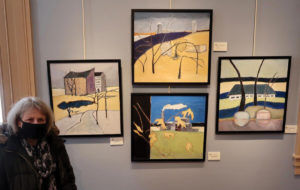
Elizabeth Aubrey
Interview conducted by Tom Kelly
Elizabeth Aubrey is a Bordentown-based painter currently exhibiting in the Trenton City Museum exhibition “Women Artists Trenton Style,” curated by noted New Jersey artist Mel Leipzig.
Aubrey, who is married to U.S. 1’s Dan Aubrey, was born in Princeton and raised in Dutch Neck. She is interested in how nature conflicts with humans and the seeming overbuilding in already crowded New Jersey. Her signature styled works are created by starting with a true-to-life visual that she then abstracts to totally change the view.
What are you communicating with your art?
I’m trying to communicate tranquility and reflection to the viewer. I wish to trigger the viewer’s imagination, not of a specific place or time but something that is from their experiences. I leave some things out and wish for the viewers to add some things of their own. I work in acrylics on canvas. I am not a fast painter. Some paintings may take me up to a year to finish.
Who were you influenced by?
There are so many that have influenced me. On the top of my list are Edward Hopper, for his reflections and lighting, and Henri Matisse for the colors and forms he employed. Two other influences are Milton Avery and Marsden Hartley, who also have excellent color and solid forms.
What is the inspiration for your current work?
The changing environment inspires me. By that I mean the disappearing of the natural for the new homes and warehouses. I like to show natural elements competing with the constant conflict of the industrial influences. As I drive down the Turnpike each day, all I see is warehouses. Yet no matter what, nature still tries to maintain a balance.
What is your process?
I start with small drawings. They are small and do not allow a lot of room for details. From these sketches I then make color studies to see which colors will work the best. From there I enlarge the study and create the painting. I work in spurts and will complete about five or six paintings at a time. It’s almost like a series but not with the same theme.
What is your favorite local museum?
My two favorites are the Princeton University Museum and the Philadelphia Museum of Art, of which we are members.
Are you a mentor/teacher/ curator?
I’ve curated shows with the Trenton Arts Workshop Association and the Sage Coalition in Trenton. I have also assisted our son, Byron, who curates exhibitions featuring artists with disabilities. One obstacle is finding venues to show art. We have artists and now need more venues.
How long do you feel it took you to find your own voice?
I think about 20 years; I’m still open to change. I have a consistent technique and subject matter but my approach is different. I find when I am ready; I really attack the work now.
What fight/struggle do you have regarding your art?
Time to create is my biggest obstacle. I was working full time and commuting an hour each way.
What one attribute should all artists have?
Persistence is key for an artist. Trying new ideas and making art for yourself can really help you create the most pure form of art. My art is not traditional or mainstream. You can’t let critics hinder you. I see the artists with disabilities making art that is pure and they are so happy with it.
Do you acquire your art supplies locally or online?
I only buy locally. I get my paint at Jerry’s. I get brushes at Michael’s. I beat up and use my brushes until they are dead.
Do you have a lot of artist friends in the area?
I have a lot of support from other artists in the area. It’s not easy for the visual arts. The artists, sculptors, and theater groups need businesses to value their work. The arts need business and the businesses need art. In Trenton, there is a strong group of young artists who realize you don’t need a museum to show art. In other places, like Hamilton, the arts are still in their infancy.
What is your dream project?
I would love to travel and paint. I wouldn’t have to go far. The tri-state area would be a good start, then maybe to the British Isles.
For more information on Elizabeth Aubrey, visit www.ejaubrey.com.
Mary Yess
Interview conducted by Tom Kelly
Mary Yess has a long and distinguished list of arts leadership and accomplishments in the Mercer County area. Predominant in her art are the old industrial buildings from the East Coast’s manufacturing heyday. Her art, based on real buildings, diverts into simplified abstraction, with terrific compositions and a limited palette. The resulting images are quite beautiful.
Her work can be seen now through June 6 in Women Artists, Trenton Style, at the Trenton City Museum.
What are you communicating with your art?
Color, light, evocation. I have a very visceral connection to color, so that aspect is probably most important to me. Subject matter is not as important; it’s more a carrier or vehicle to show the relationship between colors, between forms and lines.
But I do like to capture the beauty and sadness of industrial buildings and their surroundings. They are majestic relics and are so evocative, like lost cities. They amaze me: all the bricks, each made and placed by hand to create those mammoth buildings. They are palaces to me, and hence the title of one of my series, “American Versailles.”
What media do you use and why?
My work often falls under the category of mixed media, but the pieces are primarily oil (tube paint or oil sticks). I also use ink and pencil, even in paintings on canvas. I like lots of layers and pentimenti. I have another series, the “Oxford Codex/Lares Industria” series, where I use old file dividers as the base, incorporate discarded circuit boards on them, and paint landscapes or totem-like figures over all of it.
Who were you influenced by?
Classics like Velazquez, also Richard Diebenkorn, Joan Mitchell, David Smith, Willie Cole, Gee Bend quilters, Louise Nevelson, Bill Traylor, Jasper Johns, aboriginal art, and Persian miniatures.
Where do the ideas come from?
The starting point is usually a particular light or specific vista. Sometimes the vistas are used directly as images. Sometimes just their elements get added to my personal forms catalogue: particular building shapes (clerestories, mushroom-shaped vents), tree types, urban landscape elements (guard rails).
Do you paint on site or in the studio?
Many of the buildings I paint are in abandoned locations, and/or along very busy highways; so, it’s almost impossible to paint on site. I have to use photographs and drawings, and then do the work in the studio. But, oftentimes, I am creating the buildings and other landscapes from scratch, so those are coming from my own vocabulary of building types, tree types, etc.
Briefly describe your process.
I start with a pencil drawing, then use ink to create some of the hard lines I want to show through, then oil and oil pastel, and finally some colored pencils to scribe lines, add color or texture. Layers are important.
How have you seen the arts evolve in this area?
I’ve been involved in the Trenton area arts for many years (director of Artworks, president of TAWA, on the boards of Ellarslie and various arts commissions, and exhibiting extensively). There seem to be waves of activity. To paraphrase Ian Malcolm from Jurassic Park, “Art finds a way.”
What drives you to paint?
It’s very absorbing, it is exploration, and it takes you into another domain.
What fight/struggle do you have regarding your art?
I’m very fortunate to have a great studio space. What’s tough is not being able to work on site (as mentioned above). But I’m not a “realist” painter, so I don’t mind using photographs as a jumping-off point.
What local attraction(s) do you love to visit or inspire you?
Any place that has industrial buildings. Trenton has a treasure trove, but also Buffalo (NY), Erie (PA), or along the train route from here up through Boston.
What is most fun about being an artist?
Taking reality and transforming it into something else.
What is on the horizon?
I want to push further, maybe even into abstraction. Am also looking to find a place where I can do welding again.
Tom Kelly is a columnist for the Community News Service’s Hamilton Post.