It wasn’t exactly the Cedar Tavern, the famed Greenwich Village gathering spot for mid-20th century abstract expressionists and Beat poets, but back in the day in the lobby of Taylor Photo, you might run into a painter known as the Chekhov of Trenton; a historic preservationist whose many books include “The Roebling Legacy”; or a photographer whose monograph “Facing Sculpture” was a compendium of penetrating portraits of contemporary sculptors.
Taylor Photo wasn’t just a place where artists had their prints made; clients included some of the more well-known architects of the era — Michael Graves, Philip Johnson, Frank Gehry, Robert Stern, and others.
Founded in 1982 by brothers Bill and Robert Taylor, in their basement at 123 Jefferson Road in Princeton, Taylor soon became the largest studio and photography lab in New Jersey, building its 35-year home at 743 Alexander Road.
In those three decades, photography transitioned from the wet darkroom to digital, from large format cameras to handheld devices; the economy went from boom to bust several times around the block; and there was the pandemic. Taylor withstood all but the last.
“Restaurants closed, workers weren’t working, there were no social events for photographers to photograph, galleries were closed, and artists weren’t needing prints, and we felt the trickle down,” says Ron Eckert, who had worked for Taylor for 20 years.
He is now business development manager and photographer for the newly formed Allegra – Princeton/Taylor Photo at 6 Corporate Drive in Cranbury, an industrial warehouse once home to Utrecht Art Supplies, a company that itself folded into Blick Art Materials.
“The merger gives us the ability to do what we do and to add more services,” an enthusiastic Eckert says.
To the new company, Taylor brings its impressive equipment and client list, including architects, artists, and academic and nonprofit institutions. Among the U.S. 1-area clients are Princeton University and Lewis Center for the Arts, Grounds For Sculpture, the Arts Council of Princeton, Morven Museum & Garden, Historical Society of Princeton, Institute for Advanced Study, Rutgers University, and Triumph Brewery. A Civil War-era flag was restored, photographed, printed on canvas, and mounted for the Rocky Hill Municipal Building.
Allegra came to the merger with a 30-year track record in printing and sign making. And it is no stranger to working with artists — director of client relations Maurice Galimidi is an artist who has exhibited at the Arts Council of Princeton and Trenton City Museum at Ellarslie, and won awards at Phillips Mill in New Hope, Pennsylvania, and in the Mercer County Artists Show.
Founder Bill Taylor made the transition as a contract photographer for the company that still bears his name, while brother Robert has gone on to do other things.
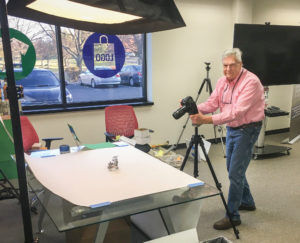
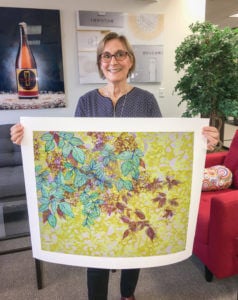
“I like my work so much, I just keep doing it,” says Eckert, who shoots portraits as well as artwork. He has designed a special easel with a T bar and slides to hold artwork, up to 30-by-40 inches, in place. “Artists take great pride in their work, and we take great care to give back what they have given us. We use the best printers, inks, and papers. It’s often impossible to tell the difference between the print and the original.”
One thing Allegra/Taylor can do that a person with a home printer cannot is adjust the platen for thicker substrates. “A home printer will jam,” says Eckert. The Epson Sure Color Pro 9000 can make a much larger print than one can make at home, and with Epson pigmented inks that claim archival properties for 200 years — that means no fading or color changing.
Eckert cites a survey that found the most popular sized art in the country is 16-by-24 inches. Most home printers cannot print anything larger than 11-by-14, and few people own printers that can make anything larger than 8-by-10. Allegra/Taylor can print up to 8-by-15 feet, and on substrates beyond paper, from metal and Sintra (plastic) to vinyl and fabric. The print can be laminated on both sides, or encapsulated, to become waterproof.
“Digital is the best gift to photographers and artists since color photography,” says Eckert. Programs like Photoshop can be used to correct exposure, enhance color, straighten lines, remove reflections, sharpen contrast, increase resolution, even add details that may not be in the original. When clients bring in old black-and-white photos to be digitized, they can even have them colorized.
Ron Biela started at Taylor Photo in 1986 and has made the move to Allegra/Taylor, having ridden the wave from wet darkroom to the most cutting edge photo processing. For a client such as Toll Brothers, he can add windows, which may not yet be fully built, to a photo, including the snow or foliage seen through that window. He may have to Photoshop out construction equipment from a job site, or make the grass greener. “I tell the client I won’t make drastic changes,” he says.
Biela has become a specialist on the Matterport, a 3D video system that is used for virtual tours. With a series of nine lenses, the Matterport spins for a 360-degree shot. The photographer controls it through an app, being careful to stay behind it. The Matterport automatically stitches the images together.
The Matterport was used, for example, to create a virtual tour of a clubhouse at Penn State. The viewer can feel immersed in 360-degree views of the lounge area, and feel as if they are going down the stairs to a fitness studio, through warrens of hallways, even up an elevator. Area real estate firms have also been using the technology to offer virtual tours of homes for sale at a time when in-person visits were ill-advised.
Biela and Eckert say the application is perfect for museums or historical sites, where an exhibition or objects on loan may only be on view for several months. With Matterport, the client pays a hosting fee to keep the exhibition alive in perpetuity.
Eckert took me behind the door to the production area, a large warehouse filled with a sea of printers of every size and variety. Signs for the Lewis Center for the Arts and Grounds For Sculpture were hot off the presses. At Allegra/Taylor, humans are still operating the machinery. The company employs up to 35.
A catalog for The Purple Carrot, a plant-based meal delivery service, had just finished printing. Next, the paper would be trimmed, stapled, and the catalogs packed and shipped. The Purple Carrot’s pages were filled with mouthwatering photos of food and recipes, sent to Allegra/Taylor as a digital file.
Film cameras are still a real thing at Allegra/Taylor. When a client brought in an old black-and-white camera that still contained film shot by the client’s grandfather, a history was unraveled — the family had been unaware its patriarch had served in World War II. Eckert, who grew up in Bridgewater, was reminded of his own family history — his great uncle was a portrait photographer, and his uncle was an aerial photographer for the U.S. Air Force.
With help from those uncles, Eckert earned a merit badge in photography as an Eagle Scout in 1959. His mother worked at home, and his father was a mechanical engineer. Three years later, at age 15, Eckert sold his first photograph and put the earnings toward purchasing equipment.
He earned a bachelor’s degree in business administration at Johnson & Wales University in Providence, Rhode Island, and took photography classes at the nearby Rhode Island School of Design. He worked for a photography studio in Somerville before starting his own business, Snapshots, also in Somerville, that he ran for 25 years. Eckert describes it as a mom-and-pop store that did both studio and darkroom.
As a photographer, Eckert has “shot everything from porches to planes, anything that’s not underwater,” he says. His personal photography can be seen at FineArtAmerica.com.
One of the things Eckert enjoys most about his job is interacting with artists and photographers. He puts them in a category with magicians. “Some may see a scene at, say, the beach, and photograph it. Others put up a canvas and just paint what comes. Others will start with a sketch and build upon what they see. I love when someone can make something beautiful.”
He often offers practical advice on pricing and marketing fine art prints. “I like to tell artists, if you can dream it, we can do it.”
Taylor Photo, 6 Corporate Drive, Cranbury. 609-452-9444. www.taylorphoto.com.