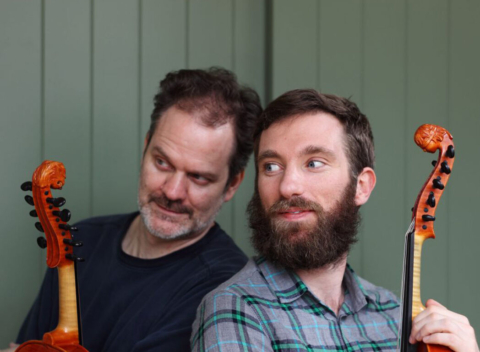
Princeton University’s Taplin Auditorium became the fitting space for Princeton University chair of music, composer, and fiddler Dan Trueman to hold the recording launch of a CD he created with fellow fiddler Caoimhin O Raghallaigh, “The Fate of Bones.”
Part of the Princeton Sound Kitchen series of new music presentations, the significance of the evening was not lost on Irish native O Raghallaigh who connected the theme of the new work with the Celtic festival of Samhain, the predecessor of Halloween.
He also noted other Irish connections to the suite performed during the evening, including the bodily remains of an early Bronze Age (circa 2,000 BC) man on display at the National Museum of Ireland in Dublin.
The Irish connection continues with the meeting of the two musicians when Princeton resident Trueman came to Dublin on a Fulbright Scholarship in 2010.
While both demonstrate a masterful and versatile understanding of the violin, background information provides details that shape their approach. Trueman has a passion for Norwegian Hardanger fiddling and O Raghallaigh is influenced in part by fiddling traditions in the sliabh luachra region in southwest Ireland.
Both also are informed by contemporary approaches to music and their presentation included works that slide between innovation and tradition.
“Both the ‘The Fate of Bones’ album release and this concert were originally scheduled for April of 2020,” notes Trueman in a statement available in a program and online. “We finally performed the concert in Dublin this past May, and are doing it again just this once, here in Princeton, tonight.”
As the program notes, the collaborative recording was realized by the two musician sharing an online folder where one would make a musical statement and the other would answer in a type of call-and-response approach.
Trueman adds that the instrument used for the recording and concert were “a new kind of instrument that (Norwegian fiddle maker) Salve Hakedel created for us about a decade ago, and the traditional Norwegian Hardanger fiddle sound at their best when in various scordatura, or cross-tunings as fiddlers call them, where the tuning of the bowed strings interacts with the sympathetic string to reinforce one another and create a perpetual ringing glow.
“Often, Caoimhin and I have our instruments in quite different, if complementary, tunings, which creates all sorts of wonderful puzzles for our fingers and ears to solve, and many of our tunes are in some ways a product of that puzzling.”
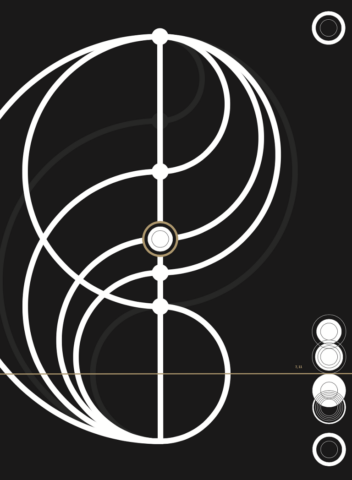
Another artistic element was added when the two fiddlers re-engaged the same artist who created the design for the packaging of their first album, Laghdú. “We asked the designer Rossi McAuley (founder of Distinctive repetition in Dublin) to design album artwork for us; he went far beyond that call and created an entire set of unique CD packaging, printed on recycled materials with organic inks. For ‘The Fate of Bones,’ we went back to Rossi and had a broader conversation about the purpose of the album artwork today, in the era of streaming. These conversations began around 2017, while the Golden Records from the Voyager spacecraft were being celebrated for the 49th anniversaries. Etched into the surface of those records is iconography aimed to enable some alien species millions or billions of years in the future to decode and listen to their contents; surely that is the most ambitious and optimistic record release of all time!
“While our ambitions are far more modest, Rossi and his collaborator Stephen Kerr went about developing a similarly inspired iconography that represents the different turnings that Caoimhin and I use with our instruments.”
The result, says Trueman, is artwork that is “concise and beautiful.” It also became part of the performance. “One of the tunes we play emerges when we ‘read’ this iconography, and (we) play two versions, one to open each half of the program, each one in a different set of tunings; the gestures sound forms remain similar, but the sonorities are transformed and filtered by our changed tunings.”
“We don’t know the fate of our bones. Remains can outlast the monuments or attitudes built to contain them as they continue to scatter, transform, ever-complicated,” notes Fiona Hallinan, an Irish artist who explores the theme of death through the project she co-founded, “Department of Ultimology,” and was invited to share her thoughts on the recording.
“There is vulnerability when we send sounds out, as a record into space, or a voice message to a friend. We don’t know how things will land, yet the thought of reception invites us to act. Helping my child learn to speak, I’m told it’s not important what the words are, but that they are responded to. We make sound to know we are heard,” writes Hallinan.
About being able to launch the recording with a concert, Trueman says, “Hopefully more will follow, but if we’ve learned anything over the past couple of years, we can’t count on anything.”
For more information regarding “The Fate of Bones” and to hear selections, visit thefateofbones.com.
For more on the composers, visit music.princeton.edu/people/dan-trueman and caoimhinoraghallaigh.com.