The poem that modernized Western European and American literature is currently celebrating its 100th anniversary.
“The Waste Land” — written by the American-born English writer T.S. Eliot and edited by American-born poet and critic Ezra Pound — jolted the literary world when it appeared first in the October, 1922, premiere issue of The Criterion, a British literary magazine founded and edited by Eliot.
The poem then reappeared in the November issue of the American literary publication The Dial and in a book published in December by New York City publisher Boni & Liveright.
Opening with an unsettlingly stark statement that threw aside romanticism and sentimentality, “April is the cruelest month,” the post-World War I poem then took the reader on a tour of the psychic landscape of a once confident civilization that now found itself wasted — creating an era sometimes referred to as the “Lost Generation.”
That the poet explored the above theme with a new mixture of literary techniques, religious allusions, mythology, languages, memory, and personal desire challenged readers to come to grips with their past, present, and future — elements that contribute to the poem being called one of the most important works of the 20th century.
And while it was written in England, “The Waste Land” has an intriguing connection to a box in the Princeton University Library.
In it are 1,131 letters that Eliot wrote to Emily Hale, a woman with whom he was infatuated with for decades.
The star-crossed romance for the St. Louis, Missouri-born Eliot and the East Orange, New Jersey-born Hale began when the two met in Cambridge, Massachusetts, in 1912.
Eliot was studying philosophy at Harvard. Hale’s family had moved to the Boston area, and she was pursuing studies as a voice and drama instructor.
Although Eliot says he fell in love with Hale, he left her and the United States for Europe in 1914. He eventually became a British citizen and entered an unhappy marriage.
Eliot’s feelings for Hale were rekindled after a meeting in 1927 and became the spark for the series of letters that continued to 1956.
Hale donated the letters to Princeton University in 1969 in order to provide future scholars with insights into Eliot’s life and thoughts.
Today, scholars have connected Hale to one of the enigmatic figures in “The Waste Land,” the hyacinth Girl.
The poem’s narrator introduces her as follows:
The stanza ends with “Oed’ und leer das Meer” (roughly, desolate and empty is the sea), a line from the tragic Medieval love story, “Tristan and Isolde.”
Hale as the hyacinth girl came to light when the letters were unsealed in 2020, after Hale’s provision that the letters remained so for 50 years had ended. In one letter, Eliot pointedly directs Hale to read the above lines.
As reported in a 2020 Princeton Alumni Weekly article, after Eliot scholar Frances Dickey read the letter, she said that Eliot was “telling her that she’s basically been the muse of his poetry, that she’s the hyacinth girl and the lady of ‘Ash Wednesday.’”
The article notes that “The hyacinth girl is one of the most famous — and mysterious — figures in Eliot’s poem ‘The Waste Land,’ appearing, with a charming voice, in a passage that feels like a memory.”
That connection is explored deeper by biographer Lyndall Gordon in her just-released book, “The Hyacinth Girl: T.S. Eliot’s Hidden Muse.”
In addition to writing biographies of Mary Wollstonecraft and Emily Dickinson, Gordon is also the author of “T.S. Eliot: An Imperfect Life” — an apt description of a great poet who has been labeled a misogynist and anti-Semite.
“(Hale) represented one of the only non-Waste Land moments in the poem for Eliot — one that gave him hope to get out of it,” says Gordon in a London newspaper story.
While it is significant that Eliot’s handwritten letters connect him to Princeton and the area, the poet was an actual physical presence in the region when he arrived at the Institute for Advanced Study in 1948.
As a 2007 Institute article says, “On November 26, 1946, director Frank Aydelotte wrote to T. S. Eliot, extending an invitation for the poet to ‘come to the Institute for Advanced Study for a period of two or three months with no duties except to go on quietly with your own work and to engage in such discussion with Members of our group here as may seem interesting and profitable to you.’
“Eliot was unable to accept the invitation until fall 1948, arriving on October 1 of that year aboard the S. S. America. His member stipend of $2,000 was supplied by the Rockefeller Foundation, plus $1,000 from the Institute for traveling expenses.
“In Princeton, Eliot lived on (14) Alexander Street in a small white-frame colonial house with a garden. During his time at the Institute, he worked on (the play) ’The Cocktail Party,’ his modern take on Euripides’s Alcestis, involving a troubled married couple.”
In an October 15, 1948, letter to a British poet, the article continues, Eliot shared some thoughts on being in Princeton: “This Institute is a place which I think you would like, and I shall tell you all about it when I return. Incidentally, Princeton is a much more pleasant place to live in than most of the big university centers. It is purely a university town and one has the sense of being very near the country.”
Writing about Eliot’s stay in Princeton, biographer Peter Ackroyd noted that “at first, as always, he felt lonely and homesick; he suffered from a fate of many famous men: according to one observer, most people were afraid to talk to him and he ate dinner alone at the Nassau Club.
“But Princeton seemed more agreeable than most university towns and after he had met some old friends, he began to relax. After a while, too, some of the more literary residents of Princeton plucked up the courage to speak to him.”
Eileen Simpson, the wife of American poet and Princeton University faculty member John Berryman, remembered Eliot as being overly formal in behavior and dress. She also reported Eliot drinking five martinis that seemed to have no effect on him.
Although Eliot found that he soon needed to return to Europe to receive the Nobel Prize for literature, his presence still hovers and glows on the Princeton campus — literally.
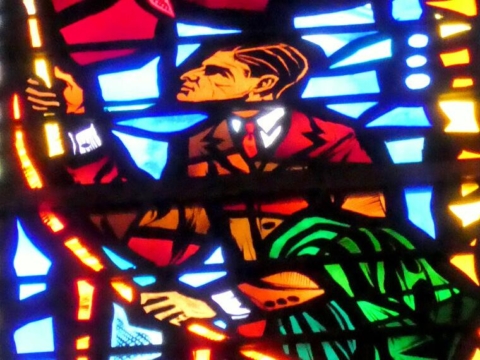
Make a visit to the Princeton University Chapel’s nave and look for the Poet Windows created by artists Irene and Rowan LeCompte in 1965.
There, as noted by historian Richard Stillwell in his “The Chapel of Princeton University” just below the image of American poet Emily Dickinson, “Eliot climbs a turning stair as in (his 1927 poem) ‘Ash Wednesday,’ lighting his way with a Eucharistic candle” — an image that reflects Eliot’s joining the Anglican Church to give him guidance through the waste land of his days.
But the candle can also serve to commemorate the anniversary of the appearance of a monumental poem — as well as recall the soul of the poem stirring in a box in the Princeton University Library.