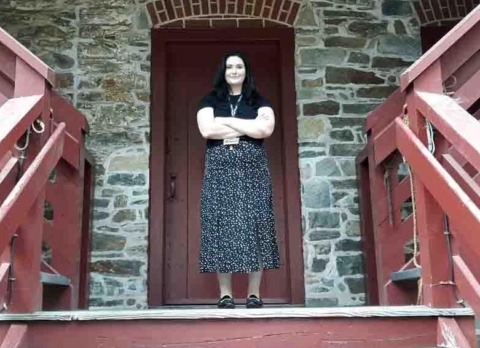
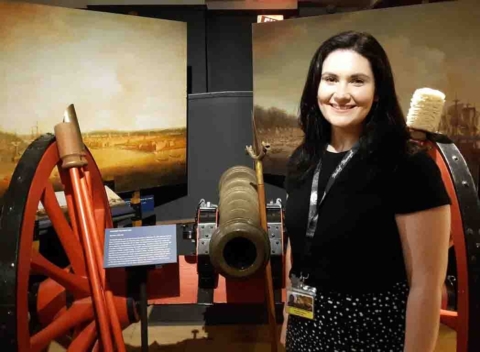
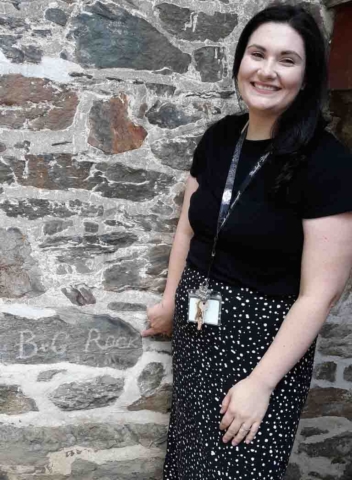
With days counting down to the Old Barracks Museum’s Saturday, October 29, Autumn Fundraiser, Barracks curator Sarah Kirk steps across the first floor Revolutionary War gallery to the fireplace and points to one of her favorite artifacts.
“You’ll see soldiers from the 18th century carved their initials and figures into the brickwork. We’ll never know who they were, but they left their mark,” she says about the scratches left by the young men who traveled thousands of miles to be quartered in Trenton in the 17th century.
Those men were the first of many who came from England to fight the French during the French and Indian War (1754 to 1763).
They were followed several years later by young Hessian soldiers sent by England to quash the American Revolution. But instead of victory, they saw the barracks fall to Washington’s Revolutionary forces during the one of the war’s most famous events — the Battle of Trenton in 1776.
Kirk, who has been studying the building like a book, says there are more messages. “Upstairs in the attic, marks are on the original ceiling joist, and one of the doors has letters scratched at the time.” And outside, rock masons made their marks when they built the building — in 1758.
Although it was one of five New Jersey barracks of that era, the Trenton building is the oldest remaining structure of its type in the United States.
In addition to its role in the above battles, the barracks also served as a hospital for American soldiers during the war, including 600 who were transported to Trenton after the 1781 Battle of Yorktown in Virginia.
The barracks’ own quiet battle to survive started in 1782. That’s when the New Jersey legislature sold the building, and it was subdivided into multiple dwellings several years later.
Other skirmishes with time and progress include the 1813 decision to demolish a 40-foot section of the building to extend Front Street through it for better connection to the State House and the 1855 appropriation of one of the buildings as a home for elderly women.
In 1899 the Daughters of the American Revolution created a public subscription to purchase the southern L-shaped portion of the property and save it from demolition. Three years later the same group formed the Old Barracks Association to preserve and restore that property. The state followed by purchasing the remaining and privately occupied northern portion. The Old Barracks Association then deeded its section to the state with the stipulation that the barracks be restored and managed by the association. The reconstruction of the central section and building restorations were completed in 1917.
Operating ever since as a museum, the Old Barracks was designated a National Historic Landmark in 1973. A 1990 Trust grant provided the funds to upgrade electrical systems, address visitor access, and restore interiors.
That includes the downstairs gallery with the fireplace and an ongoing exhibition devoted to the two Battles of Trenton. A larger second floor gallery is dedicated to the French and Indian War.
Kirk says the museum’s current collection continues to build on the one that the original organizers began in 1902.
“We have a little over 2,000 pieces,” she says, adding that some of “neatest objects” in the gallery are on loan. That includes a wallet and spy glass reportedly owned by George Washington.
In addition to other materials and paintings on display, Kirk mentions “a lot of chairs, hair weaves, samplers, and lots of stuff not on public view.”
While she says, “Most of our collection is in a separate (state) building in storage and kept in a safe area where it is environmentally controlled,” she says that “some collection highlights are online, things in storage that we wanted people to see. We’ll randomly do an online exhibit.”
She is then quick to offer a visit to the second-floor gallery where the museum has “two Wilson muskets important to the French and Indian war. Most of them were lost over time. So it is neat that we have two.”
While both were used by members of the Jersey Blue, the smaller and more facile musket belonged to an officer.
Other objects include more objects related to the Jersey Blues, a period canon, and the “Pine Tree Flag,” one of the oldest known flags in North America.
Born and raised in nearby Levittown, Pennsylvania, Kirk joined the Old Barracks in 2019.
She says her duties include developing and updating exhibitions, making sure that “all the objects are housed safely,” and being “the person who finds the objects that we want to purchase and get on loan.”
Her interest in history was sparked when she and her father — a diesel mechanic — watched the History Channel together.
She also mentions stories regarding her World War II veteran grandfather, history trips with her father and bank-teller mother, and school trips to Washington Crossing and a Native American Village.
“(History) turned into a search for what actually happened rather than what we think had happened,” she says about the deepening interest that led her to be the first in her family to attend college.
“I went to Temple (University in Philadelphia) for a B.A. in history and went to Johns Hopkins for museum studies, graduate degree.
“I wanted to be a high school history teacher, and I learned that (teaching) doesn’t need to be a classroom. You can teach anywhere and use objects to teach history you feel and experience.”
Kirk started working with museums in 2013, first at Pennsbury Manor and then at the Wentz Farmstead in Montgomery County, Pennsylvania.
When she saw that the barracks had an opening in the curatorial department, she applied. “This is my first military site,” she says.
Kirk says the barracks “is a neat place to work, different every day.” Yet she also says it has challenges. “The hardest part of my job is keeping an 18th century building environmentally sound for our objects. The temperatures should stay consistent. It’s a constant struggle to find the right balance,” especially since the museum is applying for American Museum Association accreditation and applying its collection maintenance standards.
Another challenge has been the pandemic that changed museum operations, wiped away the tours organized by schools and groups, and made potential visitors concerned about going to public venues.
“It’s been hard. A huge part of our income was from group tours. We are trying to find ways to bring in people, and that includes online exhibits and stories. But that doesn’t bring in revenue. People need to trust us that it is safe to come back here.”
Kirk says the museum has also updated its tours, spruced up the second-floor exhibition, and now offers more period gun demonstrations.
Then there is the future and the celebration of the 250th anniversary of the American Revolution. “People are going to look at Philadelphia, but we have (a draw) here. The Battle of Trenton was pivotal to the war.”
Also pivotal is the upcoming “All Barracks Eve” festival fundraiser that will help the Barracks.
Sprinkled with Halloween flavor, the October 29 event is promoted as a family-friendly affair that includes period demonstrations, walking tours, activities for children, and the telling of traditional spooky tales around a bonfire. The event starts at sundown. Admission is $10 for children under 12, and $20 for those 12 and above. Snacks and drinks will be available for purchase.
For those unable to attend but who would like to visit or assist the organization’s efforts, the historic venue is open throughout the year.
The Old Barracks Museum, 101 Barrack Street, Trenton, Wednesday through Saturday, 10 a.m. to 5 p.m. $8 to $10. 609-396-1776 or www.barracks.org.