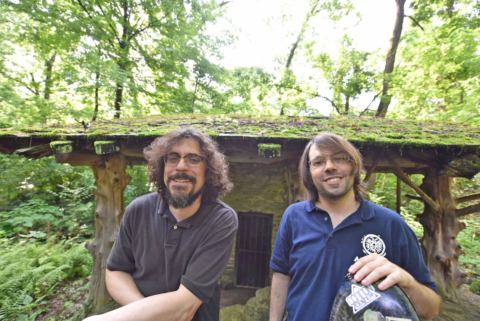
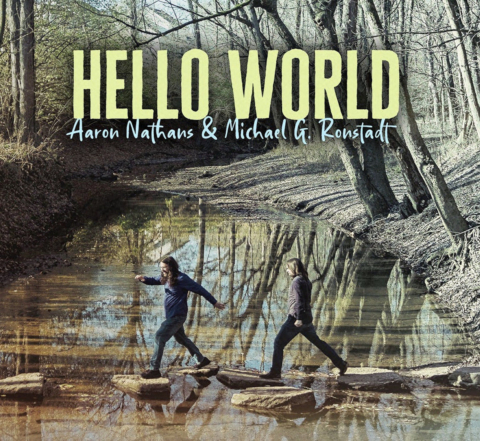
Say hello to “Hello World,” a new CD by folk artists Aaron Nathans and Michael Ronstadt.
I received the hello when Nathans dropped it off at the office several weeks ago.
Nathans and I had crossed professional paths last year when he produced the “Composers & Computers” podcasts for Princeton University’s School of Engineering and Applied Science, where he works as digital media editor.
That series examined Princeton University’s significant and continuing contribution to electronic music.
You can read more about it in the September 14, 2022, U.S. 1 story “A Good Ear For Stories — and Electronic Music — Inspires a Princeton Podcast.”
But now we were onto something different.
As was mentioned in that story, Nathans was also a folksong musician. So, I wasn’t surprised when I saw a CD with a pair of long-haired musicians gamboling over a creek in the woods.
At first glance, I thought it was going to be standard folk fare — political observations, simple life, simpler times, a ballad or two, and so on.
But, on the first listening, on my car CD player, I realized I was wrong.
True to its genre, Nathan and Ronstadt melodically played traditional acoustic instruments — with special emphasis on the cello — and sang with homespun abandon .
And while the repetition of the phrase “Hello World” came in loud and clear in the first song that also takes the CD name, I was hazy about what I was hearing.
Were they actually singing about digital communications and programming? And what about the sound at the end of the song, the one that sounded like an old modem connecting?
I didn’t have time to reflect much more because the light yet mellow plucking of a guitar quickly introduced the next song, “Dr. Joelson’s Bag,”
On the surface, the song seemed a simple ballad-like piece about a mid-20th century Paterson pediatrician who had just trudged through the snow to make a house call to a poor family’s sick child.
But underneath, there was something else, something elegiac, something dealing with local heroes and human kindness.
It also reminded me of my own family doctor who made house calls at various times, and Dr. William Carlos Williams, the New Jersey poet-pediatrician who lived in the Paterson region.
I now started listening more intently and become more interested in the series of crisp and balanced recordings by some obviously proficient musicians who were singing about an offbeat list of subjects: playing in the snow, dollar store gloves, an empty baseball stadium.
There was even a song about British mathematician and computer pioneer Alan Turing, recipient of a Princeton PhD in 1938 who “won a World War in your mind” because he was able to design a program to break a complex Nazi communications code. He was also arrested and penalized for being a homosexual.
Wrapping up the suite of 10 songs was “Twelve Tone Girl,” a folk recollection of what seemed to be a young woman who was interested in the music and composers featured in Nathans’ podcast. In this case it is about a system of music in which the each of the 12 notes of the chromatic scale are arranged one by one to create a passage that advances the composition.
Since one seldom hears a folk song with the lyrics “She’s got a habit for Milton Babbitt,” one of the prominent Princeton electronic-music composers, I was hooked.
“We were trying to fill a niche,” says Nathans, meeting at café not far from the Princeton University building where he works.
We’re talking about the digital music and references in his songs.
“During the folk revival, (folk musicians) were reviving instruments from a long time ago,” continues Nathans, who is about to turn 50 and lives with his wife and children outside of Philadelphia. “Now these computer-generated sounds have been around. The people who developed them, they are old and gone. It was, ‘Let’s put some computer sounds at the end and some computer sounds there.”
He says the “Hello World” song and title come from the same-name program developed by one the computer professors at Princeton University, Brian Kernighan.
“You type in six lines of code, and it comes up ‘Hello World,’ and you’re in business,” Nathans tells me. But in the song, he mixes the binary code and calls the result, “Zero-One-Sunshine!”
As for “Twelve Tone Girl,” Nathans says “the love interest was mainly a writing device to help introduce this bygone style of music to a contemporary audience. And it was a way to help bring out (Michael Ronstadt’s) music history and music theory chops.”
Nathans says he met Ronstadt while they two of them were playing at a venue in Collingswood, New Jersey. And if the name sounds familiar, it is. He’s from a musical family that includes his aunt, Grammy Award-winning singer Linda Ronstadt.
In addition to “Hello World,” created through a Kickstarter campaign, the two have produced five other folk collections.
Returning back to “Twelve Tone Girl,” Nathans says, “My involvement with 12-tone music and such was strictly limited to my work on the podcast. But Michael has a master’s in cello. He was an informal adviser as I built the podcast, and he filled me in on the history of this style of music. He is an adventurous musician, and I enjoy bringing that side of him out. We found the tension between these styles of music, and finding ways to bridge them in song, to be a thrilling challenge.”
Elaborating on intertwining technology and folk music, he says, “As with the podcast, it’s been an interesting challenge to write about technology in a way that underscores our humanity. For all of its cold, machine-like detachment, technology is a tool. It reflects who we are, for better and for worse. We shape it, and it shapes us back.”
We then turn to other songs and when asked about Dr. Joelson, Nathans says, “He delivered my mother, her mother, and my father’s father, in addition to many other relatives. There was always talk about the great Dr. Joelson around the kitchen and dining room table, growing up and on holidays.
“But specifically, my late great uncle Jerry Nathans founded the Jewish Historical Society of North Jersey. And he personally archived Dr. Joelson’s medical bag, which was probably sitting at the bedside when he was delivered.”
How about “Flatbush Sunset” — a song about baseball?
“I’m a huge baseball fan,” he says, explaining why he used the sport to achieve a variety of ideas that appear in the song.
One was to conjure up the spirit of Jackie Robinson, whose inner strength enabled him to endure racist taunts and prejudice on his way to baseball history.
Nathans says there aren’t a lot of songs about not engaging in fights. Especially when it is “easy to fall into social media conflicts” on regular basis.
Additionally, the former journalist says his love of the game is also connected to an early career choice. “I started as a sports writer. It allowed me to interview my baseball heroes.”
Then, he realized, “I could make a difference helping to people understand the world and started working for AP and moved to a couple newspapers. I ended my news career in 2014 at the Delaware News Journal.” Before coming to Princeton, he was the communications and public affairs manager for the American Institute for Economic Research.
Another song, the waltz-tempo “Let’s Play in the Snow,” he calls “the most straight-forward song on the album. I started the work writing something ironic and sarcastic about a grown up trying to keep up with the kids in the snow.”
When I call the collection quirky, Nathans smiles and says, “That is our signature. I grew up on listening to ‘Prairie Home Companion’ and lots of folk music and at the same time I listed to pop music, too, with an ear to how interchangeable the songs were. We are folk musicians, but we do break the conventions. Some like it and some don’t. But I think it is interesting.”
I then share my interest in lyrics that remember a lone doctor in the snow, bodies no longer limber, days and lives passing, and new mornings rising.
Nathans nods and connects them all to the pandemic and the lockdown.
“So much was lost,” he says, “We lost people. I was dealing with my own melancholy and loss. Part of a songwriter’s job is to capture the world around them and make it applicable to other people.
“Look at the album cover, the world is starting over. We’re making a fresh start.”
“Hello World” by Aaron Nathans and Michael Ronstadt, available online in a variety of formats and costs. For more information on the duo, visit their website at nathansandronstadt.com.