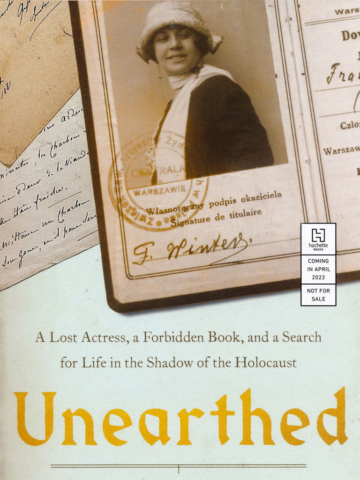
Meryl Frank’s “Unearthed: A Lost Actress, a Forbidden Book, and a Search for Life in the Shadow of the Holocaust” is being released this April by Hachette Books.
The first-person account chronicles the author’s attempt to determine the fate of family members lost when the Nazi Germany disrupted Europe with its attempt to dominate social order and eradicate people it vilified.
While showing one family’s personal, the book shows how the past affects — even haunts — the present.
That idea becomes more relevant with the fact that the author lives in Highland Park, New Jersey, where she also served as mayor for 10 years.
Appointed to the United States Holocaust Memorial Council by President Joseph Biden in 2022, Frank was described as “an international champion of women’s leadership and political participation. She was appointed as the United States Representative, and subsequently, as the United States Ambassador to the United Nations Commission on the Status of Women (CSW) by President Barack Obama in February 2009.”
Additionally, she has served on the Boards of Jewish Women International, The Sisterhood of Salaam Shalom, The American Jewish Congress, and, in 2012, was named one of the “The Fifty Most Influential Jews in the World” by the Jerusalem Post for her work on behalf of women around the world.
In the following excerpt from the book’s introduction, Frank engagingly opens her book with a mysterious book that becomes the catalyst for the one Frank writes — as she rewrites her family history:
On an overcast Sunday in June, I headed up the New Jersey Turnpike to see my aunt Mollie at her home in Bayonne. That in itself was not unusual. Mollie had invited me over countless times since I was a small child to regale me with stories about our family, before they were lost in the Holocaust. And when Mollie invited you somewhere, you went. But this time, when she’d called to summon me, there was an edge in her voice that suggested an added significance.
Even in her mid-80s, Mollie was formidable. My aunt was barely five feet tall, but she might as well have been a giant for how large she loomed. Below auburn hair and arched eyebrows, she had our family’s signature high cheekbones, Roman nose, and quick brown eyes-constantly assessing. She was always dressed immaculately, wearing a prominent piece of statement jewelry, either a family heirloom or a more modern treasure discovered in her travels. (Jewelry held special significance in my family, talismans that represented our history and love). The only thing that belied her sophistication was her thick North Jersey accent.
Now she opened the door and enveloped me in a warm but quick hug She led me to the living room, tastefully decorated in midcentury rosewood atop ombre shag rugs in browns and golds. The modernist furniture was accented by more family heirlooms, brought over by my grandmother when she emigrated from Vilna (then a city in a Lithuanian state in the Russian Empire) in 1905, and an astounding modern art collection Mollie had gathered before the artists were lauded as modern masters– Picasso, Matisse, Braque, Chagall.
I was feeling tense. Somehow, I had been designated as the family member to talk to my aunt about giving up driving, which to her felt tantamount to surrendering her independence. I knew she was deeply opposed to the idea, and none of us liked to battle with her. But lately she’d been forgetting things, and operating a vehicle simply wasn’t safe anymore. I readied myself to broach the topic with as much diplomacy as possible, but she surprised me by raising another, perhaps even more jarring, subject.
There, without ceremony, beneath a Ben Shahn lithograph of Martin Luther King Jr. Mollie began to talk about the responsibilities she expected me to assume after her death.
Her face took on a serious expression, unfamiliar to me. One essential responsibility would have to assume after she was gone, she explained leaning in concerned, an “unusual” book.
She walked over to an elegant cabinet and opened its doors. I moved to rise as well, but she waved me back into my seat.
“Wait there,” she said, accepting no argument.
Even now, at her advanced age, she was a commanding presence.
Nestled between an illustrated three-volume history of Jewish life in Vilna and a VHS cassette of a PBS documentary, “The Partisans of Vilna,” was a thin book. I recognized these surrounding resources because I had inherited Mollie’s preoccupation with the past, all that had happened to our family before, during, and after the Holocaust. As she slid the paper back from the shelf, I thought it didn’t look like much, for all the weight the conversation seemed to hold. But she held it with a reverence that fixed my attention.
“Twenty-One and One,” as the book was titled, was scarcely more than a 100 pages long, with brown lettering on the cover above a wood block-style illustration of arches and alleyways, a representation, I would later learn, of the Vilna ghetto, half concealed by a dark theatrical curtain. Carefully, Mollie leafed through to the only page written in English, a description that explained the book was “about 21 Yiddish actors murdered by the Nazis in Vilna 1941-42,” my realization beginning to dawn.
She pointed out a black-and-white photograph of my cousin Franya Winter that had been reproduced alongside a Yiddish essay about her. In the image, she was smiling innocently at the camera, no sense of the horror that was to come. Her dark curls peeked out from beneath a kind of veil. Her face was round and youthful, her gaze penetrating. Although this was the first time I had seen this photo, I knew Franya well. As a child, I had spent countless hours poring over old photos of my European relatives from the first part of the 20th century, and Franya, in particular, had always enchanted me. I knew from Mollie that she had been an actress before World War II, and you could see a spark in her eyes. But like my other family members, I knew nothing about what had become of her, only that she was gone. She didn’t make it.
Franya’s chapter was very near the front of the book-or rather, since the book was laid out in the customary Hebraic style read from right to left, very near the back. I would later understand that the order of the chapters had their own significance.
Mollie didn’t tell me what was written, and since I couldn’t read Yiddish, I had no way of deciphering it. But she offered the book to me, and I took it in my hands. As I leafed through the pages, a strange sense of protectiveness came over me. “When I’m gone,” Mollie began, “I want you to take this book.”
I understood: I was to be the book’s custodian, ensure its safekeeping.
Something about this text was important. “Keep it,” she continued, “and pass it on to your children.”
I agreed. I thought she was finished and readied to move on to the issue of her driving, when she stopped me, her hand on my arm, and looked me hard in the eyes to confirm that I was listening.
“But don’t read it,” she said.
Unearthed, 242 pages. $29, hardcover, $15.99, paperback, Hachette Books.
Frank will read from her book for a Friends of the Highland Park Public Library book launch and fundraising event at the Greenhouse Loft, 431 Raritan Avenue, Highland Park, Sunday, April 16, 7 p.m. For more information, go to www.hpplnj.org.