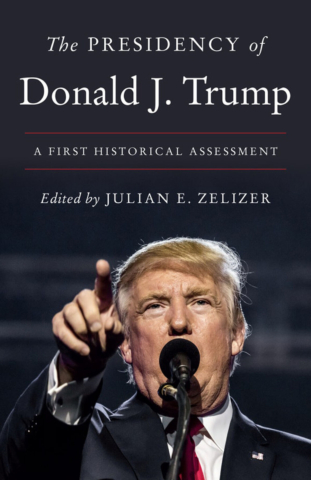
It’s July 1, 2021, and Princeton University historian Julian Zelizer was ready to sign into an unusual Zoom session.
The 45th president of the United States had requested an opportunity to talk to Zelizer, editor of the then in-process “The Presidency of Donald J. Trump: A First Historical Assessment,” and the book’s 17 other contributing essayists.
The former president reached out to “tighten some of the research” being conducted for Zelizer-led edition of the Princeton University Press series that had previously assessed the presidencies of George W. Bush and Barrack Obama.
While the Zoom session was unusual for a number of reasons, the main one was no former president had ever intervened before.
But, as Zelizer notes in the newly released book’s introduction, “this time was different. Trump, with political ambitions for seeking a second term, seemed eager to influence how historians saw the past.” And that it “wasn’t a total surprise. His term had even ended with his promoting a pointed narrative, an effort to sell to his supporters, and to some extent the history books, that he was not an unpopular one-term president like Herbert Hoover or Jimmy Carter whose record had been rejected by the public. Rather, Joe Biden won the election, Trump said, only because he had stolen it.”
Despite misgivings by the some of the contributors and warnings from non-contributors who had worked in Washington that “urged us to proceed with caution because the former president had a record of misconstruing the nature of these conversations,” Zelizer agreed and soon found himself sharing screen time with Trump “sitting at a wooden desk in his Bedminster golf club with an American flag on the side.”
As Zelizer reports, “In the surreal modern communications format that resembles the old ‘Hollywood Squares’ television show, on the same day that the Trump Organization was charged with a ‘scheme to defraud’ the government, Trump reiterated a number of claims that he had been making about his term. The consummate showman, Trump knew his audience. Building on the documents that (Trump campaign senior advisor Jason) Miller had shared with our group, which presented him as a rather conventional and moderate president with a long list of achievements, Trump focused primarily on what he believed to be the most important components of his record on the economy, foreign policy, trade, and the pandemic.”
The report on the session where a non-confrontational Trump interpreted his accomplishments, admitted to problems with tweets, engaged in questions and answers, and insulted his enemies is just the beginning of the 488-page book.
It goes on to put President Trump within the context of his times and is based on the following thought Zelizer shared with a CBS reporter: “One thing that historians who’ve lived through the moment have, that historians 200 years from now won’t have, is a sense of what it felt like to live in the moment.”
The essays written in context examine the Trump administration’s response to race and gender issues, white nationalism, international relations COVID, media, the private sector, and more — while also looking at developments and responses as by-products of ongoing political and social trends.
In regards to putting Trump into a sense “of what it felt like to live in the moment,” the following excepts from Zelizer’s sketch of the life of Donald Trump — “a man who came to Washington from the world of New York real estate and reality television” — reflects the shared experience of many of us who lived in the New York/New Jersey region and witnessed his ascent:
‘Trump worked for his father’s real estate company, Trump Management, starting when he was in college. When Donald’s older brother died from alcoholism at age 42, (Donald’s father) Fred decided that Donald would be the heir to the business. Just three years after graduating from (the University of Pennsylvania’s Wharton School of Business in 1968), Donald moved into the position of president and grew the operation into the Trump Organization. His father provided him with the money he needed to make investments. He had been receiving hundreds of thousands a year form his father since he was a child. Transfers of money and shell corporations amounting to more than $413 million in his lifetime revolved around elaborate schemes by which his family could avoid taxes.
“Trump made a name for himself in the city by purchasing the beat-up Commodore Hotel and transforming it into the Grand Hyatt, which officially opened in Midtown in 1980. He developed Trump Tower and purchased the Plaza Hotel in 1988. Meanwhile, Trump started to invest in other properties. In Atlantic City, New Jersey, he opened the Harrah’s at Trump Plaza in 1984 and the Trump Taj Mahal in 1990.
“Besides procuring real estate, Trump focused much of his attention on branding. He licensed his name for clothing, food, and buildings that his company did not run. He bought the New York Generals in 1983, a foot team in the upstart United States Football League, and sponsored boxing matches. In 1988, Trump acquired Eastern Air Lines Shuttle and turned it into the Trump Shuttle. Like most of his ventures, this business lasted for just four years, failing to produce any profit. Within two years, the company wasn’t earning enough to cover the mortgage payments for the $245 million loan he used to buy the planes. He depended on family partnerships to bail himself out of these ventures.
“During the 1980s and 1990s, Trump emerged as a well-known figure in the New York media, a constant presence on the gossipy Page Six of the New York Post. Always focusing his attention on the brand name, Trump relished his reputation as a brash, straight-talking real estate mogul who took part in the city’s colorful nightlife. Though he never found acceptance within New York’s elite social circles, with many of the city’s prominent figures seeing him as too brash and untrustworthy, the media soaked him up. He reveled in the image of being a tough, say-it-like-it-is guy, a man of the people who had done well. His father’s wealth and money didn’t make it into the narrative. Never hesitant to provide provocative statements to reporters, Trump emerged as a go-to guest on radio and television shows. He rides around town in a chauffeured silver Cadillac with his initials on the plates. He dates slinky fashion models, belongs to the most elegant clubs, and, at only 30 years of age, estimates that he is worth ‘more than $200 million.’ His love life continued to fascinate, first his 1977 marriage to Czech model Ivana . . .then his affair with Marla Maples, whom he married in 1993 . . .and Trump married Melania Knauss, a Slovenian model, in 2005. As of this writing, 256 women have accused Trump of sexual misconduct, including rape, since the 1970s.
“In 1987, his best-selling book ‘The Art of the Deal,’ ghost written by Tony Schwartz, burnished his image as a master deal maker unrivaled in negotiations. The public started to perceive him as a brilliant entrepreneur. Trump’s appearances on professional wrestling and the Howard Stern Show made him a know voice.
“Notwithstanding the image of himself that he promoted, Trump’s business career was always problematic. Starting in 1973, when he hired former senator Joseph McCarthy’s chief counsel, Roy Cohn, to advise him, the U.S. Department of Justice sued the Trump Management Corporation for racially discriminatory practices, violating the Fair Housing Act of 1968. Cohn helped Trump Management countersue the government for $100 million for making the charges. The government and the Trumps reached a settlement in June 1975.
“Besides race relations and labor practices, his business track record also caused deep concerns in the financial community. After the 1980s, most banks refused to do business with him because he had defaulted on hundreds of millions of dollars in loans; only Deutsche Bank was willing to lend him funds. During the 1990s and early 2000s, his organization filed for bankruptcy six times. He used the bankruptcies and other techniques to avoid paying income taxes for almost 18 years.
“His road to presidential politics happened gradually. Trump had run in some primaries as the Reform Party candidate in 1999. He roared back into the political spotlight in 2011 when he spoke to the Conservative Political Action Committee conference. In 2012, Trump emerged as a major figure in the birther movement, a campaign that stemmed from fringe right-wing organizations claiming that Barack Obama had not been born in (the U.S.).
“Reality television, however, constituted his main path to political power. The producer Mark Burnett, a successful Briton who had pioneered this art form with the show ‘Survivor,’ decided to launch a series about business. The premise of the show was that a successful tycoon would judge contestants who were competing in different tasks. Burnett thought that Trump would be the perfect person for the job. His brash, larger-than-life personality was the exact character he was searching for. And the formula worked. ‘The Apprentice’ was a smash hit for 15 seasons, attracting millions of viewers per episode. With the tagline “You’re Fired!” the show promoted Trump’s reputation as the tough-as-nails, brutally honest business mogul who was the only person willing to tell it like is. New Yorkers were more familiar with him, but ‘The Apprentice’ brought Trump to massive audiences around the country. Many came to perceive him as one of the savviest and most skillful entrepreneurs around — even as his actual business dealings were suffering.”
The Presidency of Donald J. Trump: A First Historical Assessment, edited by Julian Zelizer, 488 pages, $27.95, Princeton University Press.