Those inclined to step outside to gaze at the stars over the next few months should know they’re not alone.
The lengthening and less humid autumn nights provide a good opportunity to look up and wonder.
Yet, obviously, one doesn’t have to wait for one particular season or even to get outdoors to wonder about our star and planet neighbors; books are always on hand to transport us into the heavens.
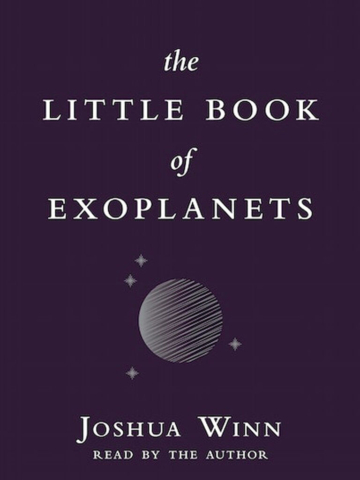
That includes the recently published Princeton University Press book “The Little book of Exoplanets” by Joshua Winn, professor of astrophysical sciences at Princeton University and a coinvestigator in NASA’s ongoing Transiting Exoplanet Survey Satellite mission.
Winn opens his book by tapping into the above mentioned by noting that based on the fact “you are reading this page, I’ll venture to guess we have something in common. At some point in your life, you were outside on a clear night looking at the stars, and you started wondering. Do any of those stars have planets? Are there other worlds like the Earth?”
He then conjures our own recollection of encountering the awe of starry nights with his own.
“My earliest memory of this state of mind was during a childhood family vacation to the Grand Canyon. We arrived at our campsite in evening twilight. My father lifted me on top of our Chevrolet Impala where I could lie down and look up. The air was cold, but the hood was still warm from the long drive to the campground. It was the first time I’d ever seen a truly dark night sky. Bright stars began appearing in their familiar patterns — but here, far from city lights, they gleamed like diamonds on black velvet. As twilight deepened and my eyes adjusted to the darkness, it seemed like a fog was slowly dissipating, revealing multitudes of fainter stars. Unfamiliar and numerous, the faint stars were disorienting. I could barely make out the constellations anymore.
“I knew from my astronomy books and magazines that each of those points of light was an enormous nuclear furnace with the same power and grandeur as the Sun, which had been baking us all day before it set below the horizon. With a seemingly infinite number of stars on display, it felt impossible that the Sun and the Earth were unique or special in any way. Was each one of those points of light somebody else’s Sun? Which one was home to a young alien, lying atop its father’s warm spaceship, looking toward me?”
According to Winn that was decades ago, before the advent of astronomical technology that allows astronomers to detect not only stars but the planets that surround them.
As he continues, he shows that he was part of the process. “About two decades ago, I became an astronomer. Thanks to lucky timing, I was able to join the scientific journey from complete ignorance about planets outside the Solar System to definitive evidence that they exist around at least 30 percent of Sun-like stars and strong evidence for an even higher abundance of planets. The newly discovered planets include potentially Earth-like worlds along with many exotic planets that bear little resemblance to any of the members of the Solar System. We’ve found planets on highly elongated orbits, planets on the brink of destruction by the gravitational force of a nearby star, planets as light and puffy as cotton candy, planets orbiting two stars at the same time, and planets that probably have oceans of lava. Some of the new planets were anticipated by authors of science fiction. Others have inspired new stories.”
They have also inspired new names, as Winn notes. “Planets that belong to stars other than the Sun are called extrasolar planets. Usually, the name is shortened to exoplanets — although increasingly, I just call them planets, and I think this will soon become common practice. After all, based on the statistics of our surveys of nearby stars, we can be sure that at least 99.99999999% of all the planets in the galaxy are orbiting stars other than the Sun. Doesn’t this overwhelming majority deserve the general name planet, without any prefix? The infinitesimal minority of planets that happen to share our star should be called solar planets or (less seriously) endoplanets.”
While that new naming sounds easy, Winn says that questions about names arise when astronomers try to decide what types of astronomical bodies deserve the name, such as the seemingly simple term “planet.”
As he notes, “Recent discoveries have led to disagreements. Should we impose a minimum or maximum mass, or a restricted range of orbital distances, for an object to qualify as a planet? What should we call a Jupiter-mass object that exists alone in the emptiness of space, far from any star?”
And while the book will touch on some of the developments that have created the debating, he brings the argument back to Earth and notes that the arguments about the correct names for things are “rarely as interesting as the things themselves. Sometimes, we get so caught up in debating, we forget how lucky we are to be alive in an age when the frontiers of knowledge expand so rapidly that our nomenclature needs time to catch up.”
He also reminds readers and himself that “the discovery of exoplanets was one of humanity’s longest-awaited scientific achievements. Twenty-five centuries ago, Greek philosophers speculated about the possibility of other worlds and whether the Earth is unique. Yet, it was only about 25 years ago that exoplanetary science began in earnest.”
And while the information keeps coming in and the knowledge grows, Winn points out that it “is a sobering fact that up-close inspection of exoplanets is out of the question. Exoplanets are detached from human activity, with the sole exception of what we can learn via telescopes, peering from afar.”
Yet, he suggests, why wait for wonder and that his book wants “to give you a complete briefing on the field of exoplanetary science that is as accurate as possible without requiring specialized training. If I have succeeded, you will be able to understand and enjoy the progress we have made and the breakthroughs you will read about in the future. You’ll be able to separate science fact from science fiction and follow the boundary as it keeps moving. You’ll understand the scientific principles that allow us to detect and study exoplanets, using instruments ranging from backyard telescopes to billion-dollar spacecraft. You’ll see how the new discoveries have revised our understanding of the formation of stars and planets, including our own Solar System.”
For himself, he says, “It has been a dream come true to become an astronomer (although I wouldn’t have minded becoming an astronaut, either), to participate in the exploration of exoplanets, and to be able to share what we have learned so far.”
And that seems something to look up at the sky or down at a book to wonder about.
The Little Book of Exoplanets by Joshua N. Winn, 304 pages, $22.95, Princeton University Press.