The September 20, 1816, session’s minutes of the Nassau Presbyterian Church in Princeton state that on that day “Betsey Stockton — a coloured woman living in the family of the Reved. Dr. Green, applied for admission to the Lord’s tale Sessions being satisfied as to the evidence of her experimental acquaintance with religion, and her good conduct — agreed to receive her (into the congregation).”
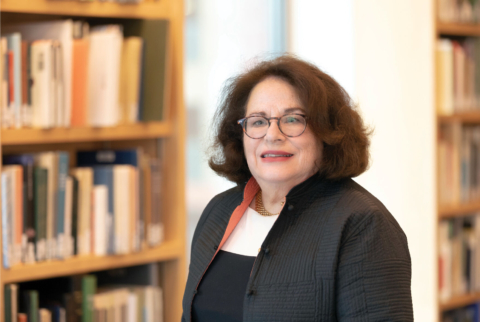
The note appears on appears on page 179 of the recently released book “She Calls Herself Betsey Stockton: The Illustrated Odyssey of a Princeton Slave” by of Constance K. Escher — who will speak at the Princeton Public Library on Wednesday, March 30, at 4 p.m.
The above church session statement easily helps puts Betsey Stockton and Escher’s book into perspective.
Born a slave at the Princeton residence of Robert Stockton, circa 1798, Betsey is “given as an enslaved person to Elizabeth Stockton as part of her marriage dowry to Rev. Ashbel Green,” a co-pastor of a Presbyterian Church in Philadelphia (and later president of the College of New Jersey, now Princeton University).
In Philadelphia, Betsey’s early exposure, through Green, to religion and education becomes a continuous path she will follow. Along the way, she returns to Princeton as a slave, joins the church, becomes free, is educated through Princeton Theological Seminary tutorials, becomes a missionary to Hawaii, and returns to Princeton to help found what is now known as Witherspoon Street Presbyterian Church.
“My Betsey Stockton ‘Aha!’ moment came in 1984,” writes Escher in the opening pages of the book. “As I opened a biographical file in the upstairs library in Bainbridge House on Nassau Street, a period photograph labeled ‘Betsey Stockton’ tumbled out. There, staring back at me, was a portrait with engaging eyes. It showed the intelligence, the nobility, and the authority of the sitter. Inquisitive by nature and training, I began by asking myself questions a historical biographer uses to ferret out basic facts. Who was Betsey Stockton? What was the life story behind the portrait of this former Princeton slave?”
The teacher for 26 years with the Princeton Public Schools, former reach associate for Princeton University’s Shelby Cullum Davis Center for Historical Studies, and contributor to Princeton Alumni Weekly and Vassar Quarterly answered her own questions with this 200-page narrative mixing historic research, letters, journal entries, and illustrations.
The result is an eye filling account of a hitherto invisible individual with a remarkable and inspiring life — as the following excerpt demonstrates:
Betsey Stockton’s calling to become a Presbyterian missionary stands a long-held historical theory about making Christians of the heathens on its head. In reality, the impetus for this cultural convergence in the Sandwich Islands did not begin with White Americans. Instead, it came through the person of a young Hawaiian native and recent Christian convert. He was ‘Opukaha’ia; his anglicized name was Henry Obookhiah (1790-1818). As a child, he had witnessed bloody wars in his native land. The legend surrounding his life includes the scene of this Sandwich Island youth found crying on the steps of Yale in 1809 “because nobody gives me learning.”
In 1818, his early death and apotheosis to Christian martyrdom at the heathen school in Cornwall, Connecticut, spurred New England Protestants to take action through the ABCFM (American Board of Commissioners for Foreign Missions). Over a thirty-year period, the board sent a human armada of 155 missionaries in 12 groups to the Sandwich Islands.
Paradoxically, from her humble fo’c’s`le (forecastle) hammock in the Thames, Betsey Stockton carried with her the cultural tool so critical for preserving the indigenous culture she was entering: teaching English to Hawaiian natives at her “first school for commoners” there. Being sent to a foreign mission as a single woman of color, a freed slave who was uniquely well educated, Stockton’s quest was unique. She came without the stance of White supremacy but as an ambassador for change within her missionary calling. To accomplish this goal, she conversed in the indigenous Hawaiian language on board the Thames, learning from native speakers William Kmoolla and Richard Kalauiula, both Hawaiian scholars educated at the heathen school in Cornwall. The pair had become the living legatees of the sainted Hawaiian Henry ‘Opukaha`la.
The original manuscript pages of Stockton’s holography “journal” are lost. Stockton and (New Jersey born missionary) Charles Stewart sent portions of their journals to Green in Philadelphia by passing whalers. By 1822, Green was editor of his new venture, a bi-monthly Philadelphia magazine, The Christian Advocate. While still an administrator for Princeton Theological Seminary, Green had been dismissed from the presidency of the College of New Jersey. He had moved to Philadelphia to oversee his new publishing venture. By serializing the publication of Stockton’s “Journal” between February 1823 and May 1826, Green featured the unfolding drama of the sea voyage and residence in the Sandwich Islands. He hoped to bolster readership and sales; some of Charles Dickens works were serialized in the same way.
In May 1824, Green emphasized Stockton’s African descent and her early reading lessons in a private family. Actually, she had gained literacy while still a child slave of Green in Philadelphia and later in Princeton.
He closed with a tantalizing reminder to his readers: “A Missionary life at sea has not been so often and particularly described as that on land.”
Green’s publication of the “journal” saved Stockton’s work for posterity. With a wider reading of her journal, Betsey Stockton assumes her rightful place among early 19th century authors, linguistics, and educators. As an educated author, her writing is unique among freed slave narratives.
Stockton’s literary voice is joined by two others. Reading the trio of whaleship journals enables armchair travelers to hear the voice of those early 19th century writers. These eyewitnesses revealed details of the five-month voyage to the Sandwich Islands. While Stewart’s whaleship journals were quickly published as two freestanding books, “A Private Journal of a Voyage to the Sandwich Islands” (1829) and “A Residence in the Sandwich Islands” (1830), Betsey Stockton’s original salty “Journal” has remained a fragmentary work.
The third Thames journalist was Louise Everett Ely. Ely’s manuscript diary added another distaff voice and vision of the voyage. Like Betsey Stockton, Ely had previous teaching experience, having been the ‘instructress” of the First District School of Cornwall, Connecticut. Forty years old at the departure of the Themes, Ely was joined by husband James, a former student of the Foreign Mission School at Cornwall. Her concern with neighborliness on the high seas, meal preparation, and packing goods in the “barrels — not trunks” for sea voyages provides welcome details of New England domesticity by a school teacher in 1822.
This extraordinary account of Green’s “mission family” sailing to the far side of the world — onto possible cannibal islands — was unique. Ashbel Green, ever the pragmatist, now 61 and in shaky health, needed to insure the commercial — as well as religious — success of his publishing venture.
The commercial mission of the voyage of the Thames was to catch whales and bring back barrels of spermaceti oil. But Betsey Stockton’s voyage was famously recalled in 1960 as a stand-alone book, “The Missionary Whaleship,” researched and written by crew-descendant Thomas French. The Thames was to round the horn of South America, pass the dreaded Tierra del Fuego (Land of Fire), and continue into the Pacific Ocean. Its final destination for the missionary passengers: the Hawaiian archipelago.
The owners of the whaler were the New Haven Whalefishery Company. The Thames was to cruise in the newly opened Pacific grounds for whaling because the formerly abundant whaling ground in the Atlantic had been depleted by 1822. …
Betsey Stockton and 17 fellows in her missionary family receive free passage to the Sandwich Islands, a not uncommon practice at the time. Family members were almost all university- or common school-educated White American couples, newly married before their departure. Other passengers were four returning bilingual Hawaiian youths, former students at the Cornwall heathen school.
In contrast, Betsey Stockton, a single woman of color, possessed a unique education form her studies at Nathaniel Todd’s Woodbury school and tutorial at Princeton Theological Seminary. In her teens, Stockton was “apt to teach” African American children. Young as she was, her aptitude for teaching was already recognized. She came as a lone outsider with the mission family. Her bilingualism would conserve and protect the Sandwich Islanders’ ancestral culture and heritage from the increasing presence of foreigners.
She Calls Herself Betsey Stockton: The Illustrated Odyssey of a Princeton Slave, Constance K. Escher, 200 pages. $24, paperback, Resource Publications.
Constance Escher, Princeton Public Library, 65 Witherspoon Street, Princeton. Wednesday, March 30, 4 p.m. In-person presentation or livestream via Crowdcast. Register. www.princetonlibrary.org.