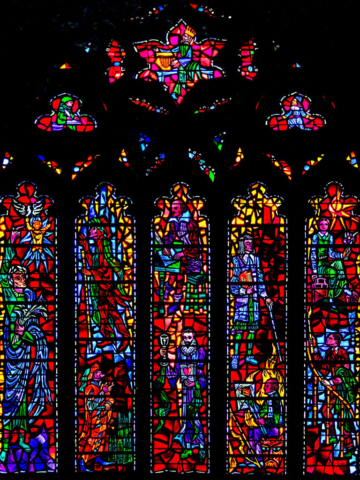
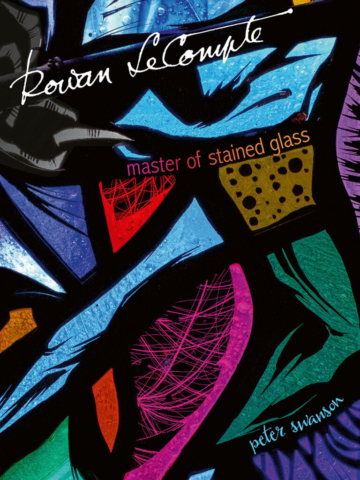
“Rowan LeCompte: Master of Stained Glass” is a newly released publication on an American artist whose work can be seen almost any day at the Princeton University Chapel: The Poets Section on the upper south side of the building.
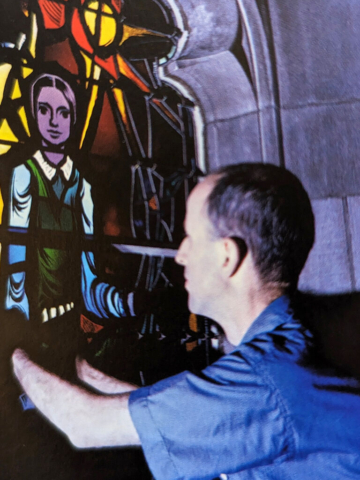
Written by filmmaker Peter Swanson as an extension of a film he created on LeCompte, the book is an overview of the artist who was born in Baltimore in 1925 and died in a hospital near his Waynesboro, Virginia, home in 2014.
The 310-page book was produced by LeCompte’s nephew, Robert LeCompte, and published by ACC Art Books in England.
It is an exhaustive overview of LeCompte’s work and is chock-full of expertly photographed images.
Swanson provides a quick glimpse of the artist with: “Rowan LeCompte first drew breath in 1925, but he maintained in later life that his ‘second birthday’ was in 1939, the year he discovered the stained-glass windows of Washington Cathedral. At the age of 14, he walked into the half-built cathedral and entered a world of light that he’d previously only heard about and seen in pictures. That would become his spiritual home for the rest of his life.”
LeCompte set his sights on creating work for the cathedral and eventually designed 40 of its windows. That includes the 1976 “Creation” window over the cathedral’s west entrance.
An art critic for the Washington Post called it “one of the masterpieces of Christendom” – although Swanson says LeCompte “was not religious in a traditional sense” but “a very spiritual person, and I believe he recognized the places in which he worked as sacred spaces partly because of their intended purpose, but also partly because of the effort communities of people put into raising the funds, designing the structures, and constructing the buildings. Be it small county church or large cathedral, Rowan tried to honor that effort with his own work.”
LeCompte’s aesthetic vision seems to have been shaped when, at age 16, the artist went to the cathedral and met its architect, Philip Frohman.
According to Swanson, LeCompte set out to meet Frohman’s desire for windows that “have glass of a prismatic character with a combination of rich colors and sparkling silvers and golds, in which the clarity and purity of color would not be dulled by filming with paint, in which each piece of glass would be like a jewel of a precious stone, which would not be colored screens to the light but appear as radiant sources of a rainbow-like and celestial quality of light.”
Swanson’s chronological unfolding shows the young artist in contact with architects and glass designers including the owners of two important glass studios that also contributed to the Princeton area: Charles Jay Connick, the Boston-based studio that provided work for Princeton Chapel and Trinity Church, and the Henry Willet Company, the Philadelphia company that also created work for Trinity Church.
The former, Connick, rebuked him and told him “knew nothing about the work.” Willet allowed the young artist to use its resources for an early artwork. But it was Frohman who not inspired LeCompte but gave him a chance by offering him the opportunity to donate a small glass to a chapel he was designing.
As the artist’s career took off, so did his personal life, and after serving in World War II he married Irene Matz, the artist sister of an army friend. The couple created their own company, set up shop in Matz’s hometown of Matawan, New Jersey, and began creating work that eschewed traditional stained-glass design. Swanson says that one window was “reminiscent of a crazy quilt made up of irregularly shaped pieces of material that are sewn together in a random pattern.”
While the term “modernism” comes to mind, Swanson says “only some of the windows Rowan and Irene were designing in the period could be called ‘modern art.’” However, they got labeled with the reference when a 1953 window design for a Maryland Church “was featured in the April 1955 issue of Life magazine as part of an article on modern art in stained glass,” writes Swanson.
Now back to the Princeton Chapel and the work that Rowan and Irene LeCompte jointly designed in 1965.
According to Swanson, the subject of this window, poetry, was close to Rowan’s heart and was one of his and Irene’s most prestigious commissions up to that point. This is distinctly a LeCompte window, and unlike any other in the chapel. Its bold colors and bright glass create a unique light in the chapel bay.
“The window celebrates poets, beginning with the psalmist King David in the rose at the top. Below him in the trefoils are Martin Luther on the left and the poet George Herbert on the right.”
Swanson then hands the commentary over to Richard Stilwell, who says in his book, “The Chapel of Princeton University,” in the left lancet “Virgil points to the Holy Child of the Forth Eclogue, whose advent shall renew the world. He stands on Parnassus and holds the lilies of Aeneid IV to recall the line ‘Give me handfuls of lilies,’ which Dante, who appears in the second lancet, heard spoken by the Church Triumphant at the opening of Paradise. Dante is shown as an aged exile from whom Virgil’s Holy Child was the Prophesized Christ. Below Dante is Chaucer, who introduced Dante to England, shown with Canterbury Cathedral.”
Swanson takes over and points out that “clergyman and poet John Donne is at the bottom of the central lancet, with William Shakespeare at the top. To Shakespeare’s right is John Milton, his blindness indicated by the cane he is using. Below him William Blake sits upon his ‘Tyger’ drawing. The tiger has a double meaning, referring both to the poem by Blake and the Princeton University mascot. Emily Dickinson and T. S. Eliot share the rightmost lancet, completing this magnificent window.”
It is a magnificent window — and a beautiful publication that catalogs the artist’s life of using line, color, and light.
The Princeton University Chapel is located along Washington Road adjacent to Firestone Library. It is open daily with prayer services set at 7 a.m. and 7 p.m. chapel.princeton.edu.
Rowan LeCompte: Master of Stained Glass by Peter Swanson, 310 pages, $60, ACC Art Books.