“The George Nakashima Woodworkers: Process Book” is Mira Nakashima’s new book that gives a new look into the art of her father, 20th century New Hope, Pennsylvania-based woodmaker and innovator George Nakashima.
Featuring original sketches, the philosophy behind the elder Nakashima’s masterpieces, and family history, the artfully crafted book explores the father and daughter’s “devotion to discovering the inherent beauty of wood so that noble trees might have a second life as furniture.”
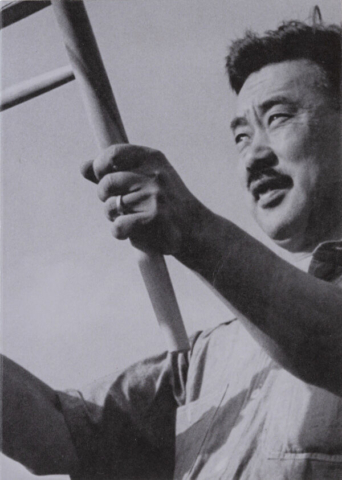
Nakashima (1905–1990), recognized as one of America’s most eminent furniture designer-craftsmen and his style of “organic naturalism,” was an MIT-trained architect who chose to work with furniture.
In 1945, he established a studio in New Hope, Pennsylvania, that is now recognized as a National Landmark and a World Monument Watch Site.
Mira, who has a BA from Harvard University and a master’s in architecture from Waseda University in Tokyo, has worked in the family business since 1970 and currently produces her father’s designs as well as her own custom, hand-crafted furniture.
Early in the book, she invites readers to embark on a journey into the artistry at the heart of George Nakashima Woodworkers and be open to the “voice and spirit of the wood selected” for each piece.
“Our intention is that our furniture not only will become a useful object in your everyday life, but also will serve as a reminder of the mysterious powers of nature,” she writes.
It is an idea the elder Nakashima explored at length in his 1981 book, “The Soul of a Tree: A Woodworker’s Reflections,” and was also examined by his daughter in her 2003 book, “Nature, Form, and Spirit: The Life and Legacy of George Nakashima.”
In the new book Mira writes, “My father established his furniture business in the 1940s, a time of great change in his field. His contemporaries were obsessed with the commercial possibilities of mass production and the cultivation of a signature design aesthetic, and my father’s motivations in setting up his own practice were reactionary and radical. Leveraging his knowledge of architectural history, engineering, and the principles of building and design, he insisted on a return to simpler modes of craftsmanship and commerce that emphasized direct contact both with natural materials and with his clients.”
She adds that father’s ideas were also shaped by a spiritual mentor, Indian philosopher and poet Sri Aurobindo. That influence stimulated George Nakashima’s practice of integrating all aspects of furniture making — materials, designers, fabricators, and clients — into a “discipline of selfless action as a way to perfection — not as an expression of ego. He treated wood with the respect due to other living beings and his furniture took on a life of its own.”
Mira writes that she began working as her father’s design assistant in 1970. For two decades she oversaw every detail of operations.
She also “learned that making furniture is an act of faith on the part of both maker and recipient: faith that the wood, usually purchased as logs and milled under my father’s supervision, holds promise to become something beautiful; faith that the designer will use it to its fullest potential, balancing the dual concerns of practicality and aesthetics; faith that the crafts-people will construct a piece in the best way possible.”
This new book connects to the woodworking studio’s beginnings and catalog of offerings.
“The first Nakashima ‘catalog,’ from 1946, consisted of a few drawings on tracing paper, with snapshots of relevant projects affixed occasionally to a blank space on the page. As the years went by, my father added more and more designs — sometimes in the form of pencil sketches, sometimes as photographs — until our ‘catalog’ was more like a portfolio, crammed full of images of one-of-a- kind projects that could never be replicated.
“In thinking about the future, we have returned to the intention of that first ‘catalog,’ which was not a catalog but a Process Book like the one you are reading now: a window into how and why we do what we do. We offer to you the understanding that our work is firmly rooted in the design and craft traditions developed by George Nakashima, but that it always was and will be the result of an evolving process, open to new challenges within the scope and technical capabilities of basic wood construction, honest joinery, and the purposefully limited size of our shop.”
Although not part of the book, it is appropriate to understand the importance of the Nakashima site.
As the Library of Congress notes, The house is significant as the home of George Nakashima during most of his productive career as a furniture designer and woodworker, as well as that of his wife, Marion, and their children, Mira and Kevin Nakashima. The house was the second structure erected on the site in 1946, preceded only by the woodworking shop. The house was designed by George Nakashima and erected under his supervision. It was designed in the international style combined with elements of traditional Japanese architecture, thus combining the concrete forms that Nakashima admired in the work of pioneers such as Le Corbusier and former employer Antonin Raymond with the traditional Japanese craftsmanship that he observed while living in Japan. The latter included a deep appreciation for wood as a building material and the ability of Japanese carpenters to capture its intrinsic beauty, the lack of the need for symmetry, ideals such as ‘wabi-sabi’ or rustic simplicity and minimalism as manifested by the Japanese ‘Sukiya’ style” – one emphasizing elegant simplicity.
The World Monument Fund designation is related to center’s connection to modern design – both Nakashima’s aesthetics and the architecture of the complex.
One of five modern U.S. sites selected for support in 2014 by the independent New York City-headquartered organization dedicated to “safeguarding the world’s most treasured places,” the Nakashima complex fit the organization’s “Modernism At Risk” Program.
“Mid-century modernism is frequently underappreciated by the American public and is quickly disappearing,” notes WMF information. “Craftsmen trained in the preservation trades are in short supply, with few training programs in place to advance the culture. This project addresses both of these challenges to the preservation of modern heritage. It increases the visibility of this unique complex of modernist buildings, in which novel engineering construction methods, materials, and shapes — such as thin-shell concrete, plywood, and hyperbolic paraboloid roofs — are combined with traditional Japanese woodworking techniques. By creating a training program for craftsmen to undertake the ongoing repair and maintenance of the buildings, it increases knowledge and builds the capacity of the preservation.”
The Nakashima Foundation provides periodic tours of the studios and grounds by advance registration only. For more information, go to nakashimafoundation.org.
For more information on George Nakashima, see June 23, 2021, U.S.1 article, “Go With the Flow in ‘George Nakashima Woodworker.’”
The George Nakashima Woodworkers: Process Book, 108 pages, $35, George Nakashima Foundation. For more information or to order, visit nakashimawoodworkers.com.
“On the slopes of Rozel Point I closed my eyes and the sun burned crimson through the lids. I opened them and the Great Salt Lake was bleeding scarlet streaks. My sight was saturated by the color of red algae circulating in the heart of the lake, pumping into ruby currents, no they were veins and arteries sucking up the obscure sediments. My eyes became combustion chambers churning orbs of blood. . . . Surely, the storm clouds massing would turn into a rain of blood.”
The words are mid-20th century American-born artist Robert Smithson’s regarding creating arguably his most famous work, “Spiral Jetty.”
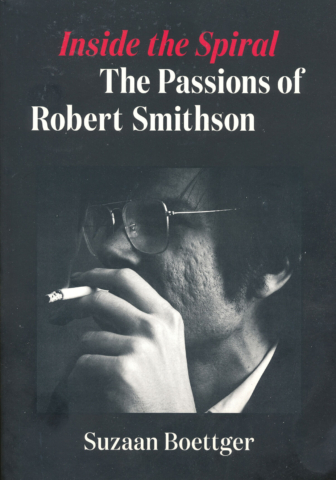
The quote comes from the newly released “Inside the Spiral: The Passions of Robert Smithson” by Suzaan Boettger, an New York-based author and professor emerita at Bergen Community College.
A deep and engaging study of the artistically daring New Jersey-born and raised Smithson, the book is an artful and handy guide to an artist whose art expanded an artistic tradition — based in European and Roman Catholic expression — into some literally ground breaking concepts, including the introduction of earthworks and “non-sites.”
Authoritative in research, the citation-heavy book expertly discusses the often-elusive intent of an artist that whose ideas still stimulate aesthetic thinking — as demonstrated in the 2013 Princeton University Art Museum exhibition “New Jersey as Non-Site.”
As Boettger notes, “‘Spiral Jetty’ became a cultural disrupter, breaking out of art world acclaim to cross over to an audience enthralled by its majesty, mysticism, remoteness, and strangeness. The earthwork is not an objet d’art, or even just an environment, but a challenging destination that, once arrived at, offers immersive wonder.”
She adds that jetty’s remoteness has created a “solitary ambiguity” that “has stimulated not only scholars’ analyses of the Jetty but visual artists’, poets’, and novelists’ accounts of traveling to, locating, and becoming absorbed by the spiral, walking it almost ritualistically.”
Smithson, who died in a small airplane crash after completing the jetty, said in his autobiographical film about the project,” “Following our spiral steps, we return to our origins.”
Putting the artist and his time in context, Boettger writes, “At the time, Smithson was the alpha artist of a group of ‘macho’ cowboy-boot and Stetson-hat-wearing earthworkers, all Caucasian males (reflecting the most populous component of ambitious New York sculptors, the values of their private patrons, the social convention then of privileging that gender and race, and the popularity of Westerns as film and television entertainment). They moved sculpture’s innovation of arraying units as site-specific interior spatial environments to the outdoors, at remote expanses, and vastly enlarged them, working in earth hacked and mounded.”
In this era when traditional art was pronounced dead, Boettger says Smithson’s work in sculpture and conceptual art “pioneered the transition to working with raw geological matter, first bringing it into the gallery, filling low bins whose shape corresponded to that of maps of the locale from which the rocks or sand had been taken.”
Yet, at the same time, he was “publishing extravagantly imaginative essays in the art world herald Artforum that at once spoke to public concerns and both camouflaged and slyly conveyed personal issues.”
Calling Smithson an “influencer of conceptions of what art could be and do,” the author of “Earthworks: Art and the Landscape of the Sixties” adds that “Smithson’s synthesizing merged dichotomies of object and environment, center and periphery, nature and culture, and most distinctively for his own practice, making and writing,” and continues to have an impact on succeeding generations. Hence, the importance of the book.
Equally important, though, is Boettger’s intent to expose the “less recognized” and “inner-directed” works, including his early paintings and drawings, and how they are “embedded in the personal: juxtapositions of secular and sacred subjects; scientific and occult systems; heterosexual and homosexual eroticism; professional and private identities; a wounded self and constructed persona.”
One key Boettger uses to examine Smithson’s complexity was to place it in both a personal and historic context.
As she writes, “The decade of the 1960s is known for its fracturing of social cohesion around personal values and the Vietnam War, the expansion of racial consciousness, and the onset of an environmentalist conscience. Morbidity appeared in earthen sculptures … primordial forms manifested the bruised social body buffeted by murders of civil rights workers; violent assassinations of beloved leaders; a virulent war and antiwar activism — all of it on the nightly TV news programs of the three network channels families gathered around to watch, coalescing audiences into community.”
However, she argues Smithson’s response in art “ suggests reactions more personal than counterculture skepticism, hip irony, or political pessimism.” Instead, she suggests it was Smithson’s Jungian exploration of fixed spiritual dualities — absolute good and absolute evil — and realizing that the whole artist needed to assimilate the two.
“Smithson was not a stranger to the dark,” notes Boettger, his “references to history — and to Christ’s Passion, circles, mirrors, non-sites, entropy, ruins — so often metaphorize biographically relevant issues that it appears he contrived cunning passages to simultaneously disguise and disclose personal corridors. And it wasn’t just his life history but his life’s prehistory, a family crisis that preceded his birth and had a profound impact on his understanding of himself in the world — and that thus needs to be incorporated to an understanding of him and his work.”. . .
“How do we know this?” Boettger rhetorically asks before quickly answering, “He told us, albeit indirectly . . .With characteristic self-awareness, he acknowledged that his artistic wrestling with materials was also a form of psychological grappling, the art both reflecting and illuminating for him interior states.”
One that “makes his figurative images comprehensible and resolves deliberately encoded works — the most monumental in every sense being ‘Spiral Jetty’ — into meaningful focus.”
Inside the Spiral: The Passions of Robert Smithson by Suzaan Boettger, 440 pages, $34.95 (paperback) and $140 (cloth), University of Minnesota Press.