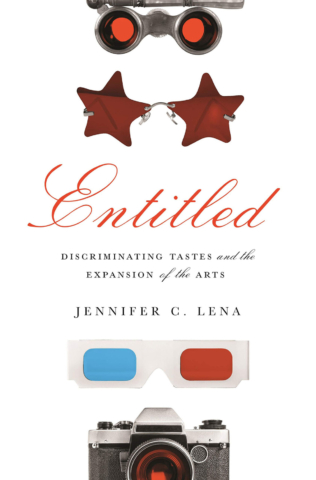
Jennifer C. Lena’s new Princeton University Press publication, “Entitled: Discriminating Tastes and the Expansion of the Arts,” takes a historical look at the development of the arts in the United States — something worth considering during the current era when a pandemic is challenging how art has traditionally been presented and providing new opportunities for art creation and production.
“The arts in America are, in many ways, the invention of a group of influential, rich Bostonians called the ‘Brahmins,’” the sociologist and Columbia University professor states early.
She then notes that before 1850, there were few distinctions between American forms of entertainment. “Operettas, symphonic pieces, and comedic songs would be featured on the same concert bill; portraits and landscape paintings hung next to stuffed animals; and Shakespearean plays were followed by performances of contortionists.”
Additionally, “most culture organizations were commercial enterprises, owned by entrepreneurs like P.T. Barnum, who had a for-profit museum, and Theodore Thomas, the most renowned figure in orchestral music at the time.”
However, Lena argues that between 1850 and 1900, bourgeois urban elites built organizations that could define, isolate, and ‘sacralize’ some of aspects of culture and introduced “a vocabulary of concepts and adjectives, reasoning logics, and justifications to explain” aesthetic qualities.
That included the idea of “high” art that was “’grand,’ ‘good,’ and ‘best,’ like what could be found in all the large European cities — ‘true’ and not ‘vulgar.’ This ‘sacralization’ of high art, with a ‘strong and clearly defined’ boundary between it and entertainment, established the outlines for a legitimate, elite culture.”
Lena says the reason for the movement was that the Boston Brahmins were “a highly connected, self-conscious social group tied together by kinship, philanthropic endeavors, commerce, and club life. Threatened by waves of immigration and an emerging middle class, they were driven to create a boundary around refined tastes to symbolically mark their cultural and social superiority.”
Lena credits the work of Princeton University sociology professor, emeritus, Paul DiMaggio who argued that the “Brahmins engaged in three key activities while inventing art in America. First, they adopted the existing organizational form of the nonprofit corporation — familiar to them from their educational and philanthropic experience — to a new purpose. Second, they engaged in the classification of works as art or entertainment. In making decisions about what works to exhibit or to present in performances, these elites introduced distinctions between what was museum-worthy and what was not, between what was symphony-worthy and what was merely entertaining. Finally, they taught audiences how to relate to art — how to behave in its presence, how to make meaning from viewing it.”
Putting that effort into place, Lena shares DiMaggio’s opinion that “Boston’s cultural capitalists would have to find a form able to achieve all these aims: a single organizational base for each art form; institutions that could claim to serve the community, even as they defined the community to include only the elite and upper-middle classes; and enough social distance between art and audience, between performer and public, to permit the mystification necessary to define a body of artist work as sacred.”
Lena put the concept into perspective by focusing on how “the decisions made within the Boston Museum of Art and the Boston Symphony Orchestra would have a sizeable influence over what cultural objects and performances other organizations would select to display, and, therefore, what Americans would define as ‘art.’ They would also influence the kinds of people who would have the authority to make these decisions.
“In orchestra music, for instance, the sacralization process involved a shift from playing work by contemporary authors to playing compositions authored by a small number of ‘great’ dead composers. (Sacralization, in this sense, refers to the process by which people begin to talk about some works as if they were separate from everyday life — ‘sacred.’ It does not refer to the content of the works themselves, nor is it meant to indicate any ‘religious’ content, although that may be present in some work.) Through the efforts of the Brahmins, ‘high culture’ became a strongly classified, consensually defined body of art distinct from ‘popular’ fare.”
The author writes while this idea of creating such organizations and an artistic canon influenced the elites in other American cities, there were variations on “the application of the artistic legitimation processes.”
As an example, Lena writes that in New York City, “the existence of a relatively large and powerful middle class meant that elites were never able to exert exclusive control over arts organizations, and commercial orchestras survived their invention. The New York elite was large and fractured, so contending nonprofits emerged, competing for audience members and donor dollars by developing particularized programming long after the Boston Symphony’s repertoire had become limited and repetitive.”
However, she references DiMaggio’s idea that eventually the increasingly national institutional basis of high and popular cultures eroded regional differences.
That includes an approach of forming a governing organization that continues today. As Lena notes, when elites formed museums and symphonies, “the organizations received public charters and municipal aid and were institutionally committed to provide service to the ‘masses.’”
The evidence, she continues, “suggests that most founder-trustees were proud to be engaged in service work on behalf of their communities. They build cultural centers similar to those in Europe but founded them on American, democratic principles. Orchestras and museums were designed to educate, promote moral uplift and enlightenment, and produce and reinforce a shared public culture —something we might view as critical to a modern, heterogeneous republic.
“Arts organizations were chartered as public institutions and eventually granted nonprofit status as educational organizations. Wall labels, tours, program books, lectures, classes for amateurs, and other programming were designed for the purpose of training the public to understand great works of art. Free or subsidized admissions programs and school tours targeted young, poor, and new audiences. Institutionally, nonprofit organizations were bound to principles of service, even while their governors defined and required respect for highbrow culture, without input or appeal.”
Lena points out that this establishment of “high art” in America depended on the efforts and tastes of elites and while the idea of “noblesse oblige” is often connected to the effort, “it is better characterized by the tension between elitism and populism.”
And that “wealthy founder-trustees benefited from their control over these organizations, enjoying them both as entertainment and as mechanisms to advance their social, economic, and political capital.”
Eventually, Lena notes, when art organizations grew in numbers, sizes, and complexity, they needed to go beyond the network of those appointed by the wealthy founders and look for individuals whose curatorial and programming decisions could address “encyclopedic, canonical, and democratic concerns” — such as those in the emerging number of college and university-supported professional arts and administrative work.
Perhaps because they focus on the past and previously accepted concepts, Lena says that “academic training credentials, and affiliation with professional associations, are commonly accepted bases for the right to make claims of legitimacy. As arts administrators acquired these credentials and affiliations, they acquired the right to make claims and influence what forms of culture were presented as art.”
Lena says that while the creation of nonprofit arts organizations was “of extraordinary importance to the history of culture in America,” she also says “We must simultaneously understand that the relationship between art and popular culture” — the latter once including dance, theater, and opera — “is and always has been dynamic.”
One that continues in an era where new expressions are emerging and a virus is challenging traditional venues — and part of continued discussion of this lively and thoughtful book.
Entitled: Discriminating Tastes and the Expansion of the Arts by Jennifer C. Lena, 256 pages, $19.95, Princeton University Press.