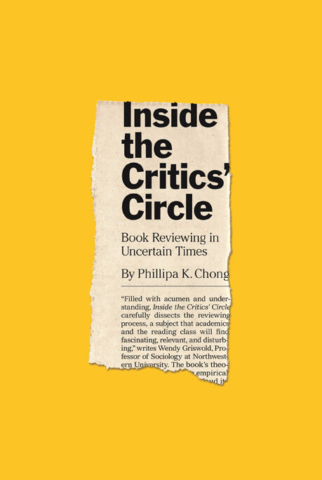
The new Princeton University Press publication “Inside the Critics’ Circle” touches on an activity that’s been stepped up at U.S. 1 over the past several years, covering new books.
While we tend to preview more than evaluate, our coverage of books reflects a sense of obligation to share ideas with regional readers, especially regarding books by writers or publishers connected to our region.
In the following excerpt, cultural sociologist and McMaster University assistant professor Phillipa K. Chong looks at the current practice of newspaper book reviews as well as their use and value:
The health of arts and culture reviewing has long been connected with the fortunes of traditional newspaper media, which have experienced significant decline over the past few decades including dwindling circulation numbers, decreasing advertising revenues, and job cuts. While I was conducting interviews for this project, the Los Angeles Times laid off all non-staff book reviewers and culled their full-time review staff to only four. Two years later, as I analyzed the interview data, the Chicago Sun-Times eliminated its regular book pages. And most recently, as I was pulling together the full draft of his manuscript, the New York Times — the last remaining newspaper in North America with a freestanding book review section — announced that the guiding question for their book journalism was shifting from “Does this book merit a review?” to “Does this book merit coverage?” with the latter suggesting an openness to alternative means of reporting on books. Such challenges signal how the function and future of traditional book reviews is being questioned not only in the wider context of news media, but also within book pages themselves.
Accompanying changes within traditional book review sections, the growing visibility of amateur reviewers has spurred interest in the potential declining influence of traditional reviewers. Amateur reviewers are sometimes called “reader-reviewers” to emphasize that their reviews and evaluations are not offered in the context of professional practice, but by private consumers — by readers, for readers. In particular, as blogs, social networking sites (e.g. Goodreads), and online marketplaces (e.g., Amazon.com) enable readers to learn about new books through alternative means, an increasing number of observers are asking: why should we pay attention to what professional critics have to say when we can get information about books in myriad other spaces? If readers can go to Amzaon.com and read 50 lay person reviews of a new book, what need to do they have for professional book reviews? And pushed to an extreme position: Why should we care about what anyone else has to say about books if reading preference is just a matter of idiosyncratic taste?
I find that critics’ sensitivity to the multiple debates about the competence and relevance of contemporary reviews manifested in more quotidian ways. This included people’s lack of certainty about whether they were the “right” people for me to interview for the project when they didn’t hold a full-time reviewing position (few people do). It also manifested in the way respondents described their review process: the doubt, oral quandaries, professional anxieties, and yes, fears for the future of book culture, which constrained how they inhabited the role of reviewer.
Far from an image of powerful tastemakers issuing edicts, the critics I interviewed experience a great deal of vulnerability while performing the work of reviewing. And by focusing on how critics respond to the broader context of uncertainty surrounding their practices, what becomes evident are the wide range of influences shaping how critics produce reviews — extending well beyond the pages of the books they read.
Why study critics at all? After all, research has shown that the more ratings books receive from reader-reviewers in places like Goodreads or Amazon, the greater the odds that it will appear on the New York Times best-seller list — while the amount of attention a book received in newspapers has little effect. If the impact of book reviews is reducible to sales, such studies could be used to suggest that traditional book reviews no longer matter.
Yet, it is not necessarily the case that the commercial success of a book should be the most salient indicator of a critic’s impact or significance. The cultural field has been described as the “economic world reversed” in the sense that economic success is secondary — if not anathema — to concerns of artistic legitimacy (e.g., winning prestigious literary prizes). Indeed, there is evidence that the idea that book reviews should be used for marketing or selling books is at odds with the professional ideology of arts journalists, especially book critics. Critics’ sense of professional value, then, and our own estimation of their worth need not be anchored in book sales. Book reviews are about more than just recommending or not recommending commodities for purchase. They are also about conferring artistic legitimacy.
Adjacent to the tastemaker idea, scholars conceptualize reviewers as cultural consecrators, whose reviews effectively demarcate which books are worth knowing about — and which are not. Consecration, a religious metaphor, was extended to the cultural field by (20th century French) sociologist Pierre Bourdieu to refer to the process and practices by which social entities are demarcated as belonging to the scared or to the profane.
As cultural consecrators, critics have traditionally been imbued with the authority to demarcate art from non-art, or legitimate from illegitimate cultural offerings. And the religious metaphor is also fitting given that assessing aesthetic value seems a rather mysterious process, involving the generation and maintenance of belief systems, as opposed to simply measuring objective underlying quality differences.
The literary consecration process involves books moving through multiple forms of literary criticism. Literary criticism as an institution can be understood as comprising three distinct yet related branches of professional literary discourse, which collectively and successively contribute to the goal of consecrating high-quality literature.
The first type of critic in the chain of consecration is journalistic reviewers, which is the focus of this book. Journalistic critics traditionally write reviews for daily or weekly publications (i.e., newspapers) and have the widest mandate of the three forms of criticism: to review newly published fiction. In practice, of course, journalistic reviewers are able to report on only a fraction of the hundreds of newly published books that come out each week. Essayistic criticism is published in more selective or specialized journals, such as monthly or quarterly literary reviews, and targets readers who have a specific interact in literature and some literary background. Rather than selecting from the entire pool of newly published works, these essayists typically select a small number of titles from those that have already received some attention from journalistic reviewers since this attention in itself conveys something about the quality or value of the novels. And finally, there is academic criticism. Academic criticism is reserved for scholarly publications, with primarily scholarly audiences. Focusing on specialized literary readings, academic criticism draws from an even more select group of books.
Note that I use the terms “reviewer” and “critic” interchangeably. While some may find this unpalatable, all unqualified references to reviewers and critics should be understood as referring to journalistic reviewers in particular.
The relative lack of scholarly attention to the process by which critics go about writing reviews can be understood as a result of the idea that aesthetic evaluation is (i) subjective and (ii) strategic. First, the belief that aesthetic valuation is subjective — as in random or chaotic rather than reasoned — suggest that there is little to empirically document. Yet this alone does not preclude valuation from proceeding. Scholars examining phenomena ranging from pricing in art galleries to judging physical beauty in the modeling industry have demonstrated that aesthetic valuation is not random but socially patterned — and thus amenable to study. Second, the strategic view of art culture…suggests that aesthetic valuation is simply a tool for people to use in producing their own status and interests, but advancing a self-serving vision of “good literature,” for example. And if critics simply use reviews as an opportunity to advance their own agendas (consciously or not), then analyzing the contents of reviews is sufficient. I argue that the world of reviewing has more nuanced lessons in store for our understanding of aesthetic valuation.
I find that book reviews are neither simply recordings of critics; thoughts about a specific book, nor reflections of critics’ self-interests; instead, reviews also include critics’ general beliefs about good books, good literary citizenship, and the proper place of art in contemporary society.
Inside the Critics’ Circle: Book Reviewing in Uncertain Times, Phillipa K. Chong, 192 pages, $29.95, Princeton University Press.
Excerpted from INSIDE THE CRITICS CIRCLE: Book Reviewing in Uncertain Time © 2020 by Phillipa Chong. Reprinted by permission of Princeton University Press.