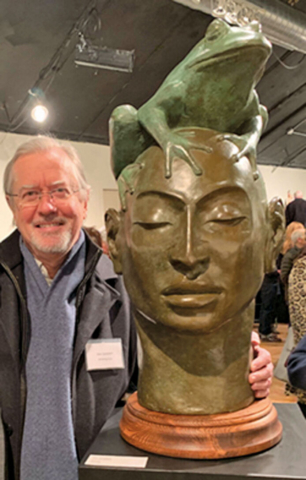
“This short book grew out of conversations I had with friends about my creative journey and how I expanded my boundaries in my art and more importantly in my life expression,” writes Skillman-based sculptor and graphic artist Don Campbell in his book “Creativity: It’s Not What You Think.”
Calling the publication “an artist’s inner journey from mind to heart to the source of all creativity,” Campbell writes in his book’s foreword the above-mentioned personal conversations grew into public talks he started giving to local organizations on creativity and eventually the book, “a companion to my talks for audience members who wish to review the ideas that I introduced.”
He says the book published through his design and creative company is a work in progress, “influenced and inspired by many artists, scientists, business leaders, psychologists, and mystics throughout my life.”
But, he adds, it “is not intended for artists only, but for anyone who has ever experienced an inner urging, a voice, a feeling that something is inside that calls out to be born.”
Campbell starts his book with a personal example of how the addition of a simple word freed his thoughts from stifling his creativity. The word was “and,” and it allowed him to have a career as a graphic artist to pay the bills and support his other career as a sculptor.
Previously, he says he “had only been exposed to the stereotype of ‘the starving artist,’ and it was reinforced by my family dynamic.”
Looking back, he says, while his art teachers “considered me quite talented and felt I had a bright future ahead of me, I chose to be a graphic designer because I felt it was my best option for making a good, secure living.”
Yet, he adds, “Unknowingly, I planted a seed that would grow into a belief system that would limit me for many years to come.” And despite his success in his field, he notes “though the span of many years, I longed for time to spend on what I really loved to do — sculpting. I was also somewhat of a self-help junkie, always looking for the magic key to improve my life.”
That included joining a “Do What You Love” workshop where he learned the word “and.”
Campbell says that creativity was always part of his work as a graphic artist, but after the workshop his sculpting took off, as did his contemplation on the creative process — and of course this book.
Admitting that “many books have been written about (creativity) from varying perspectives,” he begins his discussion with the following quote by 20th century American psychologist Rollo May: “Creativity is the process of bringing something new into being. Creativity requires passion and commitment. It brings to our awareness what was previously hidden and points to new life. The experience is one of heightened consciousness: ecstasy.”
Campbell adds that “it is about transcending or letting go of old beliefs, patterns, and habits and opening up to new ideas, information, perspectives, and possibilities.
He says one of the best methods he found for accessing the “hidden creative flow is from Otto Scharmer’s book about Theory U.
“Scharmer is an MIT senior lecturer and co-creator of Theory U, co-founder of the Presencing Institute, chair of the MIT IDEAS program for cross-sector innovation, and has a PhD in economics.
“Theory U is a change management method that helps business leaders, political leaders, civil servants, and managers as well as individuals break through old, unproductive patterns of behavior while fostering a state of being where more creative and innovative outcomes can flourish.”
Campbell says the theory starts with the premise that people “live from the perspective of what we know, or what we have accepted as true” and create closed systems or “a karmic loop, repeating much of the past over and over. Inside this system being creative is almost impossible.”
He says it then provides individuals with a process of “shifting our focus and awareness into what is essential, what was hidden, and create a space or landing field for our inner source to emerge through us. Creativity is born out of the deep connection to the present moment and sensing a new future as it emerges through us.
“We have, for the most part, always learned from experiences of the past, but Scharmer says this is not enough anymore. We must open our minds, hearts, and wills to access as state he calls ‘presencing.’ In this state we let go of our old ego and old beliefs and let something new come into this open space of presence. In this state of presence we see and sense ourselves at a much deeper level of awareness. We become open and neutral.”
An individual also becomes aware of two choices: Continue the past by repeating old behaviors based on old beliefs or use the state of presencing (or being in the present moment) as a portal to become more conscious and open up to new emerging future possibilities.
As befitting a graphic artist, Campbell points the reader to an illustration using a U-shape and guides the reader on how to “download” known information from the top of one side of the U, allow beliefs and assumptions to be dropped, reach a point of being presencing, and then “moving up the other side of the U, we begin crystallizing, experimenting, and doing, without the limitations of our old patterns. Creativity is born out of this deep connection to the present moment and sensing a new future as it emerges through us.
“Prototyping is exploring by bringing new forms and ideas into reality. We operate from wholeness using head, heart, will, and hand to manifest what wants to be born through us.”
Through the next chapters, Campbell then coaches the reader to practice deep listening to examine habits and learn to open one’s mind, heart, and will. He also then cautions the reader about obstacles to the transformation: the voices of judgement, cynicism, and fear as well as the need and desire for instant gratification and control.
They are followed by other chapters on meditation, imagination, and life flow, along with personal examples of “sculpting from presence” and the creation of work that revealed a memory of a figure he had once discovered reading “about a mythological religious order in a land entangled in an age-old rivalry of the forces of light and darkness.” And finally, the reader is provided a 30-page workbook that provides information on how to listen on various levels and how to overcome the already noted obstacles.
Yes, it is familiar territory, and as Campbell notes, there are many such books worth exploring. Yet, as he adds, “My hope is that in sharing my story I may touch something in you that will launch you into a new future. Maybe it will be opening your mind, opening your heart, or opening your will that will create a new space for something new to emerge.”
Something that may be a good read for individuals emerging from a pandemic-changed world.
Creativity: It’s Not What You Think by Don Campbell, 106 pages, $15.99 paperback, $4.99 Kindle, DJ Campbell Enterprises.