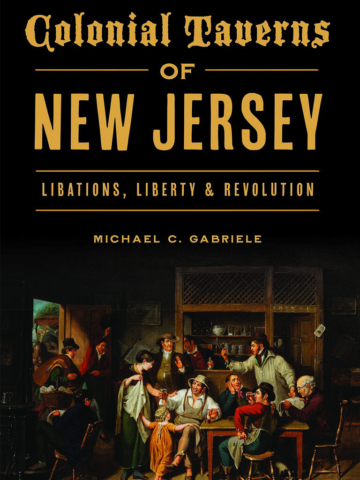
New Jersey writer and journalist Michael G. Gabriele is quick to point out in his new book, “Colonial Taverns of New Jersey,” that when the Europeans “first set foot in the New World in the 1600s, the colonial proprietors quickly recognized the business potential of New Jersey’s verdant landscape and natural resources. They also appreciated the gentlemanly pleasures of alcohol consumption.”
The rest, as they say, is history — something the author will elaborate on when he makes an appearance at the Bordentown Historical Society on Saturday, May 6.
But as the Clifton, New Jersey-based writer aptly demonstrates in his 208-page History Press publication, the places where alcohol was consumed also played a part in shaping our collective history.
As he tells us, by the end of the American Revolution — in which New Jersey saw more battles than any other state in colonies — there were at least 443 tax-record state taverns that served individuals conducting business between New York and Philadelphia, those traveling for political and religious reason, and Revolutionary soldiers moving from battle to battle.
They were also the places where news and information were freely traded, opinions shaped, and actions decided — like one not-so-happy occasion that saw one Revolutionary War-time Princeton tavern get run out of town for pro-England sentiment.
While the book doesn’t tarry long on any particular tavern or region, it provides a glimpse of tavern life in central New Jersey — with several surprising visitors.
As Gabriele notes, in 1723, future U.S. Founding Father Benjamin Franklin, just 17 years old, ambled through the wilds of the Garden State from Perth Amboy to Burlington to find work as a printer in Philadelphia.
“On October 4, 1723, the young Mr. Franklin came upon a tavern in Bordentown, owned by Dr. Joseph Brown. It was a welcomed, much- needed stop, as Franklin wrote that he had been thoroughly soaked by a heavy rain and was beginning now to wish that ‘I had never left home. I cut so miserable a figure, too, that I found, by the questions asked me, I was suspected to be some runaway servant, and in danger of being taken up on that suspicion.’”
While Franklin’s stop in Bordentown was brief, that wasn’t true of important Revolutionary War figure Thomas Paine, who moved to Bordentown and frequented a tavern that later became known as The Washington House.
It was “Mr. Paine’s principal resort and here he had many contests with gentlemen whom he met. It must be remembered in the olden days that taverns were not dignified with the names of hotels and were not frequented by promiscuous customers, but were the resort of gentlemen of means, principally. Furnished with arm chairs and tables, they possessed some of the comfort of club rooms, and the conversation or arguments were conducted with great decorum.”
The road from Perth Amboy to Burlington was not the only tavern-lined passage offered to those traveling between New York to Philadelphia. Another — newly improved in 1765-66 — featured overnight stops in Kingston and Princeton.
One popular one was “a favorite place of Washington and the governors of New Jersey,” Vantilburgh’s tavern in Kingston.
The tavern “stood at the corner of today’s Laurel Avenue and Main Street (Route 27), a site occupied by a restaurant. A colonial newspaper, dated June 1766, posted a sales notice that described ‘the old well-known tavern in King Middlesex County, known by the Sign of the Mermaid, now in the possession of William Vantilburgh.’ The tavern had four fireplaces, a garden, a large stable, and sat on a four-acre plot of land.
“Vantilburgh’s establishment achieved such renown that it earned a personal endorsement from future U.S. President John Adams, who recommended it in a letter to his wife, Abigail, on October 18, 1799. During a stay in Trenton, Adams wrote, ‘Dearest friend….If you have a mind to come nearer Philadelphia, you find comfortable accommodations at Vantilburgh’s at Kingston, where I can visit you every other day.’ The tavern remained in the Vantilburgh until it went out of business around 1880 and was demolished.”
Adams seems to have frequented the highway and makes a note about an August 27, 1774, stop in “Prince Town” and noting “Sign of (the tavern) ‘Hudibras,’ near Nassau Hall College. The tavern keeper’s name is [Jacob] Hyer.”
The tavern had been described in a newspaper advertisement as “esteemed by all gentlemen acquainted with the road, to be the best stand between New York and Philadelphia. The house is new, has a cellar under the whole and has twelve rooms; two good kitchens, one of which has a loft over it with two good rooms; a good stable with a large loft which will hold five tons of hay.”
The book follows with a note from a Princeton Historical Society publication that records an inviting place where “roast beef and rabbit stew were the most popular offerings cooked throughout the day in the tavern’s separate outbuilding kitchen and served with bread and cheese. Hyer’s alcohol stash included Madeira and claret wine, porter, gin, cider, and cherry whiskey. Dessert featured honey cakes, fruits, nuts, and wine. Hyer also offered customers long clay pipes for an after-dinner smoke.”
Besides Kingston and Princeton, another stop, Trenton, also had a healthy and important tavern industry.
As Gabriele reports, “A landowner and businessman named William Yard built the city’s first inn, established sometime between 1712 and 1715 and known only through collective memory as William Yard’s Inn. By 1715, he had established a public house, described by the Trenton Historical Society as a ‘substantial stone dwelling,’ which stood at East Front Street, near the Old Barracks.”
While it was followed by others in what would become the capital city, one of the most important was the French Arms Tavern, where the Continental Congress moved in 1784.
It was “located at the southwest corner of today’s Warren and State Streets, built of stone and stucco, two stories high, with a gabled roof. This was the period prior to Washington, DC, being selected as the permanent capital of the new nation. From June to November 1783, Nassau Hall in Princeton also served as a temporary seat for the Continental Congress.”
“The French Arms, erected around 1730, originally was a private residence The structure was sold several times until April 1, 1780, when it was leased to Jacob G. Bergen and became a tavern. Bergen was a Princetonian who had operated the College of Princeton Inn. (He) named the tavern Thirteen Stars and did extensive remodeling: adding a third story, converting two first-floor rooms into a single long room and installing a barroom in the basement. The tavern was renamed French Arms to honor France’s role in the Revolutionary War. Over the next seven years, there were additional ownership changes at the tavern, renamed the Blazing Star and then the City Tavern.
“On December 18, 1787, the tavern became the site for New Jersey’s ratification of the United States Constitution, the third state to do so. In 1836, First Mechanics and Manufacturers Bank purchased the property, tore down the tavern and erected an office building.”
As indicated, many of the taverns that survived the American Revolution did not survive the march of time. But, as Gabriele’s work demonstrates, books and talk keep them alive and, although a bit clunky with its academic references and phrasing, this one is worth sitting down with a pint and getting a sip of ye-old New Jersey’s past.
Colonial Taverns of New Jersey, Bordentown Historical Society, 302 Farnsworth Avenue, Bordentown. Talk by author Michael C. Gabriele. Saturday, May 6, 3 to 4 p.m. Free. www.bordentownhistory.org.
Colonial Taverns of New Jersey: Libations, Liberty & Revolution, Michael C. Gabriele, 208 pages, $23.99, The History Press.