“Abandoned Ruins on Public Lands in New Jersey: Forgotten and Unknown Pasts” is the fruit of author Kathleen Butler’s self-described “exploring trips.”
Originally from Port Murray, New Jersey, and now a Bristol Township resident, Butler has recently released a 98-page book produced by Arcadia Publishing’s American Through Time imprint featuring 18 history-connected adventures.
Some are to some familiar sites, such as Cape May Bunker and Fort Hancock. Some are on the roads less traveled, Fries Mills and Manuka Chuck (train) Tunnels. And some are in or around the U.S. 1 newspaper region, the D&R Canal Trail Abandoned Rail Cars in Lambertville and the Smithville Ruins outside Mt. Holly. She also adds a 19th personal journey: visiting her now-abandoned childhood home near the Musconetcong River.
With an emphasis on more photographs than text, the book reflects one of Arcadia Publishing’s approaches to preserving history, such as its series of books telling the tales of towns through historical photos and postcards.
In this book Butler provides “historical” photos she took in order to preserve the current decay of forgotten places and invite others to go on their own adventures and keep history alive in memory and perhaps through preservation.
As Butler says in her introduction, “These ruins and abandoned structures in this book are located in preserves, wildlife management areas, and parks.
“History is disappearing right before our eyes — history that is not taught in schools. We are living in an era where the need for expanding land development is at an all-time high, but some land is not worth developing on, while other land should no longer be touched. In this book, we set out to find abandoned ruins on public lands in New Jersey that were abandoned for various reasons — such as poor judgement, over industrialization, forces of nature, and more — and learn their history before they are gone forever.”
To get the flavor of the book, the following is Butler’s account of her visit to the abandoned town of Atsion (allegedly a Lenape word for the nearby waters turned red by cedar tree roots). The abandoned village is located on Route 206 in Shamong Township in Burlington County and visible from the road. It is also an easy stop on the way to Batsto Village (see page 10).
As Butler notes in one of the book’s longest entries:
Built in the late 1700s for iron-making, the Atsion community eventually needed to be revamped to become financially successful. No ammunition was originally created here as the original owner was a pacifist.
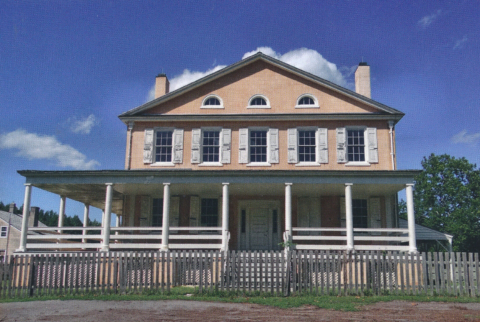
By 1824, the property was sold to Samuel Richards, who was born into wealth and had previous success in the iron industry. He turned the community around and it eventually consisted of churches, a company store, a school, and worker homes, along with mills, forges, and furnaces. Richard had his mansion built in 1826; it is a restored and preserved structure today.
The iron-making industry started declining the mid-1850s. Richards passed away in 1842 and the new owner, Richard’s son-in-law, could not keep the area profitable. Bankruptcy was declared in 1872 after building a financially unsuccessful paper mill nearby.
In 1871, the property was purchased by Maurice Raleigh, who converted the paper mill to a cotton mill. After he passed away in 1882, the mill closed.
Joseph Wharton purchased acres of the land in hopes to supply Philadelphia with fresh water from the Pine Barrens. The New Jersey Legislature heard what was transpiring and implemented new laws that prohibited the sale of water outside New Jersey’s borders.
Finally, in 1954, the estate was sold for park preservation purposes.
Today, the mansion and the church are the only structures that were renovated. The schoolhouse is unprotected, and sadly, vandals have been destroying it.
The cotton mill was mostly destroyed by vandals that set fire to it in the 1970s. Only the large chimney and the foundation remain. There are a few other remnants throughout the area including abandoned rail road tracks.
We parked in the Atsion Recreation Center parking lot that is in front of the mansion. All that remains of the cotton mill is a chimney stack that is located a bit behind the mansion.
The concrete bar is in plain view to the left of the mansion while the church (still active) and the schoolhouses are located down a dirt road that leads away from the mansion to the left. The abandoned railroad tracks can also be found in that area.
Abandoned Ruins on Public Lands in New Jersey: Forgotten and Unknown Pasts, Kathleen Butler, 98 pages, $23.99, America Through Time.