In addition to being a presence in two murals discussed in the surrounding pages of U.S. 1, George Washington was a presence in the region — first during the battles of Trenton and Princeton in late December 1776 and early January 1777, and then when he stayed at the Rockingham mansion in Kingston when Princeton served as the nation’s capital in 1783.
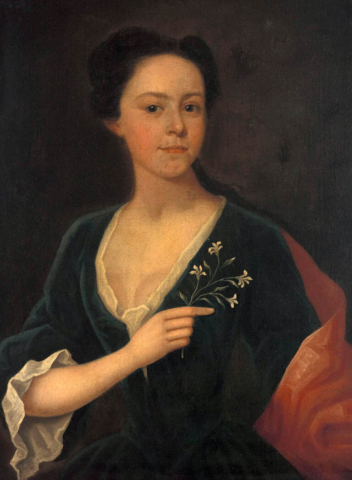
During his time in the Princeton region, Washington became friendly with Princeton resident Annis Boudinot Stockton.
In addition to residing at Morven with her husband, Declaration of Independence signer Richard Stockton, Annis was a noted poet and patriot.
She was also an ardent admirer of Washington, as demonstrated in a letter and poem she sent to him when he prepared to assume the role of the first president of the new United States of America. The year was 1789.
She opened her correspondence with the following:
“Will the most revered and most respected of men, suffer me to pour into his bosom the congratulations with which I felicitate myself on the happy prospects before us. I well know that there is nothing but the love of glory, and the enthusiasm of virtue, that is capable of animating a mind like yours — nothing but the sacred privilege of serving your country, and dispensing happiness to millions, could induce you to leave the calm delights of domestic ease and comfort — which you have purchased a right to enjoy with such well-earned fame as nothing can enhance — except this one sacrifice of yourself to the public good — by becoming the head of a government, that you and you only seem to be marked out by providence as the point, in which all will center.”
While Stockton continued her letter with more affection praise and the recollection of Washington visiting her at Morven, she also enclosed a poem.
Part of her self-described “scribblings” (or sharing of letters with Washington), the work echoes the spirit of Roman odes in its evocation of a muse as well as connecting Washington to Fabius — both the mythological son of Hercules, conceived on the spot where Rome would eventually rise, and the name of a distinguished Roman military commander.
Yet, at its soul, it is a love poem — one in love with the ideals of a new nation and expressed in heart-felt gratitude to an individual who put his life on the line to make it happen.
The following poem also marries two February celebrations: Valentine’s Day (February 14) and Washington’s Birthday (February 22):
Stockton’s “hero” is the same who lives in the murals that commemorate his courage of leading both a war against monarchy and a new nation into an untested experiment with democracy.