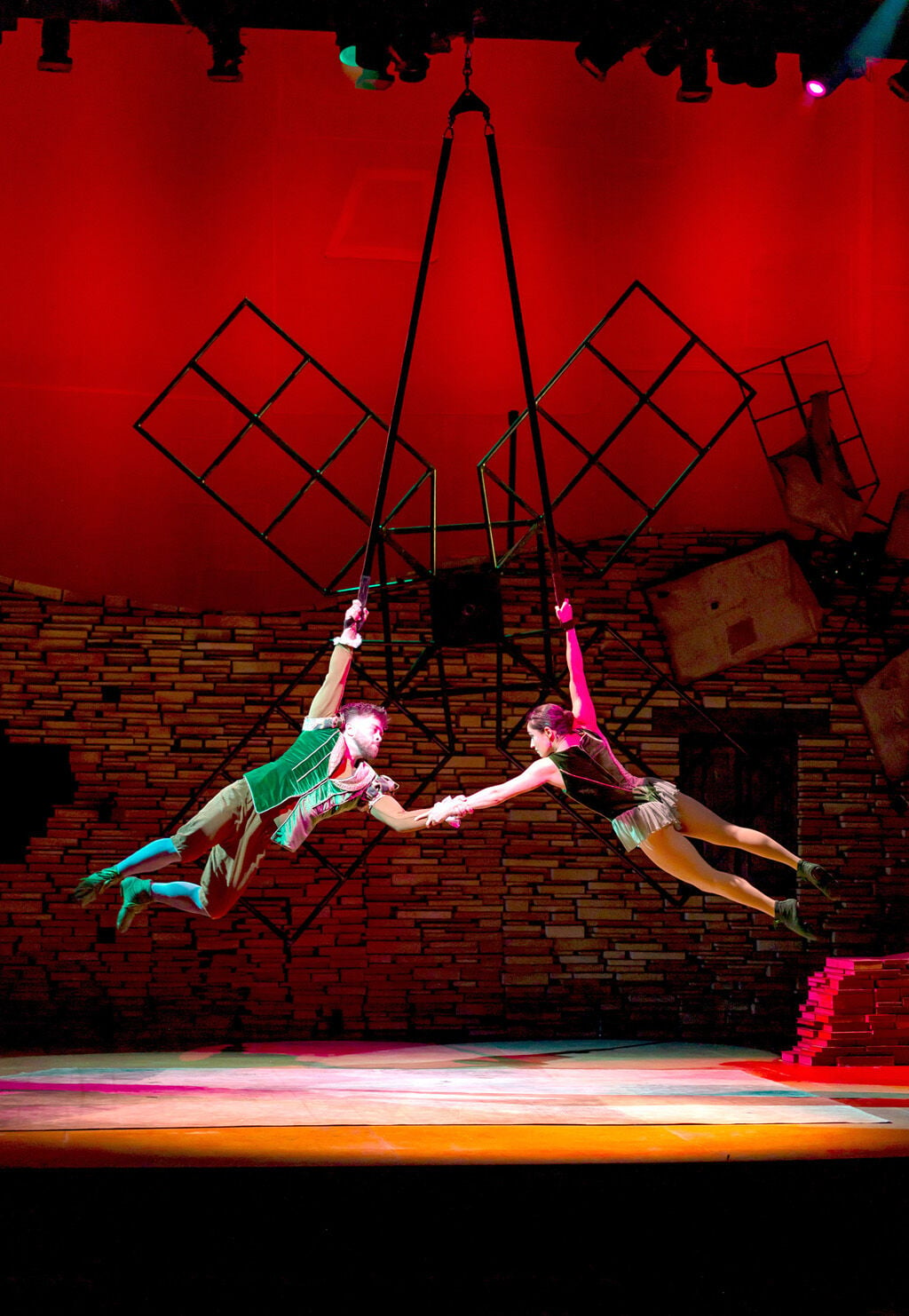
Acrobatics a la Cirque du Soleil, witty commentary about what’s going on from Miguel Cervantes, and sharp acting from the cast constantly save “Circus Quixote,” at Princeton’s McCarter Theatre through March 15, from being a tad tiresome despite its classic story and accent on comedy.
Seeing Quixote’s wayward battles and unfold provided intended thrills that the visiting production from Chicago’s Lookingglass Theatre vibrant and exciting. “Circus Quixote’s” errant knight doesn’t just tilt against a windmill. He rides it, tearing its allegedly threatening canvas sails away as he tries to curtail its alleged malevolence.
This Quixote’s skirmishes, choreographed by Sylvia Hernandez-Distasi, are fought in midair and via impressive leaps, rolls, and dives.
The physical parts of “Circus Quixote” are brilliant. The actors you hear delivering lines are suddenly riding hoola hoops 10 feet above the stage, using various kinds of cloth and mesh to fly, whirl, or collide their way to combat, fitting deftly through the slightest of spaces, and climbing seemingly insurmountable poles in scenes that recall and bring out the best parts of circus performance.
The gymnastic pyrotechnics are worth some periods of tedium. They not only revitalize a production that’s starting to flag, they exalt the wonder of human ability. “Circus Quixote’s” cast can tell a story, then fly through the air with the greatest of ease. It’s awesome, in the full, original, and non-colloquial use of that word.
More creativity involving puppetry, size, and a sense of fun add to the delight of David and Kerry Catlin’s production. All of the inventive moments hoist the narrative from becoming too repetitive and tethered to one idea.
The Catlins, as writers adapting Cervantes, go afield from most playwrights adapting “Don Quixote.” They provide battles and mishaps galore, but they concentrate on the myriad attempts from the benighted knight’s family and friends to bring him back to a semblance of sanity and safety.
Scene after scene shows Don Alonso Quijana’s dutiful niece and housekeeper enlisting caring friends to capture Quijana and and another neighbor, Sancho Panza, as they travel the villages of La Mancha looking to do a knight’s good deeds and search for Quijote’s true love, Dulcinea, preferably while she is in distress from an evil marauder.
The rescuer’s stratagems are varied and clever, but they set up each new sequence with the same premise. Plans are bound to go awry, but until they do, the explanations of each plot and their execution — until acrobatics ensue — bogs down the action.
The Catlins’ Quijote (the program’s spelling except for the title) rarely seeks battles, the windmill excepted. They find him as a niece, nun, maid, and their obliging male companions devise their latest rescue mission.
Their aim is to lead Don Quijana back to his comfortable rocking chair, even if he spends his old age reading the adventure stories that flooded his mind with ideas of living their plots. The Catlins often have Quijana go into a dream of being Quijote, yet it seems sure Quijana and Panza are on the road acting out Quintana’s fantasies.
Themes of remaining young, romantic, and useful come clear. It is a pleasure to see Quijana rise from his rocking chair, with most amusing physicality of course, stand up tall (including on the rim of the chair), and set off to be active and purposeful instead of still and idle.
More works than doesn’t in a show that know how to every path to dullness into a wonder to behold, but some variety in plotting may have provided the sheen of perfection McCarter audiences saw in David Catlin’s marvelous “Frankenstein” from Lookingglass several seasons back.
The Catlins’ scripts in not the problem; only the repetition of what usually pits Don Quijote against a foe. Especially since that foe isn’t one he encounters but one engineered to capture him, make him see the truth, or lure him gently back to the security of his home.
For the most part, the Catlins have fun with words. The actor playing Cervantes as narrator (Eddie Martinez) doubles as Sancho Panza and is given some marvelous material as Cervantes self-consciously but amusingly tells you where he is going with this story (and even has to defend at one point from another writer), and Panza provides some clever rejoinders and commentary while going along with Quijana, sometimes to keep him from destroying both of them entirely.
Theater heroes of the day include Sylvia Hernandez-Distasi, who keeps audience eyes wide open in awe and appreciation as she sends actors up poles, across skies, and along the floor, creating excitement and often beauty along the way.
It is no understatement to say how much Hernandez-Distasi’s routines are anticipated and how often they return “Circus Quixote” for glory.
Another medal-contender is Grace Needlman, who designed puppets that could be small figures that shrewdly pop out of a large dress that also serves as a portable puppet theater or behemoths that loom formidably over the set’s battlements.
Each of the puppets rates an ooh or aah as they promise threat while having witty faces or costumes that add to “Circus Quixote’s” fun.
Eddie Martinez is a charming, ironic Cervantes, who is writing his novel while the guest of the 16th century Spanish regime he served in battle, losing the use of his left hand in the process.
Martinez makes every one his lines pay, whether is he playing the sardonic author or Sancho Panza, who isn’t as innocent or ignorant as he is usually portrayed, but a simple farmer to wants to save his addled noble neighbor from numerous unforced errors.
Michel Rodriguez Cintra is a delightful as Quijana/Quijote, able to show inspired madness from either character in one moment and genuine prowess and combat ability as Quijote in another.
Rodriguez-Cintra doesn’t make Quijote a pitiable patsy. His knight musters skills and tactical abilities to thwart his family’s traps and win the day on the battlefield by outsmarting them.
Laura Murillo Hart is another who can do double duty as Quijana’s hectoring housekeeper, Alfonzo, then switching, vocally as well as physically to Quijote’s idea, Dulcinea.
Olivia Lindsay is a wise nun who wants to save Quijana for spiritual reasons but also shows her deftness as a strategist and her womanly side as one who loves a young barber from the village.
Julian Hester provides a lot of fun as that barber who reluctantly yet romantically succumbs to the nun’s pleas he participate in saving Quijana from himself.
Micah Figueroa has the most varied part as a stern Sansón Carrasco, who for reasons of propriety wants to keep folks from disparaging Quijana but who also relishes participating in the plans to capture him and seem juvenilely miffed when those plans falter or he misses capturing Quijana by thismuch. (Lack of spacing intended.)
Jacinda Ratcliffe as Quijana’s niece, Antonia, usually gets the rescue plots rolling.
Sully Ratke was amazing in designing costumes that can peel away so characters could take various forms or Quijana/Quijote can transform into knighthood. Costumes for the fantasy sequences were also excellent.
Daphne Agosin’s lighting deserves a cast credit. Shadow and colors that enhanced actions or gave it mood constantly added to the wit of the Catlins’ production.
Courtney O’Neill’s scenery smacked of classic Spanish detail and moved versatilely to provide various settings and playing spaces. The strategically places holes in the walls and trapdoors added to the adventure and comedy.
J. Grover Hollway’s sound design also enhanced the production, as did Kevin O’Donnell’s original music.
“Circus Quixote” runs through Sunday, March 15, at McCarter Theatre, 91 University Place, in Princeton. Showtimes are 7:30 p.m. Wednesday through Saturday and 2 p.m. Thursday, Saturday, and Sunday. Tickets range from $97-$36 and can be obtained by visiting www.mccarter.org or calling 609-258-2797.