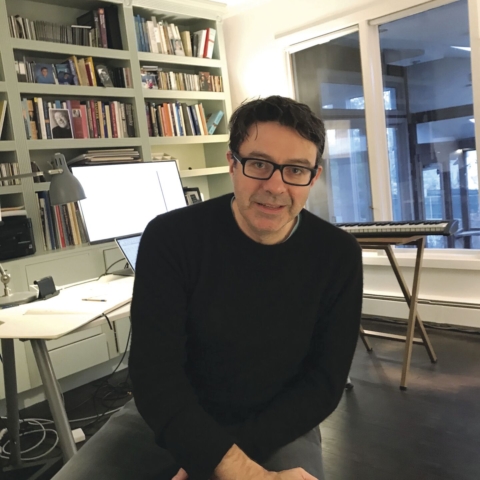
In Princeton, while the frenzied Brood X cicadas search for a mate, composer Donnacha Dennehy has been feeling frantic too, but not over love, over deadlines.
He’s putting the finishing touches on a couple of brand new pieces, and in fact had just submitted a draft of a fresh work the day we spoke.
And, unlike the cicadas, Dennehy is here to stay, having made Princeton his home for several years now.
“I really connected with Princeton, and it was a surprise,” he says. “I never imagined I would have ended up here. It’s something that happened organically, me being on this side of the pond.”
Throughout the last 15 months there was no international travel at all, including back and forth to Dennehy’s native Ireland. You’d think the man who loves to travel might have felt trapped, but no. “If you’re going to be in lockdown somewhere, Princeton is not a bad place to be,” says Donnacha (pronounced “duh-KNOCK-uh.”)
“We were lucky to be stuck in Princeton, because of all the countryside around town, for one thing,” says Dennehy, who lives in town with his wife, violinist and educator Courtney Orlando, and their three children. “We discovered it even more by biking, exploring places like Mountain Lakes and all the other parks, and nature became a big thing for us.”
Certainly the pandemic and its restrictions required adjustments in Dennehy’s daily routine, including teaching via Zoom, but he didn’t put his creativity on pause. He kept busy and continues to be busy, especially with those newest works.
“At the moment I’m finishing an opera that will premiere in Dublin (at the O’Reilly Theatre) in October, with staging rehearsals beginning in August, and I’ve just completed a violin concerto that will also premiere in October, but this time in the Netherlands,” he says.
The new opera, titled “The First Child,” is his third collaboration with writer/director Enda Walsh, and part of a Dublin-based trilogy which also includes “The Last Hotel” (2015), and “The Second Violinist” (2017).
This original work reflects on Dennehy’s youth in greater Dublin — not in the beating heart of the city, but in the suburbs, where creative people are champing at the bit for excitement and inspiration.
“Without giving too much away, there’s a couple buying baby stuff in a Mother Care shop, where the shopkeeper knows the future mother, and there was bullying involved in the past. It becomes kind of a thriller, a revenge saga,” Dennehy says. “There’s the banality of suburban life, how it rubs up against the utopias we dream of, and it could easily be set in New Jersey.”
Dennehy’s other fresh piece is a violin concerto, commissioned by German violinist Augustin Hadelich. Concertgoers in the area might have seen this outstanding performer with the New Jersey Symphony Orchestra in November 2018 (performing the rarely heard Violin Concerto Opus 15 by Benjamin Britten), as well as in fall 2016, opening the season for Princeton University Concerts.
“(Augustin) came to me for this piece, he knows my work very well,” Dennehy says. “I wrote a violin piece in 2005, but only one movement, so writing a multi-movement concerto is a new adventure for me.”
Due to the pandemic, Hadelich’s concerts were cancelled, unfortunate for him, but beneficial to the composer.
“He had time to go through the concerto bit by bit,” Dennehy says. “Augustin would play for me what I’d written, and I could work on fine tuning it, which is a wonderful luxury. It’s been intense, but I quite enjoyed it, and having Augustin to work with is phenomenal.”
Previously a tenured lecturer at Trinity College in Dublin, Dennehy was appointed a Global Scholar at Princeton University in 2012, and joined the music faculty in 2014. As of this spring, he is also the recipient of a 2021 Guggenheim Fellowship.
Orlando, his wife, is a violinist and founding member of the new music ensemble, Alarm Will Sound. She is also an assistant professor at the Peabody Institute of Johns Hopkins University in Baltimore.
Dennehy was born in 1970, and raised in greater Dublin. His parents were from County Kerry in southwestern Ireland. He recalls going there to visit his grandmother, playing tin whistle, and singing with the family during impromptu sessions. And it was in Kerry where he was introduced to sean-nós, Irish folk songs sung unaccompanied in the traditional language.
Later in life, Dennehy would collaborate frequently with famed sean-nos vocalist Iarla O Lionaird, including on Dennehy’s multi-media “docu-opera” “The Hunger.” (Based on the emotional, political, and socioeconomic devastation of Ireland’s Great Famine, “The Hunger” was performed in Princeton in September, 2019.)
“(I was to find out that) Iarla lived on the other side of the mountain from my grandmother,” Dennehy says. “That part of Ireland is renowned for its traditional culture. That’s our language, and only a small minority speaks it, but Iarla grew up with it and wants to protect it.”
He also played recorder and flute but had the desire to compose early on. Dennehy’s father, who worked in the insurance industry, and his mom had numerous jobs, including a long stint as a ward clerk at a hospital in Dublin.
The elder Dennehy was also passionate about writing and used to come home from the office to create original radio plays. Ireland’s National Radio Repertory Company put a few of them on, and that was the real hook for young Donnacha.
“It was in the DNA of our household to be creative,” he says. “The second I started school and studying formal music, I started writing it.”
He entered the Royal Irish Academy of Music at age 11 and found it terrifying but electrifying. “I was such a fish out of water,” he remembers. “Most of the other students came from families where classical music was a big thing, they’d had it for generations, and they were of fancier stock.”
Saved by a rebellious music theory teacher, Dennehy was introduced to 20th century rebels like Karlheinz Stockhausen.
“This wild guy saw something in me, and he had me working on composition/writing, and he was really into it, and I was so into everything he showed me,” Dennehy says. “My father, too, used to wake me up very early in the morning when the radio played contemporary music.”
Absorbing this sub-genre of classical music inspired Dennehy to rebel with his own compositions and he set out to “take the class out of classical.” Meaning, he approached the presentation, staging, and subject matter in a modern, less stuffy way — fewer tuxedos and polite clapping, more lighting and amplification.
He had this idea in mind in 1997 when he founded Crash Ensemble, which is considered Ireland’s premiere leading new music collective, and for the last 25 years or so has earned international acclaim for its adventurous sound. Giants in contemporary composition like Terry Riley, David Lang, and Glen Branca, to name just a few, have written for the group.
Dennehy is prolific to say the least, and a perusal of his website reveals a dizzying array of vocal and instrumental work, opera and experimental musical theater, works for small and large ensembles, orchestras and soloists. His music is described as being “…marked by a sonic and rhythmic intensity and a kind of volatile tonality …in and out of an overtone-based focus.”
He has a particular love for the intersection between words and music, however, hence his enthusiasm for the sean-nos.
Graduating from Trinity College in Dublin with a bachelor’s in music in 1992, Dennehy then came to the University of Illinois Urbana-Champaign, earning a master of music degree in 1996 and a doctor of musical arts in 2014. He continued his studies in the Netherlands with Dutch composer and pianist Louis Andriessen. Dennehy was later invited to join the faculty at Trinity and stayed throughout the late 1990s and early 2000s.
The composer says he rarely traveled as a child, quipping, “We never went on foreign holidays, we went to rainy beaches in Ireland, with pots of tea and bad sandwiches.” But as an adult he discovered the joy of traveling, and over the years worked and created in Paris and Amsterdam, as well as the U.S. and Ireland.
First invited to Princeton through his friendship with Dan Trueman, professor of music and founder of the Princeton Sound Kitchen, Dennehy has received commissions from such ensembles as Alarm Will Sound, Bang on a Can, the Kronos Quartet, So Percussion, and Third Coast Percussion, as well as vocalist Dawn Upshaw, pianist Joanna MacGregor, and violist Nadia Sirota.
He has a number of influences, from early music composers Guillaume de Machaut and Carlo Gesualdo, to contemporary artists such as John Adams and Gloria Coates.
David Bowie is another favorite of Dennehy’s, and he plumbed the late rock star’s works from the mid-1970s, particularly the minimalistic “Low,” “Heroes” (both 1977), and “Scary Monsters” (1980).
“That was the Bowie I really loved, that kind of ambition and experimentation,” Dennehy says. “It was also through Bowie that I was introduced to Steve Reich, Philip Glass, and other New York minimalists. I’m still searching out their work, and it’s quite inspiring.”
Ironically, Dennehy has a major Bowie connection in that his librettist, Enda Walsh, worked with the British superstar toward the end of his life, writing the book for the musical “Lazarus.” The musical was first performed at the end of 2015, and was one of the last pieces Bowie completed before his death on January 10, 2016.
“In fact, Bowie was supposed to come to one of my operas in New York, but then I heard he was too sick, and that was the first I’d heard of his illness,” Dennehy says. “He was quiet about it, kept working and creating.”
This kind of “perish with wet ink on your new work” attitude resonates with Dennehy.
“I believe that, as an artist, you always have to be challenging yourself,” he says. “You always have to be ‘keen.’”
Donnacha Dennehy on the web: www.donnachadennehy.com.