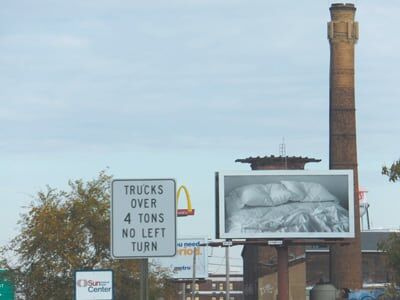
The Princeton University Art Museum’s billboard installation, “Untitled” by Felix Gonzalez-Torres, will disappear as quietly as it appeared on Monday, December 16. While there is still time to view the billboards, many drivers probably have and have been prompted into thought.
The oversized — and elegantly designed — black-and-white photograph of an empty bed created by the late Cuban-American artist appeared in late October on 12 billboards around the region, including a large sign stationed in front of the museum.
Though there was no fanfare regarding the appearance of the images, the museum website notes, “the billboards feature a haunting image of an unmade bed, empty but for the indentations left by two absent bodies. The meaning is dependent upon the viewer’s own memories or expectations of happiness and frustration, loss and desire. Any and all possibilities are conceivable. By using an advertising convention — the billboard — to encourage a viewer’s public reckoning with his or her own private experience, the artist seeks to disrupt the already precarious boundaries between the public and private realms.”
The statement notes that the work was “created at the height of the AIDS crisis,” alluding to the reality that the artist’s lover and Gonzalez-Torres himself died of the disease. However, it would be wrong to interpret the work as related only within that context. The artist himself says in an interview that his work is “about inclusion, about being inclusive. Because everyone can relate to it. It doesn’t have to be someone who is HIV positive.”
The point was echoed by a Los Angeles art viewer who noted that “Gonzalez-Torres’ work suggests that singularity only counts when it unites with others, exchanging individuality for group identity.”
The artist was born in Cuba in 1957, lived in Spain and Puerto Rico, came to New York City on a study fellowship in 1979, earned a BFA in photography from the Pratt Institute, and began exhibiting in the early 1980s. While he continued his academic work (receiving an MFA from the International Center for Photography and New York University) and worked as an adjunct instructor, he exhibited his art in major museums around the world.
According to the Guggenheim Museum, his involvement “in social and political causes as an openly gay man fueled his interest in the overlap of private and public life. From 1987 to 1991, he was part of Group Material, a New York-based art collective whose members worked collaboratively to initiate community education and cultural activism.” The museum quotes him as saying, “I need the public to complete the work to become part of my work, to join in.” He died in 1996.
The installation was conceived of and curated by Kelly Baum, Princeton Museum’s curator of modern and contemporary art. The locations around central New Jersey were chosen “in keeping with the artist’s desire that his images be shown in everyday locations, where people from different backgrounds who might not ever visit a museum would encounter them. The images were printed as all other billboard images are now printed — this, too, is in keeping with the artist’s wishes,” says a spokesperson for the museum.
The project was supported by Princeton University alumnus Christopher Olofson (Class of 1992) and president and chief operating officer of the legal technology solutions provider EPIQ Systems; the Bagley Wright Contemporary Art Fund; and partners and friends of the museum, and presented in cooperation with the Felix Gonzalez-Torres Foundation, created in 2002 to promote the visual and creative arts and foster an appreciation and study of the artist.
— Dan Aubrey
Felix Gonzalez-Torres’ “Untitled,” on view to Monday, December 16, at the following locations:
Princeton University Art Museum
Townsend Street, east of French Street, facing east, New Brunswick
Route 27, 3/4 mile north of Promenade Boulevard, facing north, South Brunswick
Route 33, 3/4 mile east of Route 130, facing west, East Windsor
N. Olden Avenue, west of Route 31 (Pennington Road), facing south, Ewing
Whitehead Road at 3rd Avenue, facing west, Hamilton
Nottingham Way at Greenwood Avenue, facing west, Hamilton
Chambers Street at Ashmore Avenue, facing north, Trenton
Route 29 at Wiburtha Road, facing south, Ewing
17 Spring Street, east of Fowler Street, facing west, Trenton
Bridge Street, west of Ferry Street, facing east, Trenton
Route 129, south of Cass Street, facing south, Trenton
artmuseum.princeton.edu.