Patriots Week in Trenton is the annual December 26 through 31 reenactment of the Trenton Revolutionary War winter battles that gave the Americans their first major victories against the British.
One of the important Trenton locales of the wars is “Five Points,” the intersection of North Broad Street, Warren Street, and Princeton, Pennington, and Brunswick avenues.It is here on December 26, 1776, that American forces led by General George Washington placed their artillery and contained the Hessian Troops garrisoned at the Barracks building just a few blocks away.
During the battle, which included Alexander Hamilton ordering the cannons to fire, Hessian commander Colonel Johann Rahl (also Rall and Rhall) was mortally wounded and the Hessians captured.
It is here that Washington’s strategic decision to surprise the British forces in Trenton boosted the morale of the Continental forces and put them on the path to victory.
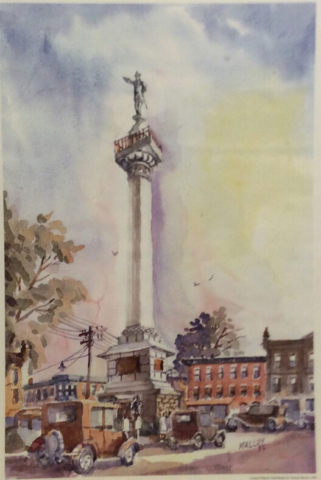
And it is here that passersby can easily overlook the details of the stately monument created by one of the prominent designers of its day and featuring artwork by one of America’s most prominent artists.
The designer is John H. Duncan, who also created Grant’s Tomb.
As the New Jersey Department of Parks and Recreation, which has authority over the 148-foot-high triumphal column of granite, reports, the design is “considered to be an early example of the Beaux Arts style, it is a Roman Doric column with a large base decorated with acanthus leaves. The capital has a ring of stars crowned by an observation platform with a railing. Above the platform is a circle of 13 electric lights, representing the 13 original colonies. The column is surmounted by a small round pavilion that features a pedestal with a statue of George Washington, right arm outstretched, pointing toward the site of his victory.”
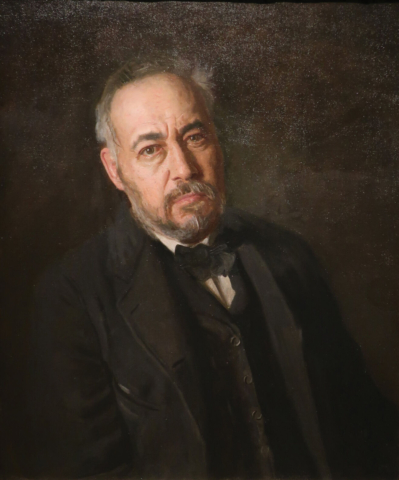
The artist is Thomas Eakins, a 19th century Philadelphia painter who studied in Paris and returned to create masterful scenes of American realism, including scenes of medical school surgeons performing operations and athletic activities.
Eakins was involved with the project for at least two reasons. He was (and continues to be) regarded as one of the most highly accomplished American artists of his day. Nevertheless, the monument designers knew he was in financial straits after his academic career was jettisoned by his insistence that female art students participate in classes that used nude male models.
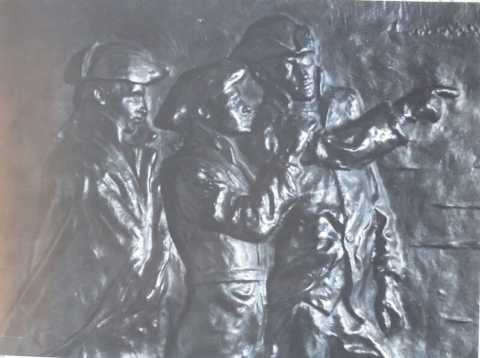
Eakins was commissioned to create two plaque reliefs at the base of the monument to show Washington’s army crossing the Delaware River and the opening of the Battle of Trenton (a third relief showing the surrender of the Hessians was created by New York sculptor Karl H. Niehaus).
While the original plaques were removed and can be seen at the New Jersey State Museum, the faithfully reproduced replicas now on the monument show Eakins’ approach to relief making and his belief that a “relief holds a place between a painting or drawing on a flat surface and a piece of full sculpture.”
In the 1993 publication “The Trenton Battle Monument: Eakins Bronzes,” New Jersey State Museum curators Zolton Buki and Suzanne Crilley put the Eakins reliefs in perspective by comparing them with the famous “George Washington Crossing the Delaware” at the Metropolitan Museum of Art in New York:
“Due to Eakins’ almost exclusive interest in relief — even if at times very high relief — sculpture, the quality of his work in this medium often seems painterly. This is perhaps nowhere more apparent than in the bronzes of the Trenton battle Monument.
“Emanuel Gottleib Leutze painted Washington Crossing the Delaware some 40 years before Eakins received the commission to treat the same theme and other related subjects in sculptural form.
“Outside the obvious differences of size and medium between the works of Leutze and Eakins there is also a strange reversal: pictorial three-dimensionality in one and sculptural two-dimensionality in the other.
“Leutze’s intention to capture ‘the spirit of a great leader and the importance of a great event’ is achieved by sharp value contrasts and silhouette-like harshness of the contours — neither of which is possible in quite the same way in a low relief. These devices successfully, and excessively, isolate the foreground from the background; the visual sensation is not unlike viewing a sculptural group against an early morning eastern sky…
“In Eakins’ version of the theme, enlarged in scope to memorialize The Continental Army Crossing the Delaware… the concept is pictorial, treated in an almost impressionistic manner. The composition suggests a snapshot effect, as it were, a visual record made by a participant in the quiet drama of the actual event.”
Notes from the undated minutes from a Battle Monument Association meeting add some additional thoughts regarding Eakins’ and Leutze’s depictions.
According the minutes, Eakins’ crossing corrects the one by Leutze that is “so faulty in its delineation of the direction of the passage of the boats, in the kind of boats used, in the representation of the ice, and of the flag carried by the American Army.”
However, in the Eakins design “the Durham boats which General Washington directed to be collected from the upper waters of the Delaware during his march through the Jerseys appear as they were used in transporting the horses and artillery. In the immediate foreground is William Washington and the lieutenant of his company, James Monroe, afterward president of the United States. Both of these officers were wounded in the battle of Trenton. With them, evidently alarmed at some noise on the New Jersey shore, is Colonel Edward Hand, and the Pennsylvania regiment of sharpshooters, commanded by that gallant officer… The little boat in the foreground contains General Washington and Colonel Knox the artillerist and a Jersey farmer is rowing them over the river.
“On the south side is the relief showing ‘The Opening of the Fight.’ The battery of Captain (Alexander) Hamilton is represented as about to fire the first shot at the enemy on King Street. The mounted figure of this brave soldier, who afterward became gifted statesman, is conspicuous in the foreground. This officer was then only nineteen years of age and his company of New York artillerists were all young men, but it was said to have been a model of discipline.”
Also involved with the creation of the memorial was 19th century sculptor William O’Donovan. In addition to the statue of Washington on top of the monument, as the minutes note, “Donovan created the two bronze statues of the Continental soldier at the monument’s entrance. The soldiers are two who fought in the Battle of Trenton: Private John Russell of the 14th Regiment from Massachusetts and Private Blair McClenachan, Philadelphia Troop of Light Horse.”
The two — along with Washington at the top of the monument and Eakins’ depictions of the action on the river and the street — will be there during Patriots Week to do what they do every day: stand witness to one of the most important battles in the Revolutionary War.
More information on the Trenton Battle Monument: www.njparksandforests.org/historic/Trentonbattlemonument.
More information on Patriots Week: www.patriotsweek.com.