Throughout the last 25 years of Apartheid in South Africa, playwright Athol Fugard put face after face on the strictures to which that country’s black African majority was forced to adhere and the humiliations it was made to endure.
As Harriet Beecher Stowe’s “Uncle Tom’s Cabin,” John Steinbeck’s “The Grapes of Wrath,” Arthur Koestler’s “Darkness at Noon” Alan Paton’s “Cry the Beloved Country,” and other significant works of literature have done, Fugard’s work brought the human side of a broad, complex situation home to his audience. In play after play, he put the personal repercussions of a political or cultural phenomenon on stage where, in his case, the effects of Apartheid on everyday human beings could be seen.
Fugard, whose works were produced around the world, acquainted that world with what it specifically means to live under constitutionally legitimized oppression, making the his characters’ situations clearer, more real, more immediate, and oh so much more poignant,
Equally important to crafting stories and creating intense understanding of and empathy for his characters, Fugard showed and told but never preached. Unlike many of today’s playwrights whose intentions are to bring some angst to light on stage, Fugard let the thoroughness and inherent humanity (or inhumanity) in what he depicted do the talking. He did not choose to beat his audience over the head with some polemic point or state baldly some moral or lesson that was a matter of attitude or agreement. He found the depth and texture to fully dramatize how people, intricately drawn people, flaws, foibles, and all, were affected by a system that denied humanity to the point of being unnatural. No study of Apartheid would be complete without including the myriad slices of life provided by Mr. Fugard, who died last year at age 92, in about two dozen works that chronicle the human toll of a foul policy at it occurs and in its aftermath.
“Sizwe Banzi is Dead,” playing in glorious fashion at New Brunswick’s Crossroad Theater through June 14, is one of the more unusual among Mr. Fugard’s works. It contains all that makes the Fugard canon telling and moving, but it takes a more episodic and improvisational approach than works such as “Master Harold…and the boys,” “My Children! My Africa!,” “A Lesson from Aloes” or “The Road to Mecca.”
That’s because Fugard did not write it alone. Actors John Kani and Winston Ntshona receive equal credit. The original production, which I saw when it came from Johannesburg to Broadway in December 1974, showed why. So does Ricardo Khan’s funny, spirited, and touching production for Crossroads.
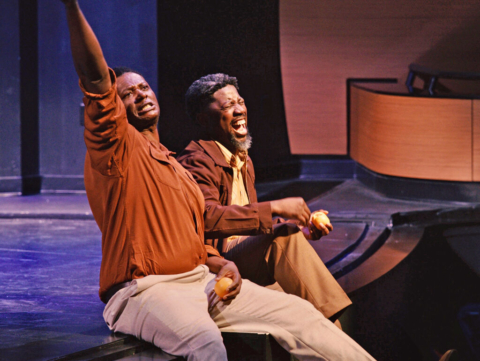
Khan’s work with actors Atandwa Kani, John’s son who adeptly honors his father by bringing special charm, dignity, and heft to his characters, and Kelcey L, Watson, who conveys the decency and sincerity in his more conventional character, clearly reveals how much “Sizwe Banzi is Dead” was built from the imagination and improvisation of three inventive men (six if you count Khan, the younger Mr. Kani, and Watson) while retaining of all the human traits and subtle, intrinsic political content Fugard was famous for incorporating so smoothly.
Khan, Kani, and Watson work sparely. They let personality and story prevail as they show an assortment of people who find ways to become and remain individuals in a strict, pervasively stunting society.
Survival, and how to achieve it, is the upbeat theme of “Sizwe Banzi is Dead,” its title and eponymous character being humorously ironic yet dangerously serious examples of how one can claim a shred of personhood in a world that works so dedicatedly to maintain subjugation and defeat.
In significant ways, “Sizwe Banzi is Dead” is more overtly political than most of Fugard’s plays. Styles, the character Kani plays in the first act, enjoys reading the newspaper and commenting on the stories and headlines within. Styles and Buntu, the character Kani plays in the second half, explain a lot about South African racial policy and documentation as “Sizwe Banzi” proceeds.
Though this information is necessarily presentational, it is often couched in conversations Styles has with the Crossroads audience and Buntu has with a living Sizwe Banzi. Artistry from Fugard, two generations of Kanis, the late Mr. Ntshona, and Watson, keep details from becoming heavy-handed or cloying. In Atandwa Kani’s hands at Crossroads, the spouting of regulations, passbook intricacies, and police tactics become a delightful, if frightening, recitation of what the average black South African faces each day than a dry, pedantic list of facts that greatly affect people’s lives.
Wit, humor, and irony fuel ‘Sizwe Banzi is Dead.” Khan, Kani, and Watson aim towards conveying those traits, secure that the sad, humiliating, gut-wrenching aspect of such insidious inhumanity of one group or people towards another, a native majority no less, comes through. Clearly and with effect.
Kani and Watson have the Crossroads audience laughing with a lump in their throats as they mention the rules their characters must live by and conspire to thwart them to allow for Styles, Buntu, and Banzi’s survival as relatively free-acting men with some semblance of control over their daily lives.
Atandwa Kani plays the ebullient Styles and resourceful Buntu, men who are aware of risks they take but choose to work in their separate ways to live by the law but under its radar in a South Africa than never keeps its foot comfortably far from the back of their necks. Kelcey L. Watson plays the more naive, relatively accepting, and less secure Sizwe Banzi, who learns what it means to be the one holding the government-issued Identity Card 3811863 more than a man who has a name, any name.
In “Sizwe Banzi is Dead,” Styles and Buntu cleverly skirt they system while fully acknowledging its existence and how it can crash all their defenses against it. Sizwe Banzi is one who must learn to adapt and take care if he wants to keep himself gainfully employed and able to feed his wife and children who lives in a district 150 miles from where Banzi must go for work that doesn’t promise to kill you, as mining for gold in his home region would.
Under Khan’s direction, “Sizwe Banzi is Dead” at Crossroads in ebullient and uplifting. Styles and Buntu are figures of hope and resilience. Banzi, through illiterate and more fearful, listens to them enough to make his present, and possible future, more productive and fulfilling than it would have been had he been left to his own devices.
Atandwa Kani has chameleon-like zest as he moves from the chatty, life-affirming Styles to the more precise, more involved Buntu. One flaunts convention by leaving a secure and predictable job at a Ford Motor factory to open his own business. The other asserts his individuality and encourages others, Banzi in particular, to defeat Apartheid by seeming to cooperate with it. Or at least creating fictions that allow one to thrive while staying at least one step ahead of a police force that looks for occasions to pounce.
Kani’s Styles is a charmer, the ultimate optimist puts his personal life back into his personal hands by opening a photography studio. An individual businessman who has achieved more of his dream that some would deem possible, Styles helps other find the joy in their own life. Kani makes him a catalyst of hope, the one who merrily taunts people into taking chances and pursuing their dreams.
Styles takes the Crossroads audience in the palm of his generous hand, handling adversity and absurdity with humor and wisdom, taking a stance akin to “the comedy continues” and accenting the positive while fully understanding his condition as a black resident of South Africa.
Styles adds joy to his perspective. He knows all he must endure, but he approaches it with a smile and a sense of irony strong enough to keep him light in the heaviest of environments.
Kani’s Buntu is a practical realist, one who sees and acts on a truth he has the courage at times to bend to his advantage.
Buntu is the kind of activist that gives credit to taking risks and maximizing chances. He knows how to be of critical assistance to others while taking scrupulous care of himself.
Sizwe Banzi and an alter ego he will adopt give Kelcey L. Watson ample chance to be a deft Stan Laurel to Kani’s renditions of Oliver Hardy.
Watson’s Banzi is an innocent sad sack at sea when his plans for his family’s future are curtailed by South African police policy. Banzi’s passbook is stamped with an order for him to leave the region he’s come to to find sustaining work within three days.
Decent and well-intentioned, he’s unequipped to cope with such a setback. He is confused and aimless.
Enter Buntu. While Kani’s character serves as a guide, Watson sees more and more light, has layers of naiveté peeled away, and accepts what he must do to meet his family’s personal needs.
Watson masterfully conveys growth that retains some of the simplicity that makes one root for Banzi and enjoy whatever enlightenment leavens his confused life.
Fugard, Kani, and Ntshona’s title brings the reality of Apartheid as experienced by all three characters home in ways that simultaneously delight and appall. The latter because the system Styles, Buntu, and Banzi must thwart exists at all.
I’ve seen four productions of “Sizwe Banzi is Dead,” the original production three times, and they are all different yet satisfying. I interviewed John Kani when he directed Atandwa in “Sizwe Banzi” for Princeton’s McCarter Theater in 2015. He said it is important the story depicted is seen by generations to come so they understand Apartheid, what it wrought, and what it meant. He sees his work with Fugard and Ntshona as preserving history as well as being an entertainment.
Ricardo Khan’s production emphasizes economy is the shrewdest ways. Beowulf Borritt provides a bare stage in which carts can be brought in to serve as structures, e.g. Styles’s photography studio. Mika Eubanks’s costumes are perfect and used well by the actors. Stefania Bulbarella’s projections add texture enough to give strength to images Styles describes.
“Sizwe Banzi is Dead” runs through Sunday, June 14, at Crossroads Theater in the New Brunswick Performing Arts Center, 11 Livingston Avenue, in New Brunswick. Showtimes are 7:30 p.m. Thursday through Saturday (but not Friday, May 29 or Saturday, May 30), 2 p.m. Saturday, 3 p.m. Sunday, and 11 a.m. Thursday. Tickets range from $95 to $45.70 and can be obtained by visiting www.crossroadstheatrecompany.org or calling 732-258-7530.