It’s fashionable these days for cognoscenti to scoff at Andrew Lloyd Webber and all his works.
The shrewdly conceived, marvelously executed, and unceasingly engaging production of “Evita” currently at New Hope’s Bucks County Playhouse gives Sir Andrew the last laugh.
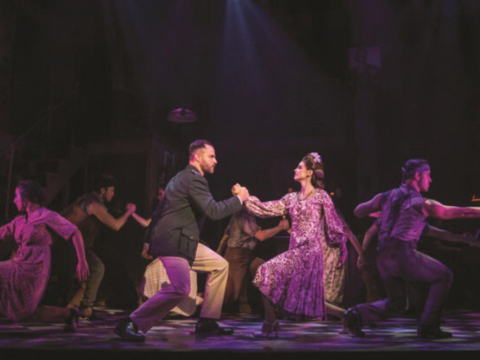
It’s brimming with artistry, from director Will Pomerantz — who places the chronicle of Argentina’s glamorous dictatress in a seedy Buenos Aires tango bar that compactly fits on the BCP stage thanks of Anna Louizos’ inspired design — to the gritty orchestrations that emphasizes the Latin in Lloyd Webber’s score and turns “Evita’s” setting into one that suits its scrappy, romanticized lead character.
Pomerantz’s staging and Marcos Santana’s choreography give BCP’s “Evita” a visceral core that makes Lloyd Webber and Tim Rice’s story of a fabled politician’s dubious rise and sudden fall, more a result of terminal illness than dwindling support or affection, immediate and compelling.
Pomerantz and Santana keep stage action going in a way that ties together loose ends that can make “Evita” seems disjointed or missing some information.
A certain lack of connection is inherent in “Evita.” Lloyd Webber and Rice did not write it for the stage. It appeared first as a two-record album, composed for listening and not necessarily for performing in the theater. The Harold Prince production of 1978 has been the standard for staging the show.
Pomerantz proves, as is universally true, that a script is just a roadmap and does not dictate staging by bringing Lloyd Webber and Rice’s piece closer to the audience, giving it a creative and localized construct, and providing the BCP audience with something constant to watch. Scenes that were always designed as individual set pieces blend better than they have in the 40 previous times I’ve seen “Evita” (including the original London production with Elaine Paige in 1979). Pomerantz has shown not only why this show is a perennial favorite but that it is a wittily delicious work of art.
Lloyd Webber provides much of its wit, and Sir Andrew doesn’t get enough credit for his ability to joke musically, turn a tune into commentary, and balance the lush with clever passages and smart pastiche.
The real hero when it comes to the bite in “Evita” is Tim Rice, who obviously judges Eva Peron as he shows his appreciation for all she achieved, especially in the last eight of the 26 years she lived.
Rice has obvious fun as commentator and shows his talent for alternatively vaunting and damning Eva with soaring funny passage in “Rainbow High” and “High Flying, Adored” in particular.
Pomerantz gives “Evita” a flavor I haven’t seen in previous renditions. He is not afraid to show Evita in all of her guises, from conniving manipulator to a poised royal presence. His production gives the Perons and Che Guevara more depth than they usually muster. He finds the fun and the nasty historic truth in the Evita story and presents them with balance that lets various aspects of Peronist Argentina come through.
This is admirable work, creative to the point of brilliance, telling to the point that you know Pomerantz is aware of the entire Evita saga and is fair to both sides of it. He is willing to let the Peronist myth come through while showing that Evita, though still revered in her country, was not a lasting asset to Argentina or South America.
Even if none of this texture came through — it is a bonus — the drive and muscular energy on the BCP stage would make this “Evita” something to treasure.
Pomerantz, Santana, Louizos, and cunning lighting designer Mike Billings create the conditions for this “Evita” to be special. The show’s cast make it so.
With some cavils about singing, particularly about maintaining pitch and not swallowing or losing end notes, this cast tells Evita’s story with panache and passion. Acting, from the ensemble as well as the five featured performers, and dancing, from the company as a whole, are vibrant, immediate, and so helpful in establishing the conflicting points of view that seem to be Pomerantz’s aim.
To be fair to Gabrielle Enriquez, who plays Eva, some of her pitch problems are caused by Charles Coes’ sound design, which is hotter than it needs to be for BCP and makes it harder for a high soprano like Enriquez to be guided by the orchestra. The overdone sound design also renders some of Enriquez’s lyrics almost unintelligible. Whole phrases were eaten during “Buenos Aires.” You could hear the difference, both in tone and lyric comprehension, between that fast, brassy number and the quieter, more conversational “I’d Be Surprisingly Good for You,” which came across clearly and proved that both Enriquez and Eric Ulloa as Juan Peron had good, flexible voices that could handle Lloyd Webber’s music.
Gabrielle Enriquez does a lot to give Eva variety. She moves easily from the strategic politician to the experienced flirt who knows how to win an audience and use charm as much as muscle to get what she wants.
Enriquez endows Eva with warming vulnerability while never stinting in her less attractive side as someone who plots with Peron to retain power and who is more interested in her own status and comfort than she is in the people she claims to love and want to help.
Pitch aside, Enriquez brings out the meaning in Evita’s numbers, showing proper wit as she tells Che “No one else can do it like I can” while explaining her value to Peron, affecting perfect humility as she tells the masses, “Don’t cry for me Argentina,” and keeping a straight face when she appears in a comic gem of a sight gag, dressed like an early Renaissance Italian Madonna in a della Robbia blue robe that fits neatly over one of her Dior frocks.
Enriquez is matched by wonderful performances by Eric Ulloa as Juan Peron and Pablo Torres as Che.
From the moment he makes his entrance to the tango bar as an unidentified civilian, one sees command and intelligence in Ulloa. He exudes the strength, charm, and self-assurance of a dictator while seeming sincere in scenes in which Juan discusses abdicating and seeking exile with an unwilling Eva.
Devin Cortez earns praise for giving talent to Magaldi, the singer who discovers Evita and brings her to Buenos Aires. It is easy to play Magaldi as a hack. Cortez didn’t do it that way. He gave his character the dignity of being good without being great (as Cortez does). Maria Bilboa brings out the humor and pathos in “Another Suitcase in Another Hall.”
Pablo Torres exudes the energy, curiosity, industry, and scorn of Che Guevara. Che serves as a narrator and guide in “Evita,” and Torres does so with likeable aplomb.
The dance ensemble is plain terrific, always showing power and zest in their bold dances. And Michael McDonald matches Anita Louizos with the quality and variety of his costumes.
Evita, Bucks County Playhouse, 70 South Main Street, New Hope, Pennsylvania. Through Sunday, October 30, Tuesday and Thursday, 7:30 p.m.; Friday and Saturday, 8 p.m.; and Wednesday, Thursday, Saturday, and Sunday, 2 p.m., $70 to $75. 215-862-2121 or www.bcptheater.org.