Two productions in since Sarah Rasmussen began her tenure as artistic director of Princeton’s McCarter Theatre, and I can see she has a taste for making clarity and giving texture to complex works with multiple moving parts.
Relatively few things happen in “The Wolves,” the Brooklyn-based Sarah DeLappe’s play about 10 teenage members of a local mid-American soccer team, but much revealing conversation takes place about late adolescent life, teamwork, competition, internal and external relationships, moral stances, and current events ranging from the Khmer Rouge to women’s issues.
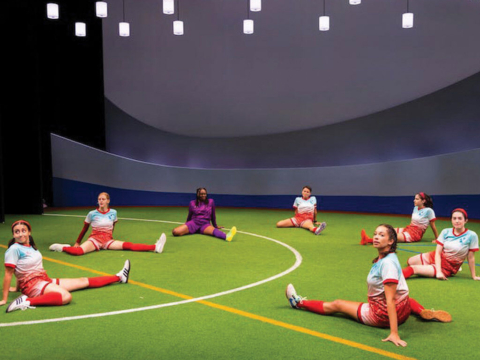
Far from being static or text-ridden, the young women address their panoply of subjects while conducting myriad stretching exercises, ball-handling drills, flexibility training, and any activity imaginable to prepare for a game, all of which loom large and are pronounced critical by the Wolves teammates.
Rasmussen abhors a void, and she keeps “The Wolves” and its universally superb cast in constant motion and a state of high energy, even when they are taking an alleged rest or birddogging it.
Amid the dribbles, passes, and limb extensions, the girls, age 15 to 17, tease each other, taunt each other, offer personal information behind a teammate’s back, jealously watch if a college recruiter attends to some Wolves instead of them all, and indulge in a range of social interactions and behaviors that turn them into a microcosm of young people.
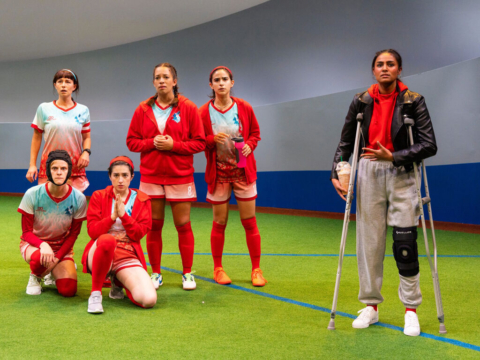
DeLappe sometimes deigns to have a character be called by her name. Mostly the Wolves players are identified impersonally by their jersey numbers. At first, this renders them as amorphous members of a unit, cogs in a team, but as “The Wolves” develops, differences in personality, experience, and outlook emerge so that several of the girls are defined with some depth by the play’s solemn ending. That ending provides “The Wolves” its one prolonged scene and introduces the lone non-player, a “Soccer Mom” who comes to visit with a hardly articulated but poignant message for the teammates, as well as a bag of fresh orange wedges that tie back to an earlier scene in DeLappe’s play.
Any sign of an individual trait, whether it’s the goalie’s habit of vomiting before games or Number 13’s penchant for mimicking people via sarcastic riffs, becomes exaggeratedly important because it blessedly breaks the play and production’s seeming efforts to keep the Wolves a group rather than offering a reason to have empathy, sympathy, or even interest in one teammate or another.
One waits eagerly, and hopefully, to get past the ocean of early conversation that gets jumbled in its speed and volume to find out something specific or significant about a particular girl.
Clues to personal style of philosophy are there from the beginning. But it takes patience for “The Wolves” to evolve from sporadic telling moments to a work that makes it clear that within every organized group or family there is an appearance of unity that hides the separate nature of each group or family’s members.
I sat admiring “The Wolves” and Rasmussen’s direction of it while being a little miffed that nothing of major consequence or concern was happening beyond paying attention to the players’ chatter and display of physical prowess. Number 13 (the versatile Annie Fox) was a salvation because at least she acted out and broke a kind of tonal monotony. Number 46 (Maria Habeeb) and Number 2 (Katie Griffith) also helped, as one revealed an interesting background and the other stood out from the pack via her opinions and relative bashfulness.
I became happier with the play when I realized incidental revelation and a gradual appreciation of the individuals was part of DeLappe’s point. By the time the lights faded on “The Wolves” and the production, I was a fan.
Still I worry about DeLappe’s tendency to withhold. In the prolonged final scene that probably consumes 20 of “The Wolves’” 90 minutes, I kept waiting to hear the specific circumstances about a situation that upsets the teammates and is obviously sad.
We never really learn all we might want to know about this situation. We hear enough to be satisfied, though it takes half the scene to glean enough information to relax without having nagging questions about why exactly the girls are so glum and out of spirits.
Acting and Rasmussen’s knack for always providing something visual or physical to command one’s attention saves the day until the overall theme of “The Wolves” comes through.
Annie Fox, whose character displays the naughtiness and wit among the Wolves, makes up for a lot of dryness at the top of the show. The glee with which Number 13 makes fun of what her teammates say and the collection of voices, moues, and overdone expression make the character’s mockery of all things serious or allegedly respectable a delight. Fox makes Number 13 the person who’s wanted in any crowd to provide comic relief and a sense of “Oh, brother!” perspective.
Maria Habeeb quietly asserts the wealth of experience Number 46 has in contrast with teammates that follow international news but have only been past their town’s borders to compete in soccer games. Habeeb giver her character a quiet coolness that acknowledges the teammates may be misinformed or naïve but takes it all in her stride, buoyed by the confidence that she does know something about the world.
Mikey Fox makes the most of her character’s leadership role and shows a lot of the team captain’s personality in late scenes. Jasmine Sharma earns attention as the “Rizzo” of the Wolves, the teammate who takes the most active interest in boys and romantic pursuits. Renae S. Brown’s timing and motion are perfect as she plays the goalie who gets sick when faced with tension. Katie Griffith supplies a needed and welcome change of pace. Her Number 2 comes from a stricter, tighter family than most of the others. Griffith makes her likeable and a little naïve despite Number 2’s insight when news and world policy is being discussed.
Katharine Powell provides a wonderful burst of dramatic energy as the Mom who becomes tongue-tied while thanking the Wolves for their support in a situation that affects all on stage. Isabel Pask and Maggie Thompson do well as two of the more reasonable members of the Wolves. Owen Laheen’s character often initiates the headiest of conversations but tends to bow out once a discussion is underway.
Junghyun Georgia Lee’s half-moon of a soccer pitch is not only colorful and cheerful, but it sets the perfect background as the team’s practices and discussions take place. Raquel Adorno’s costumes are perfect for the characters donning them. Jackie Fox’s lighting is excellent, as is Porchanok Kanchanabanca’s sound design that enhances Rasmussen’s concept for the show.
The Wolves, McCarter Theater, 90 University Place, Princeton. Through Sunday, October 16, Tuesday through Thursday, 7:30 p.m.; Friday and Saturday, 8 p.m.; and Saturday and Sunday, 2 p.m. $25 to $60. 609-258-2787 or www.mccartertheatre.org.