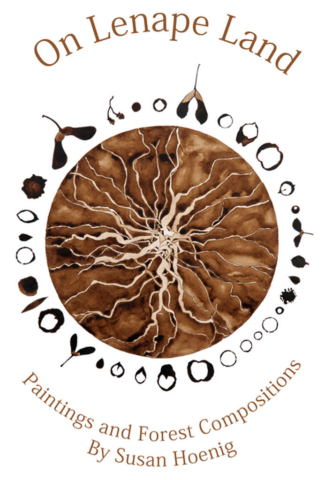
“On Lenape Land,” a collection of paintings and “forest compositions,” opens on Sunday, October 1, at the Tulpehaking Nature Center, located at the entrance of the Abbott Marshlands in Hamilton Township.
The works by Griggstown-based artist Susan Hoenig pay homage to the Lenape people who, she says in a statement, “lived in harmony with the land for thousands of years.”
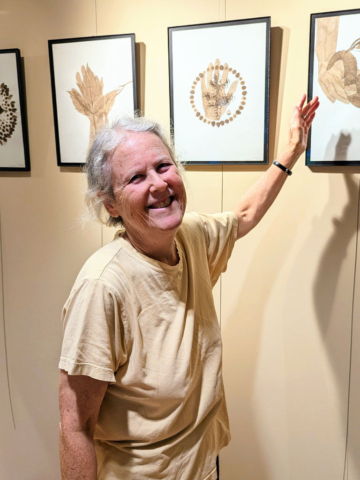
During a recent discussion at the Mercer County-owned and maintained nature center, Hoenig says the marshlands have special significance to her and her personal interests.
One connection is with abstract art and how it allowed her to discern and learn from the patterns in nature.
The other is an interest in displacement of people, drawing a link between the experiences of the Lenape during the Colonial era and that of her own family in Europe during the Nazi occupation.
The exhibition is well situated. The nature center — which uses the Lenape name for the Land of the Turtle — has a rich connection to the Lenape or “original people.”
It also is the gateway to the Abbott Farm National Historic Landmark district.
It’s named for late 19th and early 20th century Trenton archaeologist Charles Abbott, who first recognized the importance of Native Americans in the marshlands.
According to New Jersey State Museum archaeologist and curator Gregory Lattanzi, the region is significant because it “is probably the only site that had continuous native presence from about 10,000 to 11,000 years ago to contact period [when Europeans first arrived in North America].”
The reason was that the area along the Delaware River provided people with fish and plants to consume, highlands to build settlements, and other resources, like clay-like soil to create pottery.
The marshlands had been the site of several significant archaeological studies, including a series in the early 20th century led by New Jersey State Museum archaeologist Dorothy Cross, who wrote extensively about the site and collected artifacts on permanent exhibit at the State Museum — about a 15-minute drive from the site.
Hoenig, who is known for her leaf-inspired sculptures placed in wooded areas, says she first became of the marshlands when she signed for Friends for the Abbott Marshlands walks led by the group’s founders Charlie and Mary (Allessio) Leck to observe avian and plant life.
In a statement, Hoenig says, “In the spring of 2021, Mary Leck, botanist and emeritus professor at Rider University, invited me to accompany her with naturalists and conservationists to walk the trails along the Bordentown Bluffs edge, 60 feet above Crosswicks Creek.
“Since then, I have filled sketchbooks and created paintings. I am now interested in the geology of the bluffs, the exposure of the marshlands’ sediment of clay, silt, sand, and pebbles, and other streambed features. I have a passion for the lives of trees and feel a great spiritual connection in acknowledging the land of the Lenape and its history.”
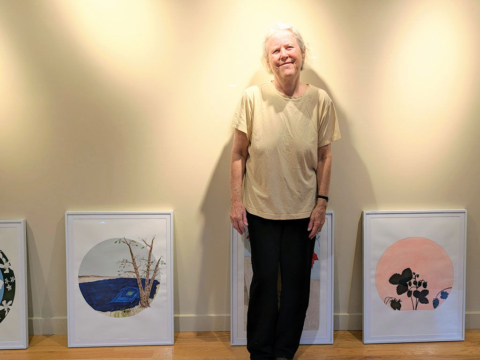
It was the previously mentioned Mary Leck who connected Hoenig to the nature center’s gallery, where 39 of the works begun in 2021 make up the show.
Sharing some thoughts on her work, she references a forest composition rendered in homemade Black Walnut ink.
Taking it from the wall, she shows how acorn caps, nuts, and seeds dipped in the ink were used “to print their unique forms.”
Another is “Coiled,” a work that references the Lenape creation of pottery adorned with abstract design, which one archaeologist called the most beautiful east of the Mississippi River. The work was also created with Black Walnut ink.
Hoenig’s love for both the natural world and art go back to her childhood in the Cambridge area of Massachusetts.
The daughter of two Holocaust survivors, she was raised by an MIT physics researcher father and ceramic artist and teacher mother.
Hoenig studied art at Bennington College in Vermont and earned her master of fine arts at the University of Iowa.
As reported in a past U.S. 1 interview, “In the course of her studies, (Hoenig) learned about the Italian American architect Paolo Soleri, who is known for creating artwork and objects using natural materials. She was especially intrigued with his process of creating living spaces by digging out huge forms from the earth, then pouring in homemade concrete, and when dry, inverting the forms.
“In the summer of 1979, Hoenig traveled to Arizona to work at the Soleri-inspired Arcosanti, an experimental town in the desert mesa. Influenced by her experience there, Hoenig began moving much of her artistic work from framed wall art to real spaces, such as the trails where her leaf sculptures can be found today.”
About her artistic development, Hoenig notes, “While spending a summer in Oaxaca, Mexico, in 1980, I walked up into the hills each day, watching women on their burros collecting firewood, taking the same pathways up into the mountains. In a valley, I created stone lines, little borders, somewhat similar to the lines around their homes, to echo the landscape. ‘Stone Crossing’ was my first large-scale earthwork.”
She adds that she moved back to Cambridge, Massachusetts, in 1981 and “began working on ‘Urban Earthworks’. I was commissioned to create ‘Stone Circles’ by a Design Guild in 1982 and ‘Spring Earthwork’ at the Brockton Museum. After a move to New Jersey in 1983, I received a New Jersey State Council on the Arts Sculpture Fellowship to create ‘Earth Energy Lines,’ stone lines to re-emphasize and link a network of old stonewalls. In 1986, I was sponsored by Artists-in-the-Gardens, Operation Greenthumb, in New York City to create “Tree Trunk Garden Path”. I worked with the Bushwick neighborhood to make a tree trunk garden path made of brick from demolished buildings.”
Since the project was visible from the elevated section of the city subway system, it attracted the attention of a neighborhood photographer who included it in his 2020 photo essay, “On Being a Black Photographer,” shown on CBS This Morning.
Hoenig says in 2006 she began working with Sourland Mountains biologist and bird bander Hannah Suthers and experienced first-hand the life cycle of birds and the conditions and habitat in which they live. “This has led to my Songbird and Biodiversity Paintings where I explore the symbiotic relationships of avian and plant life,” she says.
“In the summer of 2020, I was artist-in-residence at Mountain Lakes Nature Preserve, Princeton, New Jersey. I collaborated with Friends of Princeton Open Space to draw attention to the value and beauty of native trees. I created an ‘American Chestnut Leaf Sculpture’ adjacent to the newly planted chestnut saplings. A documentary was made of this project and I was asked to write an article for the Spring 2021 issue of Chestnut, The journal of the American Chestnut Foundation.”
While not Native American or of the Lenape people, Hoenig says, “My paintings result in a deeper understanding and respect of the Lenape culture, which reinforces and contributes to the cultural heritage.”
She was also surprised “how varied and diverse the people were over time and how life on the land could have changed and shifted.”
‘On Lenape Land,’ Tulpehaking Nature Center, 157 Westcott Avenue, Hamilton, opening with a free and open reception, Sunday, October 1, 2:30 to 4:30 p.m., and on view through December 31, Wednesday through Saturday, 10 a.m. to 4 p.m. Free.
Hoenig presents two Rhythms of the Land art workshops, one for youths on Saturday, October 21, from 10 a.m. to noon, and an adult session, Monday, December 11, 10 a.m. to noon. Workshops are free, but registration is required. 609-888-3218 or vwww.abbottmarshlands.org.