
Nearly 200 years ago, horse owners and racing enthusiasts traveled hundreds of miles to Trenton, where they gathered at the Eagle Tavern for food, drinks and a place to spend the night.
The horses were stabled behind the building, while their owners mingled with travelers, politicians and local residents inside a tavern that had become one of the city’s most popular gathering places.
Today, the horses and crowds are long gone, and for more than three decades, the tavern itself has stood empty, a reminder of a time when South Broad Street was a center of commercial and social activity.
Now, the building is preparing to welcome customers again.
The city of Trenton and Mercer County are moving forward with a major restoration of the mid-18th-century building at South Broad and Ferry streets, with plans to reopen it as a restaurant and tavern in spring 2027.
The project, supported by a $3.5 million grant from the state Economic Development Authority and additional city and county funding, is intended to return the building to its former role as a gathering place while contributing to the revitalization of the South Broad Street corridor.
Construction is expected to be substantially completed during the first quarter of 2027. The city and county plan to jointly seek proposals from qualified restaurant and hospitality operators to run the establishment once renovations are completed.
The restoration is the latest in a series of attempts to revive the Eagle Tavern, which has twice been named one of New Jersey’s most endangered historic properties. This time, the effort comes with substantial public investment and a new opportunity created by the arrival of the Trenton Ironhawks hockey team at CURE Insurance Arena, directly across the street.
The project also offers an opportunity to preserve a building that has witnessed much of Trenton’s development, from its beginnings as a colonial settlement to its growth as an industrial center.
The Eagle Tavern is believed to be the oldest surviving commercial structure in Trenton, although its history began several decades before it became a tavern.
The building’s precise construction date remains uncertain. The city’s 2001 Historic Preservation Plan dates it to approximately 1760, while other historical research traces its origins to Philadelphia merchant Robert Waln, who purchased property at the intersection of Queen and Ferry streets in 1765.
Waln was a member of a prominent Quaker family with extensive business interests in the region. That same year, he acquired the nearby Trenton Mills along Assunpink Creek, one of the area’s important early industrial operations.
The mills had previously been part of the larger estate associated with the William Trent House. Waln’s acquisition separated the mills from the main residence, leaving him with a substantial business operation in Trenton but no suitable home for his family when visiting the city.
He is believed to have constructed a brick dwelling at Queen and Ferry streets shortly after purchasing the property. The original structure occupied four of the seven bays that make up the present building, with the remaining three added during the early 19th century.
The property’s location was particularly advantageous. It stood along a route connecting the mills on Assunpink Creek with the Delaware River ferry, near one of the principal transportation and commercial corridors in colonial Trenton.
During the American Revolution, the building stood near the scene of military activity associated with the Battles of Trenton.
Maps prepared by Hessian officers in December 1776 show a building at the intersection of Queen and Ferry streets. One contains an annotation that researchers believe may indicate the house was used by British and Hessian officers during their retreat toward Burlington following George Washington’s victory in the first Battle of Trenton.
The building’s precise role during the Revolution remains uncertain. Historical accounts have included stories that Washington visited the property, but researchers have found no documentation confirming those visits.
The property remained in the Waln family for more than four decades. Following Robert Waln’s death in 1784, it passed to his daughter, Hannah, who later married Gideon Wells, a businessman associated with the Trenton Mills.
Financial difficulties eventually contributed to the property’s sale in 1811, setting the stage for its conversion into a commercial establishment.
Although the building is sometimes described as a tavern dating to the colonial era, historical research indicates it originally served as a private residence. The earliest documented evidence suggesting tavern operations at the site dates to 1817, when George Douglass applied for a license to sell alcoholic beverages.
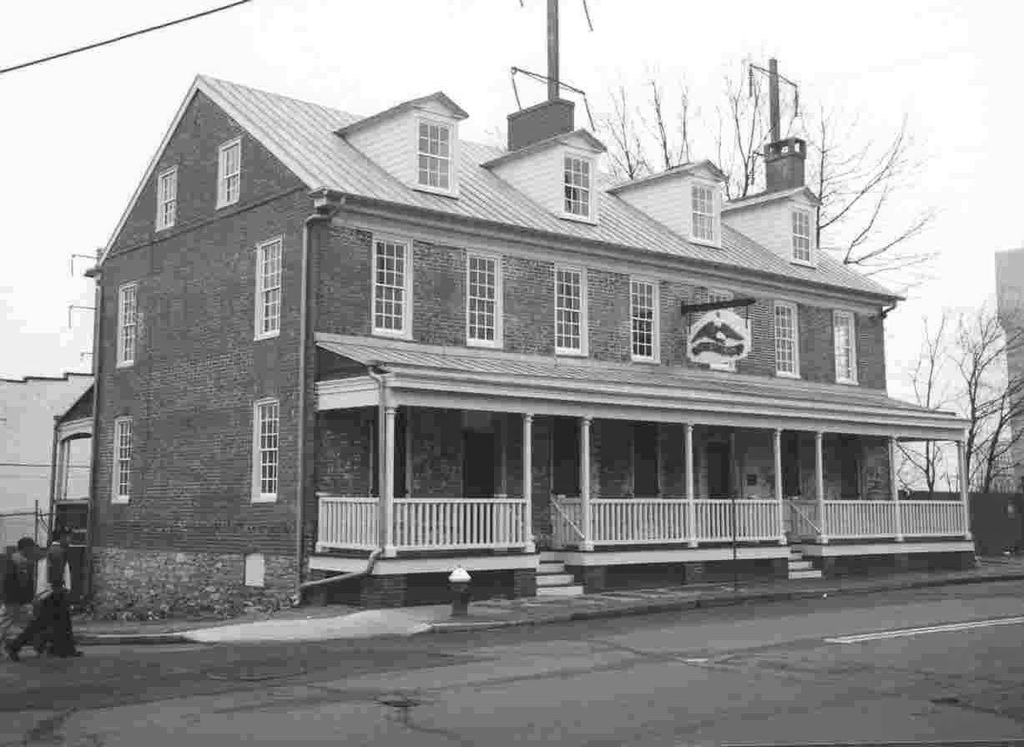
The establishment became known as the Eagle Tavern, and later the Eagle Hotel, serving travelers moving between New York and Philadelphia as well as residents of the growing city.
Its fortunes improved during the 1820s and 1830s with the popularity of horse racing.
The Eagle Race Course, one of a relatively small number of major racing facilities in the region, occupied about 100 acres east of the tavern near what is now the intersection of South Clinton Avenue and Hudson Street in Chambersburg.
The track attracted horse owners, trainers and racing enthusiasts from throughout the eastern United States. Some spent summers in the Trenton area attending races, providing a steady source of business for the tavern.
The increased activity is believed to have contributed to the expansion of the building during the 1820s or 1830s.
The enlarged structure took on the seven-bay configuration that survives today. The two-and-a-half-story building features a brick exterior, dormer windows, multiple chimneys and porches along the front and rear. The city’s 2001 preservation plan describes it as an example of vernacular Federal-style architecture.
The tavern’s success coincided with broader changes in Trenton. During the 1830s and 1840s, new transportation connections and industrial businesses brought workers and investment to the city.
In 1839, property owner Elijah Brown conveyed land immediately north of the tavern for a railroad right of way, helping establish a direct rail connection between New York and Philadelphia through Trenton.
Industrialist Peter Cooper established iron rolling mills and wire mills in south Trenton during the 1840s, bringing additional workers to the neighborhood. The tavern served local residents and likely provided meals for teamsters hauling coal to the ironworks.
As the city grew, the tavern became more than a place to eat, drink or spend the night. It was an important center of political and social activity, particularly for Trenton’s South Ward.
Political meetings and election activities were held there, and the establishment served as a polling place for primary elections. Historical accounts also describe gambling at the tavern during the mid-19th century.
During the Civil War, the Eagle Hotel was the site of a political rally supporting Democratic presidential nominee George B. McClellan, who challenged President Abraham Lincoln in the 1864 election.
The establishment also served as a meeting place for members of the Masons, adding to its role as a center of neighborhood and civic life.
Its association with horse racing continued even after the Eagle Race Course closed around 1850. During the 1850s, horse trainer William H. Doble managed the hotel and undertook improvements to the building.
By then, however, the tavern’s business was changing. The closure of the racetrack eliminated an important source of customers, and the surrounding neighborhood was becoming increasingly residential and industrial.
The property changed ownership several times during the second half of the 19th century. By the end of the century, its original role as a tavern and hotel had largely come to an end.
The building subsequently served as a rooming house and later was converted into apartments. Its condition gradually deteriorated as the structure aged and the surrounding neighborhood changed.
History beneath the ground
The Eagle Tavern’s historical significance extends beyond the building itself.
Archaeological investigations conducted on the property between 1976 and 1981 uncovered thousands of artifacts associated with its early residential and commercial uses, along with evidence of a pottery operation that predated Trenton’s emergence as a major industrial pottery center.
The excavations involved members of the Trenton Historical Society, students and faculty from Mercer County Community College and Rider College, and other local participants.
Although much of the documentation from the original excavations was lost, the recovered materials remained available for study.
In 2005, Hunter Research prepared a detailed historical and archaeological analysis for the Trenton Historical Society and the New Jersey Historical Commission. The study examined the building’s history and cataloged 4,087 artifacts recovered during the earlier investigations.
Among the discoveries were fragments of wine and liquor bottles, ceramic tableware, clay pipes, buttons, glass beads, a toothbrush, a clay marble and a copper coin dating to 1723.
The artifacts provided clues about daily life at the property during its years as a private residence and later as a tavern, although researchers cautioned that many could not be conclusively assigned to one period or the other.
One of the most significant discoveries involved the remains of an 18th-century stoneware pottery operated by James Rhodes, who purchased property adjoining the Eagle Tavern site in 1778.
Rhodes established a pottery that operated until his death in 1784. Archaeologists recovered kiln debris, fragments of pottery vessels and other materials associated with the manufacturing process.
Nearly half of the cataloged artifacts were linked to the pottery rather than the tavern.
Researchers also identified similarities between materials found at the Eagle Tavern and those recovered from another early pottery operation along the Delaware River in Lamberton. The evidence helped connect Rhodes to both locations and provided additional information about Trenton’s early manufacturing history.
Possible remains of a pottery kiln were identified near the rear of the property, suggesting that additional archaeological resources may still be present.
The findings added another dimension to the site’s significance. Beyond its architectural importance and association with Trenton’s political and commercial development, the property contains evidence of some of the city’s earliest manufacturing activity.
A long road to restoration
By the middle of the 20th century, the Eagle Tavern’s future had become uncertain.
The city purchased the property in 1965, beginning a series of preservation efforts that would continue for decades.
The building was added to the New Jersey Register of Historic Places in January 1972 and the National Register of Historic Places on Nov. 3 of that year, recognizing its architectural, commercial and political significance.
It later became a contributing property within the Trenton Ferry Historic District, which was added to the National Register in 2013.
The city leased the building to the Trenton Historical Society in the 1970s, and restoration efforts continued as preservation advocates sought to find a suitable use for the property.
The tavern reopened as a restaurant in 1980, and renovations during that decade included installation of a commercial kitchen on the lower level and a bar on the first floor. But attempts to establish a successful operation proved unsuccessful, and by the early 1990s, the building was vacant again.
Preservation New Jersey included the Eagle Tavern on its list of the state’s 10 Most Endangered Historic Places in 1995, drawing attention to the building’s deteriorating condition and the difficulties of finding a sustainable use.
The Eagle Tavern’s importance to the city’s preservation efforts was reflected in Trenton’s Historic Preservation Plan, adopted in March 2001. The building was featured on the cover of the document and identified as an individually designated historic landmark.
The plan also reflected the city’s broader concern about the surrounding corridor. It recommended conservation-district protection for a stretch of South Broad Street between Dye and Liberty streets, underscoring the longstanding importance of preserving the area’s historic commercial buildings.
The city undertook another restoration in the early 2000s, repairing the roof, windows, chimneys and brickwork and making accessibility improvements. The work helped stabilize the building and preserve its exterior, but substantial interior renovations were still needed before it could reopen.
In May 2022, Trenton issued a request for proposals seeking a developer or redevelopment team to rehabilitate the property. The city expressed a preference for returning the building to use as a tavern or brewpub, although other commercial uses were also considered.
The solicitation called for a developer capable of leasing, designing, permitting and carrying out the restoration while preserving the building’s historic character. Potential financial incentives included state historic preservation tax credits and funding through economic development programs.
Despite those efforts, the property remained vacant.
In June 2023, Preservation New Jersey again named the Eagle Tavern to its list of the state’s 10 Most Endangered Historic Places, citing its historical significance, deteriorating condition and the continued need for a viable use.
A more substantial opportunity emerged in June 2025, when Trenton received $7 million through the NJEDA’s Urban Investment Fund Grant Program.
Half of the funding, $3.5 million, was designated for the Eagle Tavern. The remaining $3.5 million was allocated to the rehabilitation of the historic Roebling Machine Shop, another landmark along South Broad Street.
The Roebling project is intended to transform the former industrial building into a large event space, creating another attraction in a corridor that officials hope will become a center of commercial and entertainment activity.
The New Jersey Historic Trust also listed a $750,000 preservation grant award for the Eagle Tavern in 2025, with the Mercer County Improvement Authority named as the recipient.
The funding is intended to support exterior rehabilitation, heating and cooling system replacement, and accessibility improvements.
The city partnered with Mercer County and the Mercer County Improvement Authority to move the project forward.
The latest rehabilitation includes structural improvements, preservation of historic architectural features, restoration of original windows and woodwork, accessibility upgrades and installation of modern building systems and a commercial kitchen.
The work is being overseen by the Mercer County Improvement Authority under the leadership of Executive Director Anthony Verrelli.
Earlier this year, Mayor Reed Gusciora joined Mercer County Executive Dan Benson, Verrelli and Construction Trades Council President Wayne DeAngelo to announce a project labor agreement supporting union construction jobs during the rehabilitation.
Major structural repairs have been completed, historic windows are being reinstalled, and restoration of the building’s interior and exterior continues.
Benson said the project offers an opportunity to preserve an important part of Trenton’s history while supporting new business activity.
“The Eagle Tavern represents the kind of investment that brings together historic preservation and economic opportunity,” Benson said. “Mercer County is proud to partner with the City of Trenton and the NJ EDA to restore this important landmark and help create a destination that will benefit residents, visitors, and local businesses.”
The building’s location directly across from CURE Insurance Arena is an important part of its potential.
The arrival of the Trenton Ironhawks for the 2026-27 hockey season has brought another regular attraction to the arena, which also hosts concerts and other entertainment events.
City officials hope the tavern will provide a place for visitors to gather before and after events, encouraging them to spend more time in Trenton and support surrounding businesses.
“For more than 30 years, the Eagle Tavern has stood empty while thousands of people passed by on their way to events at the arena,” Gusciora said. “We’re changing that. With the arrival of the Trenton Iron Hawks, we have a tremendous opportunity to keep fans and visitors in Trenton before and after the games.”
The mayor said the goal is to make the South Broad Street corridor a destination rather than simply a place visitors pass through on their way to the arena.
“We want people coming downtown not just for two hours of hockey or a concert, but for an entire evening of dining, entertainment, and enjoying our Capital City. Bringing the Eagle Tavern back to life is an important part of that vision.”
The building’s return to commercial use would also restore a connection to its historic role in the surrounding neighborhood.
During the 19th century, the Eagle Tavern benefited from crowds drawn to nearby horse races and industrial businesses. Today, the arena and other entertainment venues could provide a new source of customers.
The restoration also comes as Trenton commemorates America’s 250th anniversary, adding significance to efforts to preserve one of the city’s few surviving buildings from the colonial era.
“As we celebrate America’s 250th anniversary, we should remember that Trenton’s history isn’t confined to museums or monuments,” Gusciora said. “It’s in the buildings and neighborhoods that have shaped our city for generations. The Eagle Tavern gives us an opportunity to preserve that history while making it part of Trenton’s future. And what better way to celebrate that history than by raising a glass in a tavern that dates back to colonial America?”
Although the building’s restoration is moving forward, several steps remain before customers can return.
Construction is expected to be substantially completed during the first quarter of 2027, with the city targeting a spring reopening. That schedule remains dependent on completion of the renovations and selection of a restaurant operator.
The city and county expect to announce additional details about the process for selecting an operator as the restoration approaches completion.
Five keywords: Eagle Tavern, Trenton historic preservation, South Broad Street, Mercer County Improvement Authority, Trenton Ironhawks
One fact-checking point remains: The city’s 2001 preservation plan dates the building to about 1760, while the historical account places Waln’s purchase in 1765. I have presented both dates with appropriate qualifications rather than declaring either the definitive construction date.
