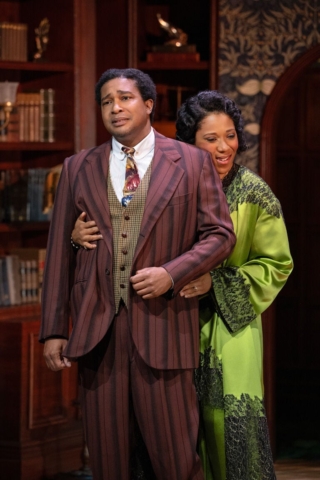
As played at Princeton’s McCarter Theatre, Heidi Armbruster’s play, “Mrs. Christie,” is more of a puzzle than a mystery.
A head-scratching kaleidoscopic puzzle that gamely juggles time, eras, fantasy, reality, the known, the suspected, and the rumored but never weaves them into coherent or satisfying focus.
Neither does a collection of brash character traits that mistake dudgeon for passion. Nor Armbruster’s admirable but unsuccessful attempt to dissect the popular detective novel by examining the literary elements and archetypical figures that govern it.
“Mrs. Christie” should be more fun. Armbruster has a nimble and sophisticated wit and can craft comic one-liners, but Donya A. Washington’s production doesn’t relax enough to let characters fully establish themselves or give their cleverest repartee space to land.
Its pitch is too high. It never stops for modulation or definition. It throws ideas and dialogue at you instead of presenting them in way that grabs and engages. A lot is going on, much of it interesting in retrospect, but frustrating and exhausting in performance. I spent much of opening night looking for clues to what exactly Armbruster was trying to do with her piece while never finding the connecting thread that would bind “Mrs. Christie” together and make dramatic sense of what seemed to be a lot of raw potential.
“Mrs. Christie” never settled. It flitted between several plot lines, themes, moods, and performance styles. Though having a Pantheon mystery writer, Agatha Christie, at its center, the play was stronger when a fictional character dominated a scene, be that character an avid Christie fan Armbruster invented to competitively investigate a never-explained episode from Agatha Christie’s life, her 10-day disappearance in 1926, or the two quirky detectives Christie invented, Jane Marple and Hercule Poirot.
“Mrs. Christie” uses one setting, Greenway House, Agatha Christie’s country home in Devon, to house two connecting stories, both of which sprout a series of tendrils that provide context but add more confusion than light.
The first story is one that preoccupies many, where Agatha Christie went and what she did for 10 days in December 1926 when her whereabouts and activities were and remain unaccounted for.
Armbruster posits that a marital infidelity, unhidden from the world at large, caused Christie to flee from Greenway to seek solace, collect her thoughts, or do something more drastic. We see Christie realizing her husband had brought his mistress to their house and hear the husband threatening to sue Christie for divorce, at the time a scandal on a par if not beyond a spouse’s roving.
Violence and attempted murder are part of this angle. We know how obsessed Christie is with Nancy, the woman with whom her husband is intimate. We see her on two occasions have dreams in which she calls out Nancy’s surname, Neele, in a long, involuntary litany. We know that Christie resents Neele for being considerably younger than she and of the same social circle.
Arguments, and even rational discussions take place between Christie and her husband, Archie who is clear he prefers Nancy to his wife.
One mystery leads to another. Did Agatha attempt to kill Neele the earlier in the evening that she vanished?
This and other matters are rehashed in the second plot line, in mystery terms, the one that distracts us from the main story and casts doubt on what we believe is the truth.
In this story, speculation is replaced by imagination.
Enter, Lucy, the ultimate Agatha Christie fan. She’s read every novel and short story Christie ever wrote. She knows the plays, too, and of course all lore, true of not, about Christie’s life.
Lucy is particularly fascinated by Christie’s disappearance. She studies it, not like a scholar but like a fan, a newsy one who is not content unless she knows an entire story and, if possible, knows it first.
In “Mrs. Christie,” new evidence, including the discovery of a missing volume from Christie’s journal, has emerged. Lucy is willing to compete with a bona fide, university-degreed Christie expert, to find out more.
Lucy has, for the most part, become a detective. Watching her, we not only see commitment but the better part of Armbruster’s wit and work. Having thought of Lucy, she can give her diametric character traits. When we meet her, she is part of an elite band of Christie fans participating in a themed-weekend, including and invented mystery, at Greenway. She has wandered into the rooms of the house off limits to guests and is kleptomaniacally helping herself to souvenirs meant to stay on display at Greenway.
Lucy will prove to be smarter and more competent than she first seems. She both represents what it’s like to pursue clues in a mystery and a spoof of detectives. It is she who seems to summon Christie’s own creations, Miss Marple and Monsieur Poirot.
From all Armbruster included, “Mrs. Christie” seems interesting and loaded with leads to follow and characters to care about and root for.
On the surface, yes. Armbruster on to something. She has us thinking. She’s just not helping come to conclusions and have some concrete resolution about why she chose to write “Mrs. Christie.”
An uneven cast and Washington’s sprawling, uninviting production does not help. It overdoes what is intrinsically exaggerated. Washington seems to call for neurotic performances instead of what might be more effective, some British reserve and everyone being cold and calculated in their actions.
Patrese D. McClain, as Lucy, Evan Zes as a silly but charming Poirot, and Gina Daniels as Jane (Marple), surmount all obstacles by giving their characters traits; in Daniels’s case, a calm approach to anything, even the outlandish, that save them from Washington’s penchant for excess.
Polly Lee may give the most amazing performance. She vies for being the best in the cast even though her character often breaks the usual image of the unflappable British secretary or Shavian assistant by being temperamental and indulging in fits of shouting.
Christiana Clark starts “Mrs. Christie” off badly as a distraught, distracted Agatha who comes on stage announcing the death of someone named Peter in a lawnside traffic accident and bemoaning so much of her life.
Clark begins so high on the scale of irrational reaction to situations that, at least at the top of a need need more finesse, there’s no place for her to go as Agatha gets more enmeshed in resenting her husband’s lack of affection and preference of Nancy Neele.
Clark’s opening scene obliterates any empathy or feeling of any kind we might develop for Agatha. She demonstrates from her first line why no man, or anyone, would want to stay with her.
Armbruster might be leading to a growing paranoia and instability. She may be aiming for Agatha to be in mid-breakdown before she is motivated to flee and hide without explanation, Clark’s effect, as directed by Washington, who has almost every character on the edge of his or her patience, nullifies Christie as a heroine or even anti-heroine. She’s just too horrid to like, too unreal to care about.
Even if her tantrums and strong expression of hurt, betrayal, and spite lead to a personal understanding and allow her to move on to become a greater writer and famous grande dame, you don’t see seeds of that in most of what Clark does as Agatha.
Frankly, I blame Washington. It’s obvious Clark can act with range. She’s following direction that sabotages her. I think that because Polly Lee, Cameron Knight, and Amber Walker perform in the same dudgeon Clark does, but they overcome that burden.
Polly Lee does so by being flat-out entertaining. Her breaking of employee’s decorum by losing her characters’ temper and yelling, is compensated for by how much we enjoy watching her rolling-eyed, surly reactions and knack for wry superiority, whether playing Christie’s lady-in-waiting, a disciplining official at Greenway in 2026, when it’s a museum and tourist site, or hilarious hotel chambermaid.
Gina Daniels is the example of how Armbruster’s characters should be played.
Daniels can be comic and show with while being perfectly clear and pert in the role, which is that of a wise older woman who helps Lucy cope with piecing together a scenario to explain Christie’s disappearance. All comes clearer when we realize the character is a prototype of Miss Marple. Even then, the wish is that more of the acting could have been in Daniels’s tone.
Patrese D. McClain is funny and earns your support as Lucy.
McClain is the only one on Washington’s stage whose character grows. As she is filching Christie’s silver in her first scene, her Lucy seems ditzy and one who just can’t or won’t follow rules.
As “Mrs, Christie” evolves (as much as it’s allowed to evolve), McClain shows Lucy’s intelligence and sincerity.
While remaining funny.
Evan Zes is a comic delight in every way as Poirot. He seems lighter than air while being debonair and oh so endowed with those “little gray cells.”
Cameron Knight is solid enough to get past some of the cartoonish parts of Archie, Agatha’s husband, that Washington seems to demand. He makes Archie’s case so well, you take his part instead of Agatha’s.
Amber Walker brings out Nancy’s oxymoronic shame and sense of belonging as Nancy. Speaking of Shavian, Jeremy Gallardo acts in the style of the master as Christie’s obsequious publisher and Lucy’s devilish rival for gathering information about Christie’s disappearance.
Whether or not it’s derived from Greenway, Lex Liang’s set is lovely with excellent touches in wallpaper selection and some Tiffany-esque stained glass at the top border of the stage.
Liang also has fun with the 1920s costumes, especially the one Lucy wears at a 2026 simulation of 1926. Amina Alexander’s lighting accents many of the moods characters express. T. Carlis Robert’s music captures the periods it’s meant to evoke.
“Mrs. Christie” runs through May 31 at the Berlind Theatre at McCarter Theatre, 91 University Place, in Princeton. Showtimes are 7:30 p.m. Wednesday through Saturday, and 2 p.m. Saturday, Sunday, and Thursday, May 14. Tickets range from $76 to $36 and can be obtained by visiting www.mccarter.org or calling 609-258-2787.