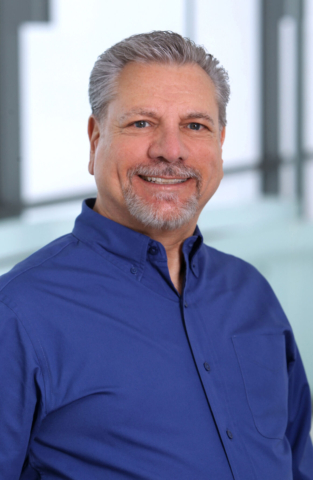
“Taking on a role, no matter how big or small, gives you an opportunity to really crawl inside the skin of someone else, which builds empathy,” says Steve Runk as he prepares to perform in the New Hope Repertory production of American playwright Thornton Wilder’s “Our Town,” running July 14 through 17 at New Hope-Solebury High School.
Runk, who has been rehearsing for the past several weeks to play the role of Grovers Corners newspaper editor Charles Webb, is no usual actor.
His day job is as director of communications at Princeton University’s Lewis Center for the Arts, where he connects the tri-state region to the center’s programs in creative writing, dance, theater, music, visual arts — not to mention its approximately 120 events per year.
Prior to this he was at the New Jersey State Council on the Arts for 20 years, including three years as executive director (where I first met him), and an earlier career developing arts programs for Rutgers-Camden and marketing a southern New Jersey-based architectural firm.
Yet, in addition to this background of working with high-profile arts organizations that attract world-class and national artists and prominent attention, Runk is devoted to working in community theater.
To learn more about this personal pursuit and allure of the small stage, I contacted Runk and set up an ill-fated interview — with “ill” being the operative word.
Both of us had a problem and needed to cancel an in-person discussion. Since one of us was having trouble talking, we decided to stay on deadline by conducting the interview via email — something I generally stay away from unless I have met the subject.
When I received Runk’s thorough and thoughtful replies, I realized I could edit our interview in a manner that could allow the printed page be transformed into a virtual stage and simply let the arts administrator and actor have the following one-person show:
(Lights up. Steve Runk enters, bows, and begins:)
I was raised in Langhorne, Pennsylvania. My dad worked in construction and my mom was a secretary.
(After) Neshaminy High School, class of 1980, I went to Villanova University, class of 1985, where I double majored with a BFA in visual arts and BA in communications, magna cum laude. I started on a master’s in English at Rutgers with concentration in creative writing.
I always liked to draw and paint and was also a pretty good writer and took piano lessons, so I pursued all of these growing up and in high school. In high school I also discovered theater and was active in theater through college and then for a short time after. In college I wanted to try dance and was a member of my college’s dance group for four years and two more after graduating.
My dad could draw well and played piano by year and sing well. His parents (my grandparents) had a country western act in Altoona, Pennsylvania, and were paid to advertise movies coming to town by dressing up as the stars and driving a horse-drawn wagon around town. My dad and his siblings sometimes joined them. My grandfather was also a talent manager and booked floor shows, all that on the side while working for Pennsylvania Railroad.
I returned to theater after a long hiatus in 2013 — I had not done any theater for 25 years at that point but really wanted to get back to it. I was turning 50 and figured if I wanted to get back to theater, I should do it while I could.
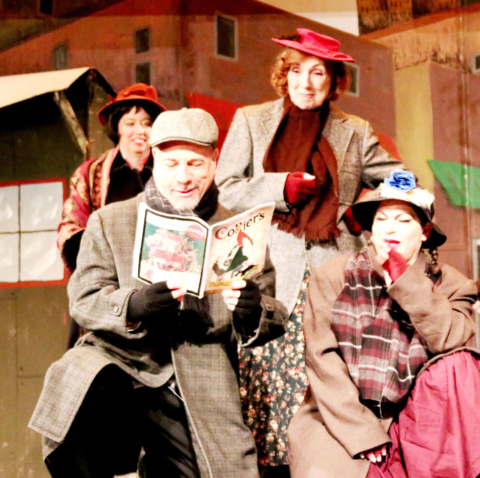
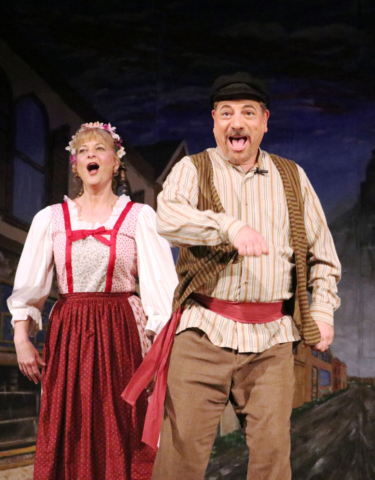
As an employer, Princeton stresses a good work-life balance, and I found I finally had the time. I had performed with Neshaminy Valley Music Theatre (NVMT) in my hometown in 1982 while in college, and they rehearse and perform at Neshaminy High School around the corner from where I live. They do a musical each year to raise funds for scholarships for students at Neshaminy who plan to pursue the arts in college. I auditioned and got a part in the musical “Curtains,” a fun musical whodunit. I’ve been performing annually since then with NVMT — we just presented “Annie” in April.
NVMT has been around since 1956 doing an annual musical to raise scholarship funds, awarding more than $165,000 to nearly 200 college-bound students. They do a good job on their productions and in recent years most of the shows have been directed and choreographed by Barrymore Award-nominated director Stephen Casey.
There is a great core group with new cast members coming and going with each show, so it is an always changing but very friendly group. No one is turned away, but everyone in the show is pushed to do their very best. I joined the NVMT board in 2015 and help out with the marketing and PR.
At NVMT everyone pitches in to help however they can to realize the annual production, so in addition to helping with PR and marketing, I’ve also helped on sets. I did set design for a production of “Grease” at Lenape Valley Music Theater while I was in college and would like to do more in this area when I retire and have more time.
For a number of years, I also worked with the Lawrence Township Public Library’s One-Act Playfest. Local playwrights are invited to submit short plays (under 10 minutes). Several are selected and then performed in staged readings by local actors. There have been some very good plays, and I’ve met lots of other local actors. (Lawrenceville resident and former Foundation Theater Producing Director) Julie Ellen Prusinowski was running it most recently until COVID.
Theater is a very collaborative art form. There is great bonding that happens among a group of people from all different backgrounds and experience levels that come together to put on a show over the course of several weeks of rehearsals, set work, tech and performances that build to that climactic point. Performing has also boosted my confidence in public speaking. Taking on a role, no matter how big or small, gives you an opportunity to really crawl inside the skin of someone else, which builds empathy. Exploring the interactions among characters teaches you a lot about real human interaction and communication.
In community theater we are all doing shows that are on top of our regular jobs and other responsibilities, so it is sometimes hard to fit it all in. In many productions I’ve been in there are a fair number of people in their 20s and many in their 50s, 60s, and even 70s, but there are not a lot of people in their 30s and 40s coming out for shows, during those years when people are raising kids.
There is something about knowing that at the end of the day, after work, you are going to head to the theater and pick up where you left off on the last rehearsal and work hard together but also have a lot of fun.
(There is) a community that is built around each production. You have a group of people, some who know each other but more often those who are meeting for the first time, spending a few months working toward the single common goal of putting together a show to tell a story. (And there are) lasting relationships that are formed by being part of a production.
Since my job supports and promotes the work of others who are doing theater — and dance, visual arts, creative writing, etc. — the more I know and understand first-hand about what our students and faculty are working on helps me do my job better.
Not surprisingly, most of the staff at the Lewis Center, and I would say in most arts organizations, came to their jobs with a passion for one or more art forms and keep their hands in the arts one way or another outside of their jobs. Conversely, what I see and learn at work may find its way back to the arts activities I engage in outside of work.
I think keeping ourselves engaged in one or more of the arts as we get older has great health benefits. Theater, and particularly musical theater, keeps your mind and body highly engaged and challenged. Memorization of lines, blocking, and choreography stimulate different parts of your brain. Moving on stage keeps your motor skills sharp and helps build muscle memory. The social benefits of group collaboration and working toward a common goal are important, as are building relationships and finding your place in different changing communities of people.
And speaking of relationships, I am grateful to have a partner who supports my interest in doing theater.
A lot of people may have thought of getting involved in their local community theater or want to but are intimidated, and I would say, give it a try. The people I have come across are friendly and welcoming to newcomers. There are usually many seasoned people also involved you can learn from and who are happy to show you the ropes. If you are too intimidated to audition or perform, get involved building sets, or making costumes or props, or doing lights or sound, or working backstage, or on the administrative side. It takes a village to put on a show and each participant and the part they play contributes to the overall goal of making a show. Community theater is one of the most rewarding community-based endeavors you can become involved in.
(Runk pauses, bows, as lights fade to black.)
Runk on Going Wilder with ‘Our Town’
When Runk was asked what type of performances he’s drawn to and what has he learned from his involvement with this production, he noted the following:
I do like musical comedies, although I am not a great singer. There is something about creating the imaginary world of the show through the sets, costumes, music, choreography.
But as an actor, I like dramas for the opportunity to get deeply into a character. Comedy is harder than you might think, but it is magical when you get the timing perfect.
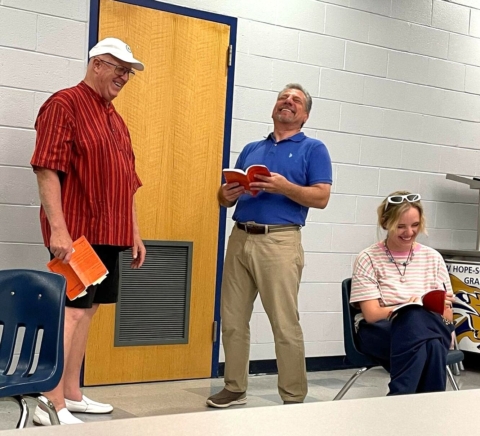
Recently I was interested in doing more non-musical dramatic theater and learned about the recently founded New Hope Repertory Theater and its upcoming production of “Our Town” through a Facebook group. That sounded like a perfect opportunity. I auditioned and was cast as Mr. Webb, one of the fathers.
I had not read “Our Town” since college and re-read it when I decided to audition. I’d forgotten the many universal truths in this classic play that still holds up today.
When you approach the play as one of the characters taking part in the story, you really do look at it quite differently than as a reader or even an audience member seeing the play. When you start to break down what your character says or what your character hears and is responding to, you have to get deeper into the lines and you appreciate even more Thornton Wilder’s beautiful language.
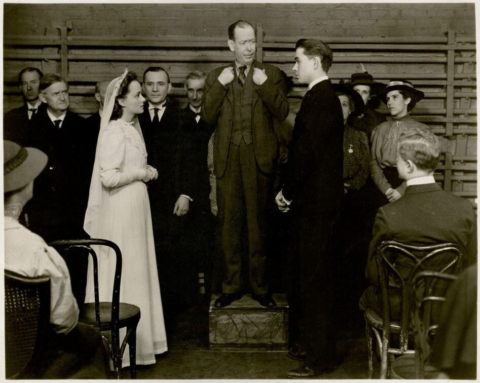
I also read more about the history of the play. While I’d heard there was an early production of “Our Town” in Princeton at McCarter Theatre, I did not know it was the first production or that Wilder did graduate work in French at Princeton University, where he got his master’s in 1926. I’d also forgotten Wilder’s play “The Matchmaker” was the basis for the musical “Hello Dolly!” which we did at NVMT in 2017.
We had to dive into the historical time period of the play to better understand the characters and the world they inhabited. Wilder instructs the play is to be done with no real scenery or props, so creating a lot of the world of the play rests very heavily on the actors and the lighting.
Our Town, New Hope Repertory Theater, New Hope-Solebury High School, 182 West Bridge Street, New Hope, Pennsylvania. Thursday through Saturday, July 14 through 16, 7:30 p.m., Sunday, July 17, 2 p.m. $15 to $25. www.newhoperep.org.