The November 2022 elections were marked by a concern for democracy, elections, and the future of the United States of America. While many were relieved that the worst of predictions did not happen, others may have felt a certain confidence in our nation and America.
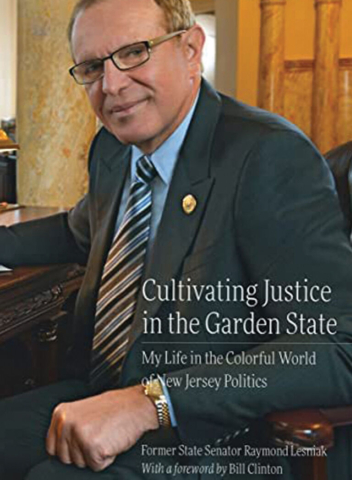
That includes the author of the Rutgers University Press publication published earlier this year, “Cultivating Justice in the Garden State, My Life in the Colorful World of New Jersey Politics.”
The author is 76-year-old Raymond Lesniak, the former New Jersey State Senator (1993 to 2020) and gubernatorial candidate whose decades of public service benefited businesses, progressives, working families, and immigrants.
President Bill Clinton provides a sketch of the man in the book’s foreword when he writes:
“I first came to know Ray Lesniak when I was running for president in 1992. We had never spoken before when Ray came out in support for me early in the campaign and stared working hard on my behalf. At that point my mother was perhaps the only other person in America who thought I could win — so it was a welcome surprise to have the strong backing of New Jersey’s state Democratic chairman, who had a long track record of getting things done in the legislature and winning elections against long odds.
“Throughout the primaries, Ray stood by me when I was up and when I was down. And on June 3, New Jersey was one of the states that helped me clinch the nomination. But Ray wasn’t done. As hard as it might be to imagine today, New Jersey hadn’t voted for a Democrat in a presidential election since 1964, and we were determined to change that. Ray played a big role in our campaign, and we carried the state by two points. Four years later New Jersey had the biggest increase in our margin of victory of any state, also thanks in part to Ray’s continued work.
“The campaigning that Ray and I did together in 1992 was the start of not only a productive political partnership but a genuine friendship. I liked Ray immediately. Though we may have seemed form the outside like the odd couple — he a Polish American Catholic from Elizabeth and me a Southern Baptist from Arkansas — we had, and still do have, a lot in common. Most important, we share a belief that politics and policy are fundamentally about creating opportunities for other people to make the most of their own lives and rise as far as their intelligence, talent, and determination will take them.
“Ray is good at both politics and policy because he likes and is interested in people, cares about their lives and their stories, and believes we shouldn’t give up on anyone. He has never been shy about the purpose of political power: use it or lose it.
“There’s no better proof of strength of that belief than the record he compiled in his four decades in office. Through his career, Ray was a friend to working people, a staunch defender of the environment, and a passionate advocate for the most vulnerable among us. As an unapologetic progressive, he had the ability to connect with allies and adversaries alike with a keen sense of when to compromise and what lines he couldn’t cross. He passed groundbreaking legislation signed by both Democratic and Republican governors. And he knew that even with his strongest opponents across the aisles, if he kept showing up and scratching at the surface, he just might find underneath a real person with whom he could forge common ground and get things done for the good of the state.”
Then Lesniak takes over and opens his book and brings us to his early days in the late 1940s and early ’50s New Jersey:
“We soon moved to the Bayway neighborhood (Linden) which is where I spent most of my childhood. And it was in that home that I learned something about the way immigrant families in America, then and now, manage to hold onto their culture and identities even as they embrace their new country and modern life. My maternal grandmother lived with us in Bayway — my grandfather had passed away before I was born — and my dad’s mother lived across the street from us. Both my grandmothers spoke only Polish. My parents insisted that we speak only English, even though that meant we really couldn’t communicate with my grandmothers. My parents were products of their Polish heritage, but they were raising my sister, Marge, and me to be good, English-speaking Americans. I was named after my dad’s father, Roman, but my parents Americanized it to be Raymond. That notwithstanding, we were very much a Polish American household We attended Polish cultural events in the neighborhood, we danced polkas, and all our christenings and weddings were Polish affairs. But even then you could see the cultural changes. On the tables at family weddings were bottles of Scotch Whisky and American rye, which you poured yourself, and, of course, Polish vodka.
“Although I didn’t realize it at the time, I was learning valuable lessons about what really makes America great. It’s about the way we adapt to each other, the way we borrow from each other, and the way we tolerate each other. I saw America not as a melting pot but as a casserole wherein the individual flavors are maintained while enhancing the overall dish. There are plenty of non-English speakers on the streets of Elizabeth at this very moment, and to be just as sure, there are people who resent hearing Spanish or Portuguese or Creole while doing business on Broad Street or waiting to be called for jury duty in the city’s courthouse. Well, my grandmothers never spoke a world of English, even thought they lived in America for more than 60 years. And my mother raised a couple of very American kids who turned out pretty well. I wish people who get upset over hearing a Spanish speaker in a bank or on a train or in a restaurant would take moment and think about their own family’s journey. We all have one.”
The rest of the story can be found in “Cultivating Justice in the Garden State, My Life in the Colorful World of New Jersey Politics,” Raymond Lesniak, 210 pages, $34.95, Rutgers University Press.