Music is the most important element in the careers of Elvis Presley, Johnny Cash, Carl Perkins, and Jerry Lee Lewis.
Yes, they all had other traits that led to their successes, traits such as a persona, personality, stage presence, and an appealing vocal style.
It’s the songs they sang and the way they sang them that made them stars. Two of them, Presley and Cash, remain famous today in an age when younger people less and less explore eras — historical, musical, or otherwise — in which they haven’t lived. Perkins and Lewis earn the appreciation of anyone familiar with them.
Music is also the most important element in “Million Dollar Quartet Christmas,” entertaining with festive, sure-handed brio at New Hope’s Bucks County Playhouse through New Year’s Day.
“Million Dollar Quartet” is a familiar entity; a jukebox chronicle of the day Presley, Cash, Perkins, and Lewis congregated at Memphis’s Sun Records, where they all began their ways up the Billboard charts. It has been a welcome production at regional theaters since it hit Broadway in 2011.
The original show featured the stars’ hit songs amid the story about how they were each moving on from Sun to bigger, national labels that could better ensure fame and fortune. It was an amiable blend of story and song with anecdotes and byplay between the stars adding texture to the main event, the musical passages.
In shrewdly finding a way to build “Million Dollar Quartet” into a franchise by adding a Christmas edition the way “Nunsense,” “The Plaids,” and “The Calamari Sisters” did, playwright Colin Escott doesn’t supply as tight a book as he did previously, when he wrote with Floyd Mutrux, but he mounts another winning show that exhibits the energy and versatility of early rock and roll and lets you see the individual and combined genius of the artists being represented on stage.
Dialogue might seem clunky, forced, banal, or trite, depending at the top of Escott’s Christmas rendition on friendly but cutting insults among friends who are also rivals and later on stories about the hardscrabble lives that preceded their success, but the dialogue doesn’t matter much.
At regular intervals, it ends, and the jamming takes over. When that happens, the clunkiest of the clunky must be forgiven in the exuberant, invigorating joy that radiates from the Bucks County stage.
The show, and Hunter Foster’s production, is a flat-out hit. Its performers are all top-notch, even when they don’t quite capture the superstar they’re playing, the musical arrangements have you dancing in your seat, and the experience in general makes you eager to get home and break out the 45 RPM records and albums moldering in your garage.
The best sections, the ones that turn out nostalgia while earning current appreciation, are those in which the performers unleash a string of hits, each performer getting his turn to show not only the prodigious talent of his model but also his own.
For harmony and variation, Escott adds a woman’s voice to the mix. She and her numbers add to the fun.
“Million Dollar Quartet Christmas” is also the funniest during these extended song riffs. In a skein that includes “Que Sera Sera,” “Let the Good Times Roll,” “Hot Diggety,” and “Tutti Frutti,” none of them originated by a quartet member, it’s not only fun to see how the stars approach others’ material but a good laugh when they roll their eyes at “Hot Diggety” and the novelty songs Perry Como made 1950s staples.
Escott can hit a winning chord when he shows how the country backgrounds of the quartet influenced their tunes and presentation. Perkins, Lewis, and Presley were born to their instruments. Cash had a style no one could duplicate. Each came from a religious home where they were exposed to Gospel rhythms and fire-and-brimstone sermons that taught how to put some life and emotion into a sentiment. Or lyric.
Within the so-so book, there is a good joke or four. The best is Carl Perkins saying he doesn’t want to tour England as part of Johnny Cash’s band because “there may be four kids in that entire country who know who I am.”
Yeah, and those four kids are named Paul, John, George, and Ringo. (Yeah, yeah, yeah.) Paul McCartney often credited his guitar stylings to those of Carl Perkins.
A show cannot provide the good time “Million Dollar Quartet Christmas” does without having a cast that can throw an exciting party. And Hunter Foster assembled such a cast.
Again, music and physicality seemed to have more to do with casting than resemblance to Presley, Cash, Perkins, or Lewis. The BCP’s cast is an interesting combination that makes you stop caring how much they match their model and starts you applauding how well they handle the full roster of music Escott has them sing.
The closest to being a ringer for his character is Tyler Michael Breeding as Johnny Cash. In profile, Breeding, who wears all black but no makeup or wig, can pass for Cash. When he sings, the tone, timbre, and phrasing are perfect. His “God Rest Ye Merry Gentlemen” is a special treat.
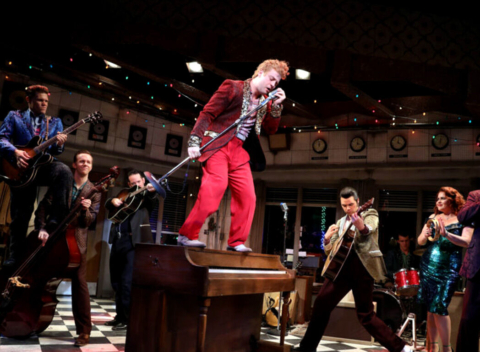
The performance that soars on all levels, from acting to singing to playing a wild piano, gymnastics and all, is Jason Cohen’s as Jerry Lee Lewis.
Cohen gives a full performance. He finds the nuances that make Lewis so flamboyant while letting the character be down-to-earth at times. All of the performers play their own instruments. Cohen is as much an artist at the piano as the recently late Mr. Lewis was. He makes Lewis the heart of the show.
Sam Sherwood looks nothing like Carl Perkins, but he plays his guitar and contributes his smooth vocals, and you hear what McCartney did.
Of course, the actor playing Elvis Presley is bound to get the greatest scrutiny. Joe Boover passes muster. I would cavil about his costuming and probably would have looked for a way to obscure a five o’clock shadow that was never part of Presley’s shiny grooming, but when Boover sings, you hear Presley. The same happens when he dances. His moves are not exactly Elvis’s, but they have a limber libidinous quality of their own, so que sera sera.
Margaret Dudasik adds immeasurably as Dyanne, ostensibly Elvis’s girlfriend but doing much more, as Dyanne is the one who usually introduces new plot beats and adds needed high notes to the show’s harmonies.
Best of all is the intelligence Dudasik gives Dyanne. She knows who Elvis Presley is, but she knows what she wants, and Dudasik excellently conveys the independent woman who will have no wool pulled over her eyes. Especially if the wool includes having to live in Memphis.
Brian Michael Henry stepped in for Bart Shatto on opening night, and you’d never know the part wasn’t his and his alone. Tucker Cruz Mitchell and James David Larson are terrific as the backup drum and bass. Some of the architecture and tableaux Foster creates with the bass is extraordinary.
Josh Smith’s set captures a store-front recording studio made famous by the stars that emanated from it. Except for the baggy wrinkled quality of Boover’s costume for Elvis, Lauren T. Roard captures the ’50s look and the way Cash, Lewis, and Perkins dressed. Ryan O’Gara’s lighting is perfect. Ashton Corey’s sound design hit some opening night glitches, but in general made the concert wail.
Million Dollar Quarter Christmas, Bucks County Playhouse, 70 South Main Street, New Hope, Pennsylvania. Through Sunday, January 1, Tuesday and Wednesday, 7:30 p.m., Friday and Saturday, 8 p.m. and Wednesday, Friday, Saturday, and Sunday, 2 p.m. $70 to $75. 215-862-2121 or www.bcptheater.org.