It’s the home of one of the state’s natural wonders, was created by one of the nation’s founding fathers, once held the role of a powerhouse of American industry, became the site of a historic labor strike, and is the thematic subject of a ground-breaking work of American literature.
Paterson, New Jersey, is a destination for those looking for a New Jersey adventure off the beaten track — and a great spot for those obsessed with the Garden State.
I became acquainted with Paterson years ago when I worked with the New Jersey State Council on the Arts on an urban park initiative and visited the city often.
I also became acquainted with the reality that many New Jerseyeans know little about the place and am ready to share some of its treasures — so here we go:
At the heart of the city is what makes it beat: The Great Falls — aka the Passaic Falls. To put it simply, the Great Falls is the second largest waterfall in the Eastern United States — second only to Niagara Falls. It is 77 feet high, 280 feet wide, and can spill 2 billion gallons of water daily, depending on both the level of the Passaic River and the hydro-electric power plant dam next to it.
Geology reports say that the Great Falls and the Passaic River were created 13,000 years ago during the last Ice Age.
Over the centuries the rocky gorge with thundering water became part of the Lenape Native Americans’ territory and was called “Totowa,” a word roughly meaning to be forced beneath the waters.
In the late 17th century Dutch settlers began exploring the area and called it “a wonder of God.” The Dutch also began farms and other rurally important enterprises in the region.
The seeds for the region’s transformation were planted during the Revolutionary War when George Washington, Marquis de Lafayette, and Alexander Hamilton took a break from the War for Independence and had a picnic next to the Great Falls – really.
Years later when Hamilton was the first U.S. Secretary of the Treasury, he remembered the falls and its potential as a source of industrial power and self-sufficiency. Prior to the war the colonies were dependent on English industry.
In 1791 he presented Congress a “Report on Manufacturers” and worked with a group of investors to create the Society for Establishing Useful Manufactures (S.U.M.) to establish an industrial town at the site of the Great Falls.
New Jersey Governor William Paterson supported the project and got thanked by having the city named after him.
Hamilton and S.U.M. are remembered by a statue of the political leader and the small S.U.M. building between McBride Avenue and the falls.
The city’s industrial history is on display at the Paterson Museum, a few blocks from the Great Falls.
The museum at 2 Market Street is housed in the former Rogers Locomotive Plant, one of three locomotive-producing companies based in Paterson during the 19th century.
And while the building of locomotives was important — with the Rogers Company creating the historic Civil War engine “The General” — more important was the industry that gave Paterson the nickname “Silk City.”
By the turn of the 20th century, Paterson was home to 32 silk manufacturers and five silk dyeing shops that employed more than 20,000 people.
The ghost of that industry is seen in the museum’s displays of looms and spools and in the city’s old buildings and speedways — where dye-colored water will spill through the city.
The museum also pays homage to another Paterson industry: the Patent Arms Manufacturing Company, begun by Samuel Colt. The company’s most famous gun is the .45 Colt Pistol.
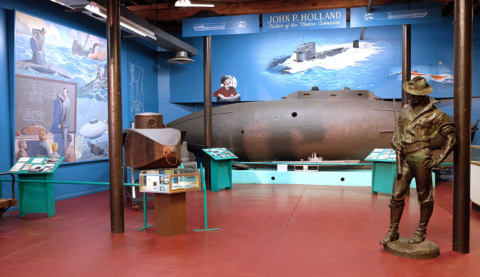
But for me one of the most exciting Paterson-made objects in the museum is the Holland Submarine (aka The Fenian Ram).
The creator of this Jules Verne-like creation was John Holland, an Irish educator who had become interested in creating an undersea vessel to thwart British control on the Irish Coast and experimented with different approaches prior to moving to the United States in the 1870s.
He moved to teach at a Catholic school in Paterson yet continued his work on creating a submarine and had developed what he believed were working plans. When the United States Navy rejected his offer to build them a vessel, the Irish Republican Brotherhood — the Fenian Society — decided to help finance his experiment.
In 1878 Holland’s New York iron works-built submarine using a petroleum engine was tested in the Passaic River near the Great Falls. The result was two 12 feet dives, staying submerged for an hour, and traveling underwater at a speed of 3.5 miles per hour.
The 2.25 ton, 14 feet long, 3 feet across, and 4 feet high vessel is in a work of industrial art — and if you’re lucky, as I once was, you may be able to get inside and re-experience the heavy metal and claustrophobic space that Holland was willing to endure in order to keep the Irish out of harm’s way.
The museum points out another Paterson-made product, film and television star Lou Costello, part of the famed “Who’s On First?” routine by comics Abbott and Costello.
Paterson history also connects to one of the most tense and important moments in American industry: the Paterson Strike in 1913.
For five months, 25,000 striking silk workers closed the mills and dye houses. The reason, according to an NPR story, was not “as a defensive battle against a wage cut. The broad-silk weavers called the strike as a way of blocking an increase in loom assignments from two to four. As skilled workers, broad-silk weavers had fought since the 1880s for control over the rate of production. Responding to their strike call, the ribbon weavers and unskilled dyers’ helpers joined the 1913 strike, making it the biggest in Paterson history.”
Although unsuccessful, the strike brought public attention to the lives of mill workers and helped shape public approval for later improvement for workers.
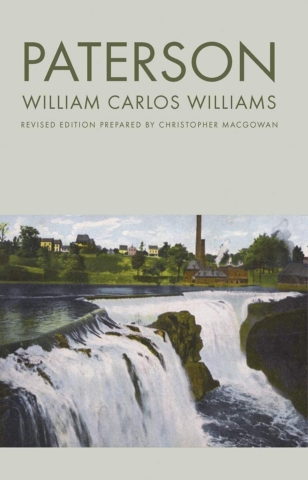
This background of rocky waterfalls, train and gun manufacturing, silk mills, and strikes eventually became the seemingly unlikely source of inspiration for a regional doctor who also had established himself as a modern American poet, William Carlos Williams.
His major work is the four-volume “epic” poem “Paterson.” His theme, he writes, is “that a man himself is a city, beginning, seeking, achieving, and concluding his life in ways which the various aspects of a city may embody — if imaginatively conceived — any city, all the details of which may be made to voice his most intimate convictions.”
While the reception of the book was mixed, it has become a 20th century modern classic that attracts visitors from around the world to Paterson, New Jersey, where people come to the Great Falls and ponder William’s dictum, “No ideas but in things.” And one of those things is Paterson, New Jersey.
The Paterson Museum reopens after its pandemic closing on August 23. For information, visit www.patersonmuseum.com.