Two recent books from the recent Princeton University Press catalog may not be current news or regional events. Yet, in addition to offering some unusual and thought-provoking reading, the two subjects interestingly show up in artistry connected to our area.
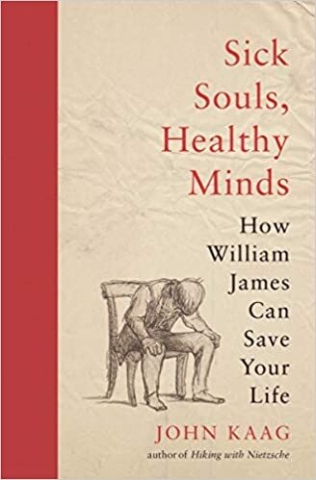
Sick Souls, Healthy Minds: How William James Can Save Your Life
“Sick Souls, Healthy Minds: How William James Can Save Your Life” is the first. Written by University of Massachusetts, Lowell, philosophy professor and author John Kaag, the 212-page cocktail of personal reflection and philosophical critique is a chatty introduction to the prominent 19th-century American thinker whose boldness and willingness to look life straight on and explore thought itself reshaped Western philosophy, psychology, and literature.
And rather than create a formula or support ideas that he believed harmed people, such as determinism, “James’s entire philosophy, from beginning to end was geared to save a life, his life. Philosophy was never a detached intellectual exercise or a matter of word-play. It wasn’t even a game, or if it was, it was the world’s most serious. It was about being thoughtful and living vibrantly,” notes Haag.
That is because we live “in a terminal condition” where “no one makes it out alive,” says Haag, adding that “James can help us survive, so to speak, by preserving and passing on what is most important about being human before we pass away. James crafted what he called a philosophy of healthy-mindedness. It may not be a formal antidote for the sick soul, but I like to think of it as an effective home remedy.”
Although from a privileged New York City background and educated at prestigious American and European institutions, James, the trained physician, medical doctor, experienced a psychological or “sick soul” crisis.
As he puts it, a sick soul arises in a person “whose existence is little more than a series of zig zags, as now one tendency and now another gets the upper hand. Their spirit wars with their flesh, they wish for incompatables, wayward impulses interrupt their most deliberate plans, and their lives are one long drama of repentance and of efforts to repair misdemeanors and mistakes.”
James’s sick soul and his sense of meaningless vexed him into a situation that offered a choice: to commit suicide or become his own human specimen and explore the foundations of his thoughts, feelings, and beliefs.
By choosing the latter and hinging everything on a “maybe,” he began to analyze cultural and social beliefs and built a new foundation of a philosophy approach called “Pragmatism” that, Kaag says “holds that truth should be judged on its practical consequences, on the way that it impacts life.”
Kaag says the result is the scientific minded philosopher and psychologist became someone who “wrote for our age: one that eschews traditions and superstition but desperately craves existential meaning; one that is defined by affluences but also depression and acute anxiety; one that valorizes ‘icons who ultimately decide that the life of fame is one that really ought to be cut short prematurely.’”
Kaag adds that “to such a culture, James gently, persistently urges, ‘Be not afraid of life. Believe that life is worth living, and your belief will help create the fact,’” with Kaag making it clear that such a statement is not an aspect of relative thinking but the need to make internal and external choices informed by science experimentation and discussion, will, and, perhaps, something innate in the species.
James’s emphasis on making choices to realize one’s life eventually attracted the attention of European philosophers and informed phenomenology and existentialism. Kaag also shows that James introduced the term “stream of consciousness” to describe human thought and provided modern writers with a new tool and helped shape the work of Virginia Woolf and James Joyce – whose monumental modernistic stream of consciousness novel “Ulysses” was introduced to the world in 1922 by Princeton’s Sylvia Beach, now buried in Princeton Cemetery.
James’s findings also informed the writing of a psychologically astute but more traditional novelist, his brother, Henry James.
While Kaag’s books deals with a pithy subject and challenging situations, it’s upbeat and light in tone. Yet it is dead serious, too, and shares ideas that saved James and Kaag’s lives and could do the same for others.
Sick Souls, Healthy Minds: How Williams James Can Save Your Soul, by John Kaag, 212 pages, $14.96, Princeton University Press.
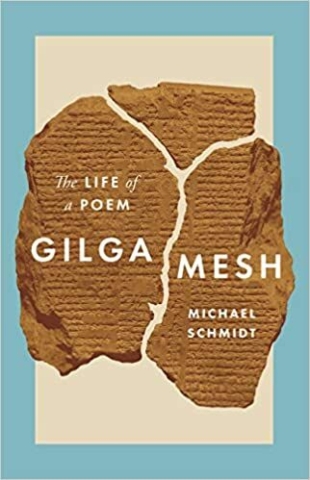
Gilgamesh: The Life of a Poem
“Gilgamesh: The Life of a Poem” focuses on the world’s oldest long poem. Written in cuneiform on stone tablets in ancient Sumerian, the once prominent story was broken and lost to time until the 19th century.
As the book’s author, literary historian Michael Schmidt, says, the story was “rediscovered, by accident and then by design, in various archaeological digs, the conventional heroisms of Victorian derring-do.” It then became a poem “reassembled, a jigsaw — actually several jigsaws in different languages and from periods separated by centuries.”
Within a hundred years, the tale using the story of a noble king’s awakening through the grief of his earthly companion returned to speak of the human condition and resume its prominence — becoming an important part of world literature and school curricula.
Schmidt calls the adaptations of the story’s known 12 tablets — with the potential of more being unearthed or found in ancient collections — an increasingly plausible approximation” of the original text and a “work in progress.”
He says that although the story’s “sparse” telling doesn’t have the same artistic approaches used in Greek poems, it “prefigures almost every literary tone and trope and suggests all the genres, from dramatic to epic, from lament to lyric and chronicle that have followed it. It is political, it is religious.”
He also rhetorically asks, “Is it is the first road novel, the first trip to hell, the first deluge, the first heterosexual romance in poetry?” although, he adds, “Does he love that dare not speak its name very nearly speak its name here for the first time?” — with the latter referring to the intense love between the two male characters.
Schmidt explores the life of the poem by focusing on each tablet, describing the story, and then providing a commentary that in addition to his own involve those of historians and contemporary writers who translated or interpreted the story. The Manchester, England, based writer says he communicated with 50 poets writing in English about the work.
He also touches on adaptations including internationally known award-winning writer, former Princeton faculty member, and Trenton resident Yusef Komunyakaa’s verse play version for actors and chorus — Schmidt calls it “convincing, but remote” from the source material.
Not mentioned in this book is that nationally known Roosevelt, New Jersey, artist Bernarda Bryson Shahn also wrote and illustrated an adaptation of the work, showing the work’s power to engage.
While the book’s approach tells the tale recorded on each tablet, it probably works best for those who have experienced and made a personal connection to the story. Several texts are referenced at the start of each tablet chapter, including the late Herbert Mason’s moving “Gilgamesh: A Verse Narrative” — the work that forged my own lifelong interest in the poem.
That familiarity also leaves Schmidt free to share in a reader-friendly manner what is known about the world from which the tale grew, the story of the tale’s reemergence, and how an ancient work speaks to contemporary readers.
Gilgamesh: The Life of a Poem, by Michael Schmidt, 166 pages, $16.95, Princeton University Press.