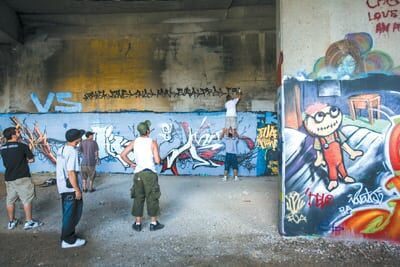
Gallery 219 in downtown Trenton has been a home to a diverse array of artists from both the urban and hip-hop culture. Among them is a group of wall writers, also known as graffiti artists. These writers have been known to be a closed society. While not usually open to scrutiny or inspection, the life of a wall writer can be one of meaning.
Princeton-based photographer Ricardo Barros was one of the “outsiders” who eventually made his way into this society and peeled down the layers to get to this meaning. Over a period of seven years he made photographs of their work, their process their interactions with their art. The result is his exhibition, ARTHAMMER, at Gallery 219 starting with an opening on Friday, December 13, and continuing through January 10.
ARTHAMMER began when Barros, a well known professional photographer, started attending an artist salon hosted by Jon Naar, an accomplished photographer from New York who had recently relocated to Trenton. Barros describes Naar as the “grandfather of photographing graffiti.” Naar’s 2005 book, “The Birth of Graffiti,” is a collection of graffiti images photographed in and around New York City during the 1970s.
Among the other salon artists was Leon Rainbow, a graffiti writer. As Rainbow described his work, Barros assumed he knew what the street artist was doing, but the more the artist spoke the more Barros realized that he knew little. Even when Barros made suggestions Rainbow corrected him. This raised Barros’ curiosity, and Rainbow invited Barros to a graffiti jam where a group of writers were working. The one rule was Barros could photograph but not show any of the writer’s faces.
The writers were initially skeptical of Barros, thinking he was perhaps law enforcement of some kind. But when the photographer returned with the first set of images the writers liked what they saw. Then slowly over the next several years Barros gained their confidence. “The more I learned about their community the more I learned that this was a very complete complex and subtle sub-culture,” says Barros. “I wanted to understand what it was that they were doing and how they approached things. The things that they were doing were so different from the way that I would do them. How could they go and paint over somebody’s building and not care that it was not their building? How could they do that? How could they sleep at night? I didn’t understand that.”
The more questions he asked the more he wanted to know. “As you looked at their work, they’re called pieces, very complex letter forms that blend into one another. Very colorful, very beautiful, but what were they saying? I couldn’t read them. Why were they putting up things that nobody could read? And why was everybody so secretive? So I basically wanted to open the door, try to sneak in and learn their secrets,” he says.
Because of Barros’ relationship with Rainbow getting the first and second introduction was smooth, but it still took several months. Then every time he was able to go down another layer he found that there were still more layers to peel through. He also noticed that all the writers gravitated toward one writer, and he sensed that he was the wise one. But it still took years to penetrate to that layer.
Barros has learned that graffiti artists do not call their work art, nor do they refer to it as graffiti. They call them “pieces” or “graph.” What the writers are about is coming up with a unique name that is especially theirs, that is meaningful to them, that nobody has ever used before, and that they can express it in visual form in a way that has not been done before. It is unacceptable to use someone else’s name or write exactly in someone else’s style. That’s considered a form of plagiarism.
Once an artist develops that name and style the point is to “put it up,” which means to put it on as many walls and get as publicly viewed as possible. As Barros notes, “it’s not just getting the name up. It means getting the name up in good places like high traffic areas where it’s visually prominent or there’s something interesting about it. For example, if it were on building next to a police station where there’s that high risk component that lends prestige to that spot. Or you can do it in a humorous way. The more ups you have the more fame that you have.”
Barros’ journey to photographing writers spans hemispheres. A native of Sao Paulo, Brazil, he, along with his two sisters, moved to the Boston area with his mother, who worked as a secretary, when he was seven years old. He came upon photography as an eighth grader and was fascinated by the alchemy and the technique. In high school at the Valley Forge Military Academy he took an adult education class in photography and became acquainted with the work of such masters as Minor White, Paul Strand, and Edward Weston. Their work spoke to him and brought him deeper into the medium, seeing it as much more than just a technical endeavor.
After graduating from high school he searched for a school to study photography but was dissatisfied. Instead, he studied art history at Lake Forest College, before transferring and receiving a BA in engineering from the University of Massachusetts at Amherst, then a master’s degree in engineering from Pennsylvania State University.
Barros met his wife, artist Heather Stoddart Barros, in Amherst. At the time she was a geology major but “spoke the same language” of science and art. In 1980 they came to New Jersey when he took a job as a civil engineer for the Department of Transportation, where for the next 16 years he worked, pursued the art of photography, and then launched his own practice.
While Barros has lived in Princeton with Heather and their three children since 1980, his professional photography studio is in Bristol, Pennsylvania. Clients include Princeton and Drexel universities, Grounds For Sculpture, New Jersey State Council on the Arts, and Robert Wood Johnson foundation. His fine art work is included in several museum collections, including the Smithsonian Museum of American Art, the Philadelphia Museum of Art, and Harvard University’s Fogg Art Museum. In 2004, Barros published the 2004 Best of Philly gold award-winning book, “Facing Sculpture: A Portfolio of Portraits, Sculpture and Related Ideas.” The publication captures the images of major artists working or exhibiting in the region.
The current exhibition comprises 39 photographs from a book in progress on that seven-year period of working with the writers. His travels with the writers not only covered Trenton but also Philadelphia, Washington, Maryland, Newark, Montreal, New York, and Boston. Through Rainbow, Barros met writers from Canada, Italy, Greece, and Spain during graffiti jams they attended. The manuscript’s working title “Touching The Hood” is a quote taken from hip-hop artist Mos Def: “Reach for the world but touch the hood first.” The exhibition title ARTHAMMER takes its name from the quote “Art is not a mirror held up to reality, but a hammer with which to shape it” by 20th century playwright and activist Berthold Brecht.
Barros wants the takeaway of the exhibit to be about something much larger than photography and graffiti. It is about people making connections. On the one hand people involved in the urban environment and writing culture hopefully will look at and enjoy the pictures. If they look closer and observe the content they might see something they have not seen before.
Barros also hopes to bring a new audience to writing culture. He describes them as people who “have no clue and no access to it. These are people who might be taking the commuter train to New York or Philadelphia and they’re passing graffiti everyday and they are either becoming blind to it or they’re completely resigned that they’ll never understand it. I would like for them to start looking at it. If they look at my photographs, and they see something interesting in the way I photograph these people or that I present this information they say, ‘Oh that’s one of them,’ and then they’re going to start making their own connections.”
The larger goal is one of participation. He thinks if Trenton is to come back it needs the participation of those outside the city to support the arts, the coffee shops, the restaurants, and the economy. He hopes this exhibit will bring in visitors who will appreciate and see the people, the community, and its culture in a different way. That will open up a dialogue.
ARTHAMMER: Shaping Society Through Writing Culture, Gallery 219, 219 Hanover Street, Trenton. Opening Friday, December 13, with 4:30 to 5 p.m., guided tour of “Gandhi in the Alley,” “Gandhi’s Garden,” “Windows of Soul,” and conversation with the artists; 5 to 6 p.m., quiet preview of exhibition; and 6 to 9 p.m., reception and music. Free. Exhibition continues through Friday, January 18, flexible gallery hours, daily and Saturday, call in advance to confirm viewing, 609-292-9334. For more information, go to Gallery 219 on Facebook or contact Ricardo Barros through www.ricardobarros.com.