When it comes to students missing school, there can be a variety of reasons.
The Princeton Area Community Foundation learned this when it set out to increase attendance rates in Mercer County schools through its All Kids Thrive Initiative, created in 2018.
Some kids missed school because of chronic illness. For others, safety concerns at the bus stop kept them away.
When kids did attend class, they were often hungry and distracted. Transportation was a barrier for some, while other families lacked stable housing.
Those experiences demonstrated that improving attendance could require addressing problems that extended well beyond the classroom.
Chronic absenteeism is generally defined as missing 10% or more of the school year. In New Jersey, that amounts to about 18 days during a typical 180-day school year, or roughly two days per month.
Through the $3 million, five-year All Kids Thrive initiative, the Community Foundation worked with 10 grantee partners. The effort focused not only on getting students into classrooms, but also on identifying the reasons they were missing school in the first place.
The Community Foundation ultimately found that increasing attendance needed to be a team effort that addressed the range of obstacles students and their families faced.
That led to the community school strategy.
The model reimagines public schools as community hubs that connect students and families to the services, support and opportunities they need so children can succeed in school. Academics remain at the center, but schools work with outside organizations to address issues such as food insecurity, housing instability and other barriers that can interfere with learning.
Bernadette Trapp, director of community schools for Mercer Street Friends, explained how those partnerships work.
“Within that hub, community partners work together to address the barriers to learning that exist,” Trapp says. “So that families can then receive support and services, and schools can focus on teaching and learning.”
The Community Foundation worked with local educational and community leaders to establish THE (Trenton, Hamilton, Ewing) Mercer Community School Coalition, composed of superintendents and educators from the Trenton, Hamilton and Ewing school districts, along with leaders from the Community Foundation, The College of New Jersey and Mercer Street Friends, a Trenton-based nonprofit that pioneered community school implementation in the city in 2015.
The coalition’s members met for more than a year before formally ratifying the organization in November 2025 by signing a charter establishing the collaboration.
The coalition grew out of lessons learned through All Kids Thrive. The Community Foundation found that schools could more effectively address chronic absenteeism when districts and community organizations worked together and shared resources, strategies and information.
The approach also recognizes that schools alone may not be equipped to address all the underlying causes of absenteeism. Community organizations can connect families with services involving food, housing and other needs while educators concentrate on instruction.
Mercer Street Friends received $2 million in state funding in 2025, championed by state Sen. Shirley Turner, to support its community schools work. The organization worked with fellow coalition members to double the number of community schools in Mercer County.
Three new community schools began operating earlier this year: Klockner Elementary School in Hamilton, Antheil Elementary School in Ewing and Cadwalader Elementary School in Trenton.
They joined three existing Mercer Street Friends community schools in Trenton: Luis Muñoz-Rivera Elementary School, B.C. Gregory Elementary School and Dr. Martin Luther King Jr. Middle School.
The Mercer schools are among more than 7,500 community schools nationwide. The modern community school model emphasizes academic support, stronger relationships between families and educators, and connections between families and community resources.
The concept itself has roots in the progressive movement of the early 20th century, when reformers promoted schools as places that could serve broader community needs in addition to educating children.
Each community school’s services are designed around the particular needs of its students and families rather than following a single program.
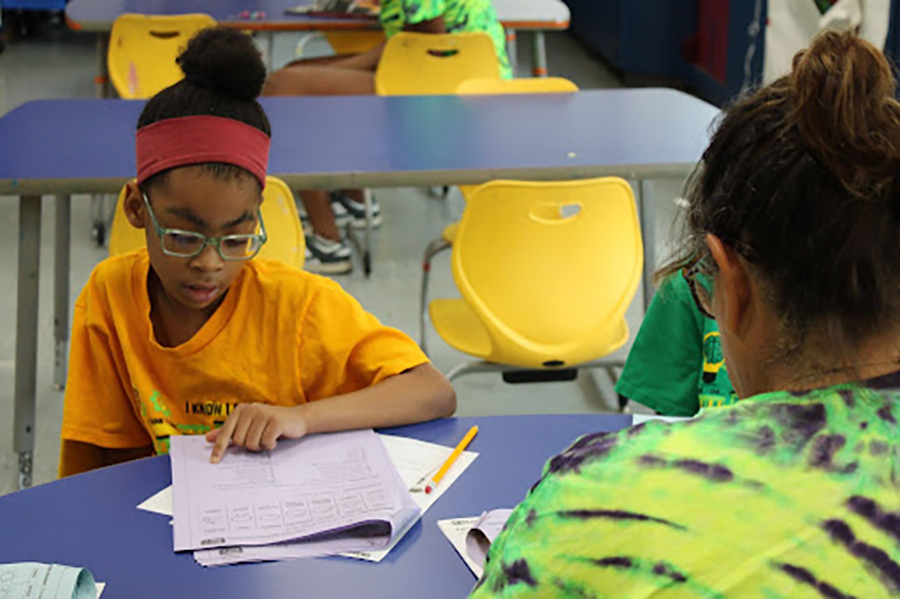
Trenton Community Schools offer programs for children including a five-week summer program, reading intervention and after-school opportunities such as clubs and sports. Other services available through the community school model can include food assistance, family support, mentoring, youth development and connections to outside resources.
“They benefit in various ways,” Trapp says. “Some students learn SEL skills and strategies so that they are able to function more successfully in school. Some get reading support through our reading intervention program, and others, sometimes it’s just someone to talk to.”
One of those schools, Cadwalader Elementary School, has recorded improvements in student attendance and reading achievement.
The school served 47 students through its reading intervention program and maintained an 89% attendance rate despite beginning services later in the year. The percentage of participating students reading on grade level increased from 5% in the fall to 17% in the spring, a 240% increase during its inaugural year.
The results at Cadwalader were part of broader gains reported by Mercer Street Friends during the 2025-26 school year.
Its Reading Intervention Program served 164 students at Cadwalader, Luis Muñoz-Rivera and B.C. Gregory elementary schools. Across the three schools, participating students maintained an overall attendance rate of 89.66%, according to Mercer Street Friends.
The program uses high-impact tutoring to help students strengthen literacy skills and reach grade-level reading proficiency. Mercer Street Friends reported gains in reading proficiency at all three schools during the school year.
The community school strategy is not limited to elementary schools, according to Trapp. It can also be applied to middle schools and potentially high schools.
Trapp was principal of Martin Luther King Jr. Middle School from 2015 to 2022 and was able to identify gaps in learning and other areas where students needed additional support.
“A lot of the time, it’s just middle school kids being engaged in something beyond school to keep their interest,” Trapp says. “To keep them safe, to keep them off computers or social media all night long, just to give them something to do. We have a variety of options at the middle school level. It just looks different than the elementary school, but it still does the same thing.”
There have also been discussions between Trapp and fellow coalition members about what the community school model could look like at the high school level. She would like to observe successful community high schools before determining how the model might best be adapted locally, she adds.
Meanwhile, the coalition is looking beyond the individual schools as it considers how to sustain and expand the effort.
The Community Foundation says its goals include finding additional partnerships with health care providers, businesses, early childhood organizations and university faculty. Coalition members also plan to use shared data to track attendance and student engagement and determine which approaches are working.
For Trapp, the next challenge is ensuring that community schools have the money, partnerships and resources necessary to continue addressing needs that educators encounter every day.
In the future, she hopes community schools can secure additional funding, gain access to more resources and become better known across New Jersey.
“I’m able to fill the food gap, but I need help to fill the other gaps,” Trapp says. “I’ve got wonderful partners that help me, but to see that grow would be great, and to just see people be more aware of what this model brings.”