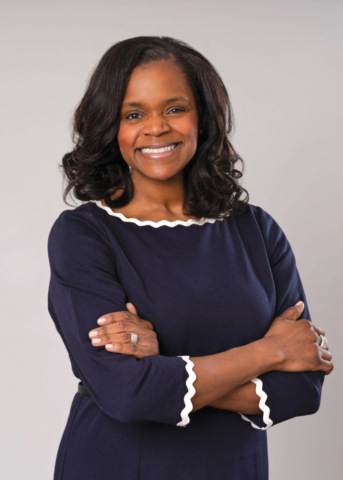
Being an advocate means amplifying voices and helping to nurture a supportive environment. For Nathalie Nelson, whether she was volunteering in Haiti during the 2010 natural disaster or becoming the successor to a nonprofit’s longtime leader, she is taking the reins from someone who has done both elements exceptionally well, then continuing those same efforts on her own terms.
Nelson is the CEO and president of Womanspace, a Lawrence organization formed in 1977 to help survivors of domestic violence and sexual assault. After more than 28 years of service, executive director Patricia Hart has now passed the baton to Nelson, who was promoted on February 14 of this year.
This is Nelson’s 10th year with Womanspace, where she has previously served as human resources manager and director of human resources and operations. Prior to that, she worked at a law firm in the area of human resources. She then received her master’s in public administration from Rutgers University.
Her new position is the culmination of hours working in community service, with Nelson knowing back in college that the government track was not nearly as appealing to her as the allure of the nonprofit sector.
“I wanted to bring my attention to looking at different stuff and different missions, because I think once you get the mission and you support it, [it’s] really easy to work and advocate,” Nelson says. “That’s how I feel about Womanspace, because I obviously support our mission — that I want to help empower all of our clients that use our services and programs.”
Womanspace’s services include an emergency shelter, crisis intervention, counseling and support, transitional housing, court advocacy, as well as educational and other resources to combat abuse. That connected to Nelson, who absorbed information about the importance of giving back during her academic career as the first person in her family to choose this path.
“I do a lot of volunteer work with my church, like the soup kitchen, so I know that’s where my heart is. Back in 2012 when I saw this position, I applied and was so grateful that I was able to work here,” Nelson says. “I also took it upon myself to learn the ins and outs of the agency.”
Nelson used to work closely with Hart, becoming not only her “right hand” in day-to-day operations, but the person Hart chose to be her eventual replacement.
“The transition has been seamless [because] I have been here so long,” Nelson says, adding that she is grateful for the general honor of working with Hart as well. “She was such a great mentor. I definitely have big shoes to fill.”
Womanspace started with a small team of women who have expanded their legacy over more than 40 years, many of them with Hart at its head. Hart helped create “Mi Hermana, Mi Amiga,” — My Sister, My Friend in Spanish — “the first collaborative initiative bringing domestic violence services to Latina clients throughout the county,” Nelson explains. She also was responsible for establishing the Domestic Violence Victim Response Teams (DVVRT) program in collaboration with law enforcement, which has catapulted Mercer County to being the first, and only, county to have trained teams throughout each municipality.
“I feel like a lot of the stuff I’ve learned, I’ve taken on and continue to do as a CEO or president. Like I even say, ‘oh, what would Pat Hart think?’ Because she is really smart. She knows the community really well, and that’s what I want to continue, and she really wanted to make sure that Womanspace was everywhere. That’s what I will continue to do, so that people know that we are everywhere,” Nelson adds.
Hart made sure to also build on Womanspace’s programming for children and families, as well as explore accessibility options through servicing Deaf and Hard-of-Hearing communities in a model developed alongside the New Jersey Division of the Deaf and Hard of Hearing.
Womanspace currently runs three hotlines and a texting hotline: 24/7 Mercer County Domestic Violence and Sexual Assault Hotline at 609-394-9000, 24/7 Statewide Domestic Violence Hotline at 1-800-572-SAFE (7233), and the 24/7 Deaf and Hard-of-Hearing Domestic Violence and Sexual Assault Texting Hotline at 609-619-1888.
“Even though we’re based out of Mercer County, we really can help survivors all throughout the state. But it’s also really important to mention that even though it’s called Womanspace, we help all genders. We’re here to help everybody, as well as children,” Nelson says.
The shelter, termed the “Safe House” has a confidential location and can house up to 25 clients, or 8 adults and 17 children. Those using the emergency services can stay for anywhere between four and six weeks, Nelson adds, but “everybody’s situation is different.”
As soon as someone enters the program, the advocacy begins, and Womanspace addresses any pressing matters in the aftermath of any trauma or experience. Those looking for help are connected to advocates for clients, housing, and children, meaning that depending on a situation, Womanspace even offers on-site homeschooling for children if deemed necessary.
There is also transitional housing available with six apartments for clients, the shelter service seeing to similar needs in terms of emotional support, financial stability, the resolution of legal concerns, and child care options. This program also focuses on preparing clients for educational goals or job-readiness skills as they work towards achieving self-sufficiency.
To make these dreams happen, Womanspace partners with Isles, a Trenton “community development and environmental organization with a mission to foster more self-reliant families in healthy, sustainable communities,” to further empower their clients.
Bi-monthly group and/or individual counseling sessions are available, yet for individuals who are unable to make an appointment, the same options are offered through drop-in sessions. There is additionally a Womanspace Chaplain for spiritual aid, making the nonprofit the “only domestic and sexual violence social service program in New Jersey to offer a Chaplaincy program,” according to their website.
Womanspace’s response teams work closely with police departments through the DVVRT program, meaning that if there is an incident, the station will call the nonprofit, who then dispatches a qualified response team member to meet the client.
These staff receive 80 hours of training, splitting the time between 40 hours of domestic violence training and 40 hours of sexual assault training. Then, they either help guide the victim through the process, Nelson says, or provide reassurance.
“Another program that we have is our education and training where we go out to schools, and we talk about healthy relationships, safe relationships, the one-on-one signs that people should be looking for. We also go to hair salons because we feel like [when] somebody is getting their hair [done], that’s when they’re talking about the issues,” she says of their different approaches. “We want to make sure that the beauticians know what to say, or what to do, to help a survivor who confides in them.”
When the pandemic started, Womanspace went entirely remote except for its emergency services. The team shifted from never having conducted telehealth appointments to successfully helping clients via cell phones and computers — all within only a week of going virtual.
“Our emergency services or shelter was never closed because we are 24/7, but we had to do different things. Especially with isolation at that time, like I said, we can have up to 25, so eight parents and 17 kids, so we brought it down to six adult and seven kids, so that we could do every other room. We also had an affiliation with hotels, so we’re able to house some of our clients in hotels, which we still have that continuously,” she says.
In the hotels, Womanspace visits clients and still gives “them the same amount of support,” Nelson explains, providing a case manager, food, necessities, or anything else that would be administered at their safe house, even coordinating doctor appointments via Uber.
“I’m proud to say, our agency, we didn’t skip a beat,” she adds. “All of our staff was like, ‘we have to help our clients, so we’ll do whatever needs to be done.’”
An expected shift Nelson notes as a result of the pandemic, though, was an uptick in domestic violence cases.
“DV definitely went up — at first it didn’t. But, probably by the summer, it’s been really high,” she says of the continuing trend. “We still have the same amount of staff, but the clients that we have have almost tripled.”
United Nations Women called the rise in domestic violence a “shadow pandemic,” with the University of Alabama at Birmingham reporting in October of 2021 that incidents increased by anywhere from 25 percent to 33 percent in just 2020 alone.
The same year as the beginning of the pandemic, Womanspace started an initiative called the Anti-Racism Project, incorporating the strict condemnation of racism as part of its organizational mission through the creation of an Anti-Racism Committee, consultants, trainings, and the anticipated employment of a Diversity, Equity & Inclusion representative — the nonprofit is now looking for a suitable candidate to oversee DEI issues.
Nelson said that Womanspace is committed to not just supporting BIPOC (Black, Indigenous, People of Color) in movements and practices, but the hiring process, highlighting her “vision to make sure that everybody knows that Womanspace is very inclusive, and that we don’t turn anybody away.”
The revised mission statement continues: “We cannot be essential if we remain silent in the face of an issue that so profoundly impacts so many survivors of domestic violence and sexual assault, as well as our employees of color who serve and act on the behalf of survivors. We will provide a just employment experience as we address the pervasive inequities that are often insurmountable barriers to both survivors and employees of color alike. In the face of these historic and systemic issues it is not enough to not be a racist organization. We must be an anti-racist organization.”
By understanding that they can help more than just women, Womanspace makes headway in its own way, cognizant of the changing conversations around these issues.
“[We need] to make sure that with health, we empower our women and men,” Nelson says. “I know it’s mostly women, but just that we empower them and make sure that they take care of themselves, also talk about self care, which is also really important for our clients, as well for our staff, too.”
Those looking to volunteer or donate can do so at the Womanspace website, Womanspace.org. Currently, no in-house volunteering is available due to the pandemic, but the donation form includes amounts for specific supportive measures such as buying seven bus tickets for Womanspace clients ($25), allowing eight women to attend a support group ($50), buying one day of food, shelter, and support for a mother and her two children ($100), providing one woman with counseling for a month ($300), and even keeping their hotline running 24 hours a day for one month ($1,000).
Womanspace’s biggest fundraiser is the event recognizing the recipient of the Barbara Boggs Sigmund Award, named for the Mercer County Freeholder and Princeton Mayor who founded the nonprofit agency. The honor is annually given “to a person who champions causes and issues affecting the lives of women and children,” but this iteration of it has been previously postponed due to the pandemic.
On Thursday, May 12, Womanspace is holding its long-awaited 26th edition of the event via Zoom at 6 p.m. to celebrate Elizabeth Smart, an advocate for child abduction prevention who was a victim herself. When Smart was taken from her home in 2002 and kept captive for nine months, national attention resulted in her discovery, as well as the arrest of the couple responsible for the crime.
In the years since her freedom, Smart has become known, as well as widely praised, for her efforts in helping missing persons and others who have experienced sexual assault.
She will be talking about her journey and her latest book, “Where There’s Hope,” which is “about what it takes to overcome trauma, find the strength to move on, and reclaim one’s life,” according to the Womanspace website. The suggested donation is $100, but “donations over $1,000 will receive a gift basket featuring local wine from Hopewell Valley Vineyards and desserts from LiLLiPiES and the Gingered Peach.”
Registration and more information are provided at the page for the event, Womanspace.org/barbara-boggs-sigmund-awards-2022/.
Another initiative that former executive director Hart created is the Community of Lights, an awareness project that has attendees light candles in a symbolic show of support for victims. The 21st Annual Communities of Light will be scheduled for some time in December.
Other events with dates in discussion focus on highlighting the AAPI (Asian Americans and Pacific Islanders) and LGBTQ+ communities, the former as part of their ongoing anti-racist initiatives, with the latter as part of June’s celebrations for Pride Month.
Going forward, Nelson wants to make it known more so than ever before that Womanspace’s services are for any, and all, communities — race and gender, in particular, are never considered a barrier to their compassionate care.
“We serve everybody, we help everybody,” Nelson repeats. “I think it’s a misconception [for people] when they see Womanspace, that they think that we only help women, but we don’t. We help everybody.”
Womanspace, 1530 Brunswick Avenue, Lawrenceville 08648. 609-394-0136. Nathalie Nelson, president and CEO. www.womanspace.org.