There are nearly 40 car, train, and pedestrian bridges whose spans cross the Delaware River to connect New Jersey and Pennsylvania.
And while some are larger and grander, the Lower Trenton Bridge in the capital city is arguably one of the best known in Central New Jersey.
It is also the most historically significant.
Known familiarly as the Trenton Makes bridge, its silhouette or lattice work can be seen on numerous designs in the region and has appeared in art, films, and record album covers.
And while the bridge can’t speak, it does have a voice.
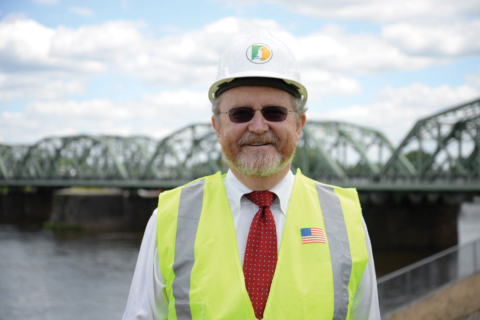
Joe Donnelly is the deputy executive director of communications for the Delaware River Joint Toll Bridge Commission, the organization that owns and maintains 20 Delaware River bridges from Trenton to just south of New York State.
He is also known for his public talks on area bridges and brings special attention to the Lower Trenton Bridge.
“There is a lot of bridge history that is out there,” Donnelly says over coffee in a Bucks County café. “I spent time researching and trying to put together the pieces of the history of the various bridge crossings that are across the Delaware River in our service area.”
That said, he readily talks about the Lower Bridge and its significant and often overlooked history.
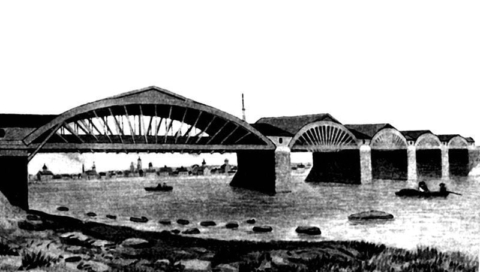
In addition to being the country’s second covered bridge and the first to span the Delaware River,” the now 200-year-old bridge was “the most famous bridge in the world” during its day, says Donnelly.
The reason includes the design by Theodore Burr.
The cousin of vice president Aaron Burr, the Connecticut-based engineer, who lived between 1771 and 1822, used an innovative combination of trusses and arches to create covered bridges noted for their strength and durability.
The most sought-after bridge designer of his day, Burr was buried in a potter’s field and has been little remembered, despite the efforts of the Theodore Burr Covered Bridge Society of Pennsylvania and the Theodore Burr Covered Bridge Resource Center in the house Burr eventually built in Oxford, New York.
According to DRJTBC documentation, Burr’s 1,008-foot-long and 36-foot-wide bridge “had massive laminated arches. The floor was suspended from the arches with iron chains, a revolutionary design for its time. The structure’s New Jersey and Pennsylvania entrance portals featured high and elaborate fronts, with great arched doorways over the carriage ways and foot-walks. The piers and abutments were constructed of stone masonry designed to be elevated enough to clear the highest flood. As a result of floods reaching a level higher than expected during the construction period, the masonry was raised to a new high-water level. Because of this precaution, the bridge was not swept away during the 1841 flood that destroyed five other bridges over the Delaware north of Trenton. The bridge was modified in the late 1830s to carry steam locomotives and became the first bridge in the United States to be used for interstate railroad traffic. The Pennsylvania Railroad replaced the bridge with two twin iron spans completed in 1875 and 1876.”
A 2014 Structure Magazine article convey the novelty of the bridge by asking the question “Where did Burr get the idea for a tied arch in wood?” And answered itself with, “Whatever the source, Burr designed and built a bridge that was unique to the United States, and one that was noted around the western world.”
The bridge covered by a roof of cedar shingles also attracted the attention of artists who created drawings and prints of it. That in turn helped to make it a curiosity and destination.
Although the bridge received high praise — as reflected in the words of a toast raised to Burr at the bridge’s dedication that said “may the Trenton Delaware Bridge prove as useful to the publick, as the simplicity and strength of the plan and the skill and ingenuity displayed in the workmanship” — and whose original design drawings were featured in British engineer David Stevenson’s 1838 “Sketch of the Civil Engineering of North America,” Burr never again used the design.
“The current bridge is a five-span steel truss bridge,” Donnelly says. “It is a divided bridge. There are two dual portals on each side, and single lanes in each direction. The piers are wider than the bridge itself. That goes back to the late 1800s when it had three different structures.”
He also says people don’t realize that the bridge had been a section of Route 1 for more than 20 years and that it was “a privately owned toll bridge longer than that it has been a publicly owned non-toll bridge. That’s how long it’s been in service.”
Donnelly, who has lived in Lambertville for the past 25 years, may not have the longevity of the Lower Trenton Bridge, but he knows his bridges and the river.
The son of a Sears, Roebuck, and Company accountant, the Clifton-raised Donnelly graduated from area parochial schools, studied journalism at the University of New Mexico, and was a reporter for the Bergen Record.
While covering Trenton, he become aware of the bridge commission, saw an opportunity to join it, and used his journalistic training to join the public information office, where he conducts research and documents bridge history.
“Some of the books and articles have mistakes,” he says. “I try to correct them. Just because some prior publication has an opening date, doesn’t mean it’s true.”
As an example, he mentions a former bridge that connected the Pennsylvania town of Yardley to the New Jersey area called Greenberg, now called Wilburtha. “All the publications say that bridge opened in 1835,” he says. “It didn’t. No one can pin down when it opened. The only thing I know is that it floated away in 1841.
“It’s interesting going back on (the bridge’s history). It’s like archeology in a way. You’re trying to put together a jigsaw puzzle, but you don’t have all the history. That’s what bridge research is like.”
Turning back to the Lower Trenton Bridge, Donnelly says that while its history is fascinating, “the current bridge is a functional bridge that people use every day. So history is secondary to having the mission of moving traffic and pedestrians. The most important thing is that the bridge is operational because so many people depend on it. Our clear focus is that it is functional and safe. It’s carried hundreds of millions of vehicles over its service life.”
Then immediately, the bridge man’s conversation turns back to history and the current bridge’s designer, “Edwin W. Denzler, who became chief engineer (of the authority). He designed a number of other bridges that are still in use. He lived in the Glendale section of Trenton and walked to work every day. The commission was at the Broad Street Bank building.”
Donnelly says Denzler’s bridge was built between 1928 and 1929 by the American Bridge Company, part of steel and bridge manufacturing companies brought together in the early 20th century by JP Morgan, and used Trenton-made steel.
It also stands on the original bridge’s stone supports and uses a Warren Truss design — Englishman James Warren’s 1848 innovation of using a metal arch frame with triangular shaped beams to support weight.
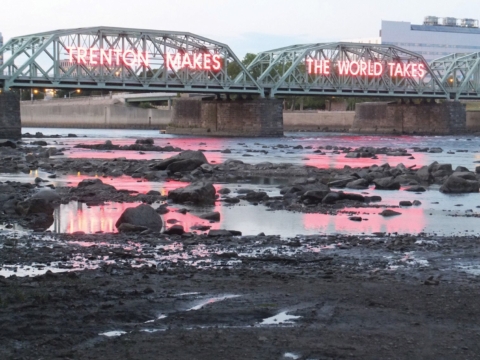
But what about that “Trenton Makes World Takes” slogan?
It came from Health Lumber owner S. Roy Heath, the 1910 winner of a Trenton Chamber of Commerce-sponsored contest to create a slogan for the then current Lower Bridge. The words commemorated Trenton’s former status as a world producer of ceramics and metal.
DRJTBC info says the bridge’s down-river truss displays the slogan, but the original sign was installed on the former iron bridge in 1917 and was illuminated with 2,400 incandescent light bulbs. The first neon sign was installed on the current bridge in 1935. It has been replaced several times since. And the current 334-foot sign — 25 capital letters standing 9-foot 6-inches high — was installed in 2005 and outfitted in 2018 with an LED lighting system that the commission says is “capable of creating 16 million color variations.”
Despite changes in city manufacturing, the sign become a regional trademark and has appeared on everything from the album cover for internationally known Trenton saxophonist Richie Cole’s “Trenton Makes,” films including John Sayles’ 1983 “Baby, It’s You” and the Janet Evanovich novel-inspired “One for the Money” in 2012, numerous postcards and posters, and even part of a mural in New York City’s Penn Station featuring a poem by nationally recognized and formerly Trenton-based poet Pablo Medina.
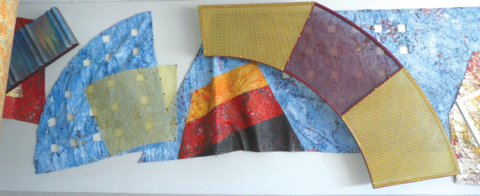
There is also “Trenton Makes Skies Waters Spinning Wheels Red Blue,” noted American artist Sam Gilliam’s 7-by-60-foot acrylic, steel, aluminum, and canvas public art work inspired by the Lower Trenton Bridge and the “Trenton Makes” slogan. The artwork was installed in the Richard J. Hughes Justice Complex in Trenton in the 1980s.
Donnelly brings up the bridge’s appearance at the conclusion of the master filmmaker Fritz Lang’s 1954 film, “Human Desire,” where noted actor Glen Ford sits in a train window showing the “Trenton Makes” slogan as the train crosses the Delaware River.
But it is more than just the appearance that engages the former journalist. “The toll bridge doesn’t appear in it,” he says about the span between the railroad bridge and the Lower Trenton Bridge. “No one knows how it was done. Was it in the studio? Did Lang actually film it by having a camera on a truck with a fabricated engine cab? Or was it done in the studio with old film in the background that predated the toll bridge? Nobody knows. That’s a mystery I could research.”
Meanwhile, Donnelly is busy informing the public about developments with the new Scudders Fall Bridge, writing notes about its unfolding history, and becoming a bridge himself — one that spans the river of time.