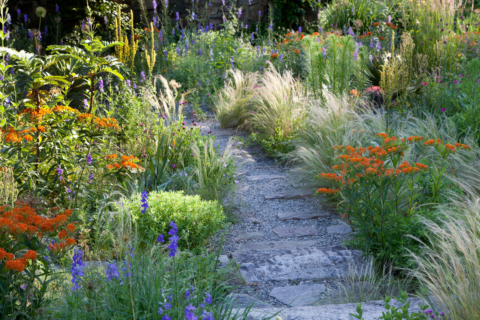
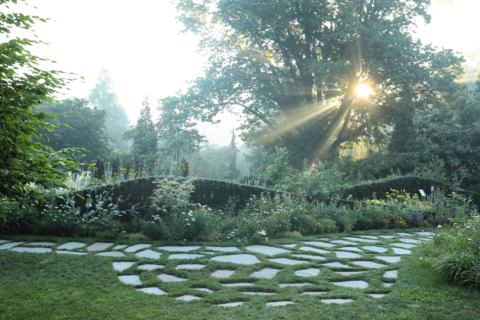
The most romantic and among the most beautiful gardens in America is just a one hour drive from the U.S. 1 area. The garden, Chanticleer, was created from a gift of Adolph G. Rosengarten Jr., Princeton Class of 1927.
Dolph, as he was known to his Princeton classmates, provided in his will that his 31-acre estate in Wayne, Pennsylvania, become a semi-public pleasure garden. Fortunately — the year was 1990 — there was not a legally binding definition as to what constituted such a garden.
Christopher Woods, who was hired shortly after as executive director, decided that a touch of theatricality was needed among the majestic trees and swaths of green lawns in the serene estate setting. Accordingly, he took some of the newly hired horticulturists — among them Lisa Roper and Dan Benarck, who have now been on the staff for more than 30 years — on trips to view world-renowned gardens in Italy and England. With this exposure the two were set free to use their concept of creativity in designing assigned garden areas within the grounds. That format set the modus operandi for the evolution of the estate.
Individuality, then, is rampant among Chanticleer’s many gardens. Today, there are eight horticulturists free to not only design but also to be responsible for the planting and maintenance of their designated gardens. As Roper notes, this singularity is among the many attributes making Chanticleer unique.
With the arrival of Bill Thomas (officially R. William Thomas) as executive director in 2003, both the size and the mission of the garden have expanded. Thomas saw to it that the 10-acre property across from the entrance was acquired, ensuring that the bucolic countryside setting outside the garden’s properties would be maintained. He has expanded the cultivated area — it now covers 35 acres — and added structures for staff and property maintenance. And he led to the garden being viewed as a whole with connecting paths that lead from one design to another rather than having the estate consist of piecemeal designs.
Thomas has also emphasized environmental stewardship and introduced an education component. This last was a bit tricky, as a pleasure garden differs significantly from a botanical garden in that it neither carries out research nor is a center for horticultural education. The solution: while there are no white or metallic name tags on plants (thus preserving vistas of beauty), there are charmingly, individually designed and constructed Plant List Boxes located in 12 of the gardens. These contain pictures and identifications of the plants in bloom at the time of a visitor’s arrival.
For true plant geeks, there is a 616-page Master Plant Inventory of the thousands of plants to be found on the grounds. Located on the website and updated in March of every year, the list contains not only every plant and its location but also its source. There are, for example, almost 375 hydrangeas found throughout the grounds. Among these there are dozens of bigleaf hydrangea cultivars, an abundance of oakleaf hydrangeas, and three of the rare Hydrangea longipes (which has yet to acquire a common name).
With the Plant List Boxes and the Master Plant Inventory, there is a lot for an inquisitive visitor to digest. The horticulturists found working throughout the property are happy to answer any questions, whether they be about a specific plant or where to find another garden. And they will also engage in conversations about the design and the plants they chose. New plant introductions and design modifications — often due to the effects of climate change — take place yearly.
Despite all this expanded activity, Chanticleer remains true to Rosengarten’s wish that it be a pleasure garden, one of large, sumptuous, beautiful scenes and charming, private enclosures that soothe and calm one’s soul. This pleasure concept even extends to the gates, fences, and chairs throughout the grounds where individual creations by the staff can be found.
There are now 16 named gardens at Chanticleer. A map on the website shows the location of each and the circular, winding path connecting them. To view all involves a leisurely one-mile stroll. The walk, however, is punctuated by the individually designed armchairs for rest or for viewing.
The Tennis Court, the site where the Rosengartens played the game, was the first garden to be developed. It reflects its heritage in the rectangular shapes of many of the beds, and there its historical accuracy pretty much ends. Although white remains an important color component, it is blended with soft yellows and then spiced up in summer with flowers in deep reds and splashy oranges.
Bell’s Woodland is the newest garden and it is still being developed, celebrating the flora of eastern North American forests. While spring is definitely the time to visit any woodland garden, summer color has made its way into the cool shady paths here. You may wish to check out the rare Swamp Leather Flower vine, with its dark purple to soft lavender blossoms, twining up the trees throughout summer.
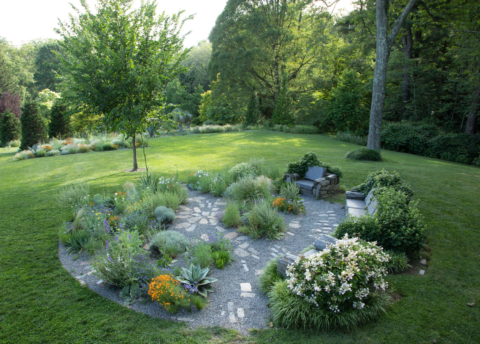
My favorite is the Gravel Garden. It is just simply gorgeous. And in a sense it is also new as a huge tree came down recently and Lisa Roper, the horticulturist in charge, had to expand and redesign some of the area. This is a sun-baked garden with flowers and foliage rising from grayish white gravel. It is filled with lavender, soft blue, purple, and orange blossoms among waving, feathery grasses and thick, prickly solidly green leaves. While it has absolutely nothing of interest that I can apply to my Princeton garden, I could sit in one of the nearby chairs for at least half an hour and savor its awe-inspiring vista.
That’s what I really like about Chanticleer: while you can learn a lot you can also simply enjoy the beauty of it all. You might also find this true.
Visiting & Picnicking
As far as a visit goes and, yes, there are picnic areas, it appears that every day is different. The garden is officially open this year from Wednesday, March 27, to Saturday, November 3. There are varied entrance times with the most common being from 10 a.m. to 5 p.m. From now through August 30, the gardens will be open until 8 p.m. on Fridays. Chanticleer is wheelchair accessible.
Parking is free, but reservations are required — some of the time. As of July 10, reservations are not needed for Wednesdays or Thursdays. And they are not required after 3 p.m. Thursday, Saturday, and Sunday but must be secured through 6:30 p.m. on Fridays.
There are four designated picnic areas on a first-come, first-served basis. Refreshments are not sold and guests are required to carry out what they carry in. You are welcome to bring a blanket on Friday evenings from 4 to 8 p.m. and choose a comfortable site anywhere in the garden. Finally, there are restrooms.
The admission fee for adults is $15; children 12 and under are free. The very detailed website includes directions and much more information.
Chanticleer Garden, 786 Church Road, Wayne, Pennsylvania. From the Princeton area, take Route 1 South to the Pennsylvania Turnpike, I-276 West, then take Exit 20 for I-476 South to Route 30 West. Roughly 55 miles and 1 hour of driving. www.chanticleergarden.org.