Two hundred and fifty years after the American Revolution reshaped both a nation and a university campus, Princeton University Library is commemorating the nation’s upcoming semiquincentennial with two exhibitions that explore revolutionary Princeton through both the founding documents that shaped the country and the lesser-heard voices of the people who lives were transformed by the war.
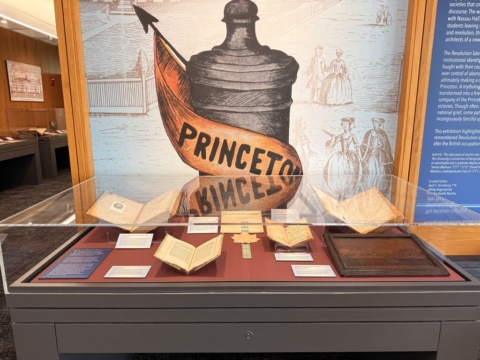
At Firestone Library, “Nursery of Rebellion: Princeton and the American Revolution,” which opened April 15 and runs through July 12 in the Ellen and Leonard Milberg Gallery, places nationally significant Revolutionary artifacts alongside deeply personal records from the period.
On May 21, “Real and Remembered: Princetonians Caught Between Study and Revolution” will open at Mudd Manuscript Library, where it will remain open through April 30, 2027, focusing on the student experience during wartime and the political activism that transformed Princeton into a center of revolutionary thought.
The dual exhibitions arrive as institutions across the country prepare to mark the 250th anniversary of American independence in 2026. But rather than approaching the Revolution solely through military victories or iconic founders, Princeton’s exhibitions aim to immerse visitors in the complexity, uncertainty and humanity of the era.
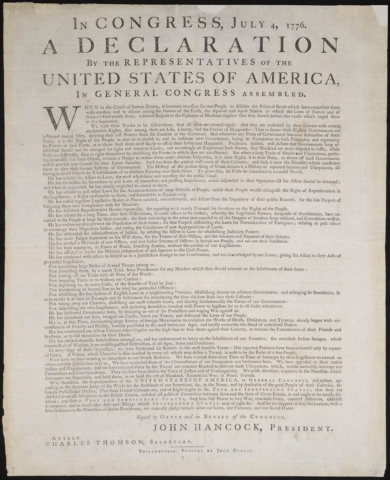
At the center of “Nursery of Rebellion” are some of the most recognizable documents in American history: an original “Dunlap Broadside” printing of the Declaration of Independence and one of only 14 known surviving original copies of the U.S. Constitution.
The Dunlap Broadside, printed on the night of July 4, 1776, by Philadelphia printer John Dunlap, represents the first public printing of the Declaration of Independence. Unlike the famous engrossed version displayed in Washington, the broadside was produced quickly and distributed throughout the colonies to announce independence.
“Princeton is fortunate to hold one of the 26 surviving copies of the first printing of the Declaration of Independence and one of the fourteen known copies of the first printing of the Constitution,” said Gabriel Swift, librarian for early American collections and co-curator of the exhibition alongside Princeton history professor Michael Blaakman. “These two documents serve as the opening pillars of our exhibition, capturing the birth of a nation and the foundation of our democracy.”
But the exhibition also explores the experiences of ordinary people who lived through the Revolution through letters, diaries, poems and manuscripts connected to Princeton and the surrounding community.
For many visitors, seeing those documents in person may be the exhibition’s biggest draw. But the exhibition intentionally moves beyond the nation’s founders to examine the local and lesser-known experiences that unfolded alongside the Revolution.
“Balancing the national with local allows us to tell a more complete, and ultimately, richer amount of the period,” Swift said.
The title “Nursery of Rebellion,” itself reflects Princeton’s Revolutionary identity. Swift said the phrase comes from a 1783 letter written by college faculty to Elias Boudinot, president of the Continental Congress, after Congress temporarily relocated to Princeton following unrest in Philadelphia.
“In the 1783 letter, faculty offered the use of Nassau Hall, but apologized for its dilapidated state as it still bore the ‘marks of military fury,’” Swift said. “The building had suffered hard use as a Continental barracks and had been a target of the British army’s ‘peculiar and marked resentment’ on the account of the college’s reputation as a ‘nursery of rebellion.’”
That reputation was not accidental. Princeton’s connection to the Revolution extended far beyond political symbolism. The Battle of Princeton, fought on Jan. 3, 1777, brought the war directly to campus, disrupting classes, forcing students to evacuate Nassau Hall and leaving lasting damage across the university.
Both exhibitions emphasize that Princeton was more than just a setting of Revolutionary history—the war transformed the university’s campus, surrounding community and identity.
That spirit of rebellion appears throughout “Nursery of Rebellion.”
Among the artifacts are correspondence between George Washington and James Madison, letters exchanged by Alexander Hamilton and Elizabeth Schuyler Hamilton and works by enslaved poet Phillis Wheatley, including a signed copy of “Poems on Various Subjects: Religious and Moral” and a published copy of her letter and poem to Washington.
The exhibition also highlights stories often overlooked in Revolutionary histories, including three Lenape students who studied at Princeton during the war, as well as Black patriots and enslaved individuals whose wartime contributions, Swift said, “survive in only a scattering of extant documents.”
“The primary challenge is the scarcity of material that speaks to the experiences of everyday citizens,” Swift said. “Thousands of letters, manuscripts, and books survive to give us a deep understanding of the role of the nation’s founders. For others, such as Prime, a local enslaved man who served in the Continental Army as a wagon driver, or Caesar Ferrit, a free Black patriot who served in the Massachusetts militia, their war-time contributions survive only in a scattering of extant documents.”
The exhibit also aims to immerse visitors in the physical world of Revolutionary-era Princeton. “Objects such as an engraved powder horn from the Seven Years’ War or the hand-drawn watercolor maps that document local campsites of Washington and Rochambeau’s troops vividly bring the period to life,” Swift said.
Swift hopes younger visitors experience “the thrill and excitement of engaging with original 18th-century documents and artifacts” and that the exhibition’s many highlights inspire students “to seek out deeper dives into the historical archive.”
Still, one of the exhibition’s larger goals is challenging simplified understandings of the Revolution itself.
“We tend to think of the Revolution in pretty black-and-white terms: the colonists waging a straightforward and noble struggle for political liberty against the British empire,” Swift said. “By drilling down into local experiences, and the ways the war reverberated throughout the community, we hope this exhibit helps visitors see that people experienced the Revolution in wildly different ways.”
The exhibition ultimately asks visitors to reconsider the Revolution not as a single shared experience, but as a moment that affected people in profoundly different ways.
“For some, it was a source of opportunity and idealism,” Swift said. “For others, it was a deep time of uncertainty, tragedy, fear, and loss.”
That emotional and personal perspective continues in “Real and Remembered,” though through a much more intimate lens.
While “Nursery of Rebellion” explores the Revolution through nationally significant documents and overlooked historical perspectives, “Real and Remembered” examines how the war transformed daily life on Princeton’s campus.
Curated by April Armstrong, Ashley Augustyniak and Rosalba Varallo Recchia, the exhibition traces how students became politically engaged following the passage of the Stamp Act in 1765, protesting British policies through boycotts, speeches and acts of defiance.
Students refused to wear imported British cloth, choosing homespun garments instead. Others wrote fiery commencement orations or famously burned tea on campus in 1774.
“We wanted to bring something that’s unique from our collections to contribute to that conversation,” Armstrong said of the exhibition’s focus on student voices.
The exhibition draws from Princeton’s university archives, particularly letters and records documenting student life during the Revolutionary Era. Through those documents, the exhibit reconstructs what it felt like to live on a college campus during one of the most politically volatile periods in American history.
For Armstrong, one of the exhibit’s most striking themes is how recognizable many of those students still feel centuries later.
“People are pretty much the same as they always were,” Armstrong said. “These are college students, and they have the same feelings as college students everywhere.”
One featured letter from student Charles Clinton Beatty begins not with politics, but with ordinary frustrations. Beatty writes about missing home and struggling with professors before casually mentioning that students had gathered Princeton’s supply of tea and burned it in protest.
“He was just writing about his life, and the big dramatic protest that is a part of it,” Armstrong said.
Another student, Peter Elmendorf, wrote extensively about the poor quality of food at Princeton before shifting into anxiety about whether his family was safe as the war intensified.
The exhibition also examines how the Battle of Princeton and the broader war transformed everyday campus life overnight.
In late 1776, word spread through Princeton that British troops were approaching the town. Armstrong described students gathering as Princeton president John Witherspoon announced that college would close immediately.
“Everybody just sort of stared at each other in distress,” she said.
Students living in Nassau Hall evacuated quickly, many leaving behind furniture, clothing and personal belongings as British and Continental troops moved through Princeton.
“Most of them just left everything behind,” Armstrong said.
The emotional impact of the war lingered long after the fighting itself. Nassau Hall suffered extensive damage during military occupation, while Princeton struggled for years to regroup after the war and resume normal campus operations.
Armstrong said one of the exhibition’s central goals is helping visitors understand the Revolution not as distant mythology, but as a lived human experience.
“There’s this saying ‘the past is a foreign land we can never actually visit,’” Armstrong said. “We wanted visitors to be able to relate to these people and see them as regular citizens.”
That connection between past and present extends beyond the Revolutionary era itself.
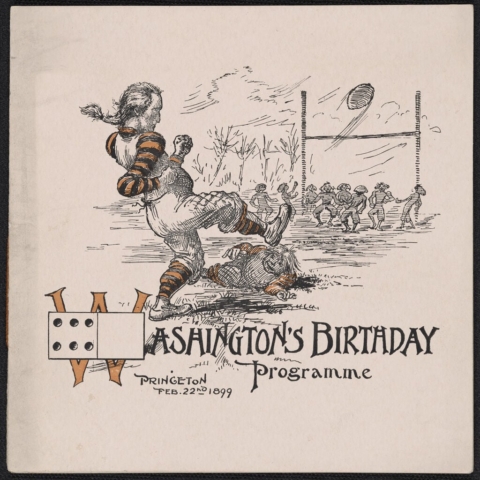
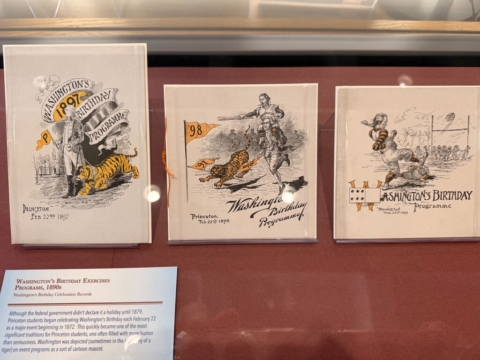
Armstrong noted that student activism has repeatedly echoed across generations at Princeton. During the revolution, members of the Class of 1770 refused to wear regalia in protest of British textiles. Two hundred years later, Princeton’s Class of 1970 similarly refused to wear regalia during the commencement as a protest against the Vietnam War.
“I think it’s striking that both groups of students 200 years apart chose the exact same protest method,” Armstrong said.
For Armstrong those parallels reinforce the idea that political engagement and uncertainty are not unique to any single generation.
“A lot of students today have a lot of anxiety about the future,” she said. “But so did these Revolutionary-era students.”
In “Real and Remembered,” those anxieties are preserved not through sweeping political declarations, but through deeply personal letters written by students trying to make sense of a world changing around them. By focusing on those everyday experiences—homesickness, fear, protest and uncertainty—the exhibition reframes the Revolution not simply as a historical event, but as a moment lived in real time by young people caught between their education and the upheaval unfolding outside Nassau Hall.
Together, the exhibitions invite visitors to see the American Revolution not as a distant chapter preserved only through famous names and monumental events, but as lived experience shaped by uncertainty, conflict and ordinary people trying to navigate a rapidly changing world. Through rare documents, personal letters and overlooked stories, Princeton’s Revolutionary past becomes less about legend and more about the individuals who studied, protested, feared and persevered through the upheaval unfolding around them.
Both exhibitions are free and open to the public during gallery hours. Online: library.princeton.edu.