The future at Princeton Plasma Physics Lab has always been fusion. In 2024 it’s extending its reach into diamonds, quantum materials, and other areas of plasma physics.
So far this year PPPL has announced a new High-Field Magnet Test Facility, the Quantum Diamond Laboratory, another type of fusion device known as a stellarator, and broke ground on the Princeton Plasma Innovation Center, a cutting-edge research hub focused on cultivating a bright future of fusion energy.
PPPL is a collaborative national facility overseen by the U.S. Department of Energy and managed by Princeton University on the latter’s Forrestal Campus in Plainsboro.
Its overarching mission to advance plasma science through decades of experimentation and innovation has strived “to solve a grand scientific challenge of the 21st century — harnessing on Earth the fusion energy that drives the sun and stars to produce a safe, clean, and virtually unlimited source of power for generating the world’s electricity.”
From Cold War Research to the Future of Fusion
Plasma, the fourth and most common form of matter, is a heated, ionized gas of charged particles with the ability to conduct electricity.
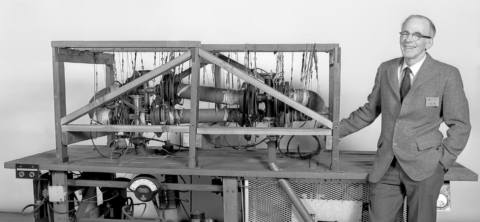
According to the PPPL website, pppl.gov/about/history, the laboratory’s founder, Princeton University astronomy professor Lyman Spitzer, Jr., conceptualized the stellarator — a device that confines high-temperature plasma in a figure-eight orientation with a “twisty” external magnetic field — to study controlled thermonuclear reactions more than 70 years ago.
Spitzer took this proposal to the Atomic Energy Commission in March, 1951, and by July of the same year, they had approved his funding. The Cold War-era research project was code-named “Project Matterhorn,” a classified government initiative formed to develop the hydrogen bomb. Two years later, Spitzer unveiled the first model of the stellarator. By 1961, the national nuclear weapons effort had ended, the Project Matterhorn research was declassified, and the site was officially renamed the Princeton Plasma Physics Laboratory.
Fusion energy evolved further with the adoption of the tokamak approach, a method for containing plasma in a doughnut-like design, or torus. PPPL’s Tokamak Fusion Test Reactor, or TFTR, “became the first in the world” to combine equal amounts of the hydrogen isotopes deuterium and tritium, “yielding an unprecedented 10.7 million watts of fusion power.”
Tokamak technology now serves as the basis for PPPL’s three major research projects, including its “primary fusion experiment,” the National Spherical Torus Experiment-Upgrade, or NSTX-U, which features a more modern tokamak design that resembles a “cored apple,” according to the NSTX-U page on the PPL website.
The difference between fusion and fission nuclear reactions is that while both produce energy for electrical power, the process of fission splits atoms, while fusion joins them together. Fission reactors produce toxic waste with long-term health and environmental risks, as demonstrated by catastrophic events such as the 1986 Chernobyl disaster.
To combat climate issues and dependence on limited, harmful resources like these and fossil fuels, scientists hope to replace power plants that burn fossil fuels with those that use fusion energy as a carbon-free solution that produces no greenhouse gasses.
In 2021, the U.S. Department of Energy launched a program to create a pilot fusion power plant and a commercial fusion reactor by the 2030s. The NSTX-U, which is currently undergoing a recovery project to rebuild and enhance the device after one of its coils failed in 2015, is seen as the “ideal candidate” for such a project.
While the NSTX-U is estimated to be 83 percent complete and set to relaunch by 2025 or 2026, PPPL continues to make progress with the Lithium Tokamak Experiment, a smaller-scale fusion reactor incorporating liquid lithium, into its tokamaks.
PPPL scientists and engineers are also playing an active role in the construction of the International Thermonuclear Experimental Reactor, or ITER, a joint collaboration between nearly 35 countries to build “the world’s largest tokamak” in southern France, according to the ITER website, iter.org/proj/inafewlines.
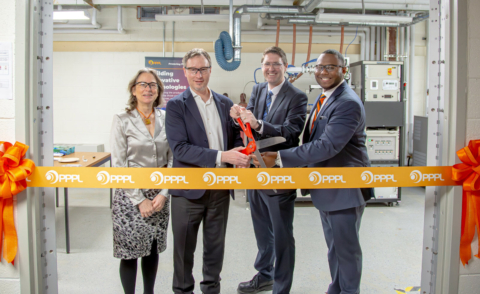
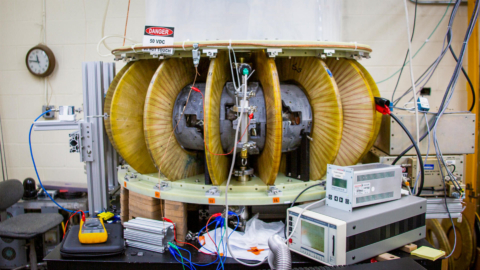
In January, PPPL unveiled the High-Field Magnet Test Facility, a laboratory dedicated to the collaborative engineering of powerful, superconductive electromagnets for use not only in academic experiments, but also for private industries “along the mid-Atlantic coast.”
Building robust magnets with similarly strong magnetic fields, as principal engineer Yuhu Zhai explains in a press release, is another step towards improving tokamaks for PPPL’s planned fusion power plants.
Most recently, PPPL debuted a new stellarator called MUSE. According to an April press release, instead of opting for more expensive and “complicated” electromagnets, MUSE relies on permanent magnets to generate magnetic fields without electricity to “show a simple way to build future devices for less cost and allow researchers to test new concepts for future fusion power plants.”
A Diamond Lab
PPPL’s Quantum Diamond Laboratory opened on March 11 as a sparkling example of the convergence between plasma and quantum information science, growing plasma to synthesize diamond material and quantum bits, or “qubits,” which can be used to fabricate devices for advanced sensors, microchips, and computers. By creating quantum diamonds on site, the lab takes a step towards a future of applications in microelectronics, medical diagnostics and imaging, and GPS navigation.
Dr. Alastair Stacey, a managing principal research physicist at PPPL and a leading expert in quantum diamond technologies, previously worked in the diamond industry with the company Element 6, where he spearheaded efforts to develop diamond materials and devices for quantum applications.
“I’m a quantum material scientist, so I work at the intersection between quantum physics, devices, and the materials that we need to make those quantum devices work,” says Stacey, who holds a joint appointment at PPPL and as a professor of physics at the Royal Melbourne Institute of Technology in Australia.
“Essentially, the quantum diamond lab is a new opportunity for the Princeton Plasma Physics Lab to use its plasma expertise for something that’s not fusion-related,” he explains, utilizing low-temperature plasmas in alternative ways for PPPL to use “that skill set to develop quantum materials, which is not something that’s been done here at the lab before.”
“In a sense, it’s a marriage of the quantum materials interest that I have with the plasma capabilities that the lab has, and from my perspective, the real advantage is that I need to use plasma to grow diamond,” he says, adding that, as a user of the technology, coming to the lab to work directly with plasma experts means he can find solutions to problems he would not have been able to tackle alone. “It’s really leveraging that existing expertise that’s already at the lab and using it for something else — and then in our space, that means making better material, making better devices.”
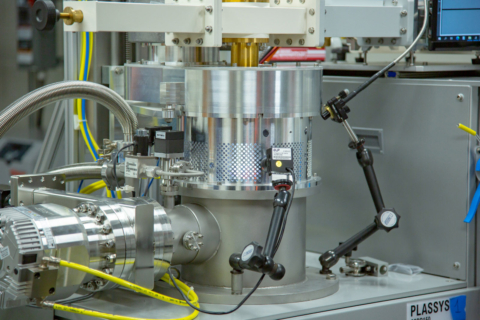
The “ambitious” facility currently features three commercial reactors that generate the plasma needed to make diamonds, allowing the scientists to simultaneously dope — or add impure atoms to a pure semiconductor to enhance its electric conductivity — in separate machines. According to Stacey, a “fourth, larger system” is expected to come at the end of the year.
“The way that we’ve designed this lab is that some of these reactors are being designed to grow material for people who need to use the material and measure material, and then one of the reactors is specifically purchased and being configured specifically to do the plasma physics — not to actually make the material, but to understand how the tool operates, and how the plasma works,” he adds.
The team utilizes the talents of three principal scientists at PPPL, including Stacey on the quantum physics and materials side, plasma modeling specialist Igor Kaganovich, and plasma diagnostics expert and spectroscopist Yevgeny Raitses.
“We deliberately designed the lab to take advantage of that team of expertise, and that’s one of the reasons why we need more than one reactor,” Stacey says, noting that the QDL will encourage active collaboration while ensuring equal space for the people who use, operate, and design the equipment in a concept known as ‘co-design.’
“You need them all to be in the same room to really develop the technology the best way,” Stacey explains. “But where the Department of Energy often really excels is when you have something like a user facility, where people don’t have to be experts in the material or the growth of the material, but they know they need to use the material, and they know that they need their material to be a little bit different from everyone else’s. What we can do is provide the opportunity to work with all of those collaborators. We have many academic and industry collaborators that are interested in what we can do, and then we can not only grow material for them, but we can also work with them to improve the technology of that growth.”
“You need a certain number of people just to get that technology right, and it’s really hard at a university to have enough resource[s] to play that role. Universities are usually single people doing their experiments, so again, that’s where the Department of Energy really excels, and that’s really what excited me about working here on that,” he adds.
“The way I view the field is that we’re really on the cusp of something pretty exciting, especially with the diamond and the quantum materials in general as well, where we’ve gotten to the point where we know that you can use this material in a way that’s really going to make a difference in, for example, medical imaging or medical diagnostics. But currently, we’re at a point where people have proven that it’s possible, that they’ve done that with the materials and the systems that they have available, which means it’s limited in what it can do,” Stacey says.
For companies of all sizes to realize the true scope of diamond’s capabilities, Stacey explains that the technology must “be maximally useful and really deliver on the promise that the academic literature now says it has; you have to have a little bit more than just one reactor that can do one thing with the set of gasses that I happen to be allowed to use in my one lab.”
Beyond the technical benefits of multiple reactors, he continues, the additional machines allow scientists to make fewer compromises and produce better results.
“Diamond, because it’s an extreme super-material — and we’ve known that it’s an extreme super-material for a long time — it has gone through a couple of phases of funding, especially in the U.S., where everyone gets excited, they put money in, it doesn’t quite fulfill the potential, and then you have this winter where people don’t fund it as well, and then somebody makes a breakthrough, and then there’s more money,” he explains.
“I think we’re in the third wave, and we’re actually getting to the point now where it’s really actually working, and our job is not to try and prove that it can work, it’s to actually make it work, and one of the big things that we will be working on in the future is how to turn something that works on a single sample, a single device level, and turn that into what people call a manufacturable process,” meaning it can produce more affordable devices “at scale.”
“I think a lot of people are aware that synthetic diamond gems have become a big thing in the last few years, and that’s really the culmination of a few decades of development of diamond growth technology,” he adds.
But because of that progress and gems being “not as demanding” of a material, Stacey remarks that science has reached the point “where we can start doing that next step, which is to get high-quality material and use it for technological applications.”
While developing diamond technologies for quantum applications is the primary goal, Stacey explains, there are a host of other opportunities, from electronics to medicine. Many of these, however, are not visible to the naked eye and often work in the background, such as the microchip in a phone.
According to Stacey, these diamond materials have matured to the point where they are no longer just a potential technological resource, but one that can be harnessed for innovation.
“In a sense, the sky’s the limit for what we can do here. Once the lab starts developing that material science expertise, then we’ll be able to see a lot more,” he adds.
A Quantum Idea Becomes Reality
Stacey credits Nathalie de Leon, an associate professor of electrical and computer engineering at Princeton University and a member of the Princeton Quantum Initiative, as a longtime collaborator who helped him develop ideas on how to grow diamonds for quantum technologies to make better sensors.
Their conversations, which began when de Leon was a postdoctoral researcher, have evolved over the years to cover everything from different types of doping to the possibility of a new reactor design formulated specifically for growing quantum diamond.
De Leon, who notes she has “essentially zero background in plasma science” of her own, says that concrete plans to launch a quantum diamond initiative at PPPL started to crystallize during the 2020 lockdown.
“What I realized is that there are very few people who have really taken the plasma science aspect of this seriously,” de Leon says in an interview. She continues that most people who grow diamonds view the process as a recipe to follow rather than a way of generating different results based on the intricacies of the growth chamber or the properties of the material.
“There had been comparatively much less work done on actually understanding the plasma itself. I think there was quite a bit of work in the ’90s, but not as much more recently, because back then there was an open question about whether or not you could get to high quality diamond with high growth rates, and then people achieved that and then stopped innovating on the reactor design, so there was less of an impetus to tackle the plasma science as seriously,” de Leon adds.
“Alastair and I started discussing the fact that nobody has really designed a new reactor for around 20 years, and 20 years ago, nobody was talking about quantum anything with diamond, so maybe if you want to grow quantum diamond you need a totally different reactor,” she explains.
De Leon presented the concept to PPPL, which had already been exploring interests in applying plasma to research areas such as microelectronics, sustainability science, and quantum materials. She pitched the project as a perfect fit for PPPL because of the national laboratory’s unique ability to fuse quantum and plasma research, emphasizing that its core commitment to state-of-the-art technologies would have a worldwide impact.
“What we need for quantum applications is a lot of process segregation [and] extremely high purity environments, so the entrance fee is three or four reactors, which is already much larger than what you would do in any academic group,” she says, to avoid problems like contaminated reactors.
According to Stacey, de Leon was able to “find the synergies” between his successes in synthesizing diamonds using plasma vapor deposition and PPPL’s extensive plasma capabilities. Stacey agreed to move to Princeton, and the program advanced with the help of David Graves, the associate laboratory director for low-temperature plasma surface interactions.
In 2021, PPPL officially initiated the beginnings of the Quantum Diamond Lab, and the Department of Energy awarded them a three-year, $5.2 million award for de Leon, Stacey, and Graves to develop a new quantum diamond sensor “with capabilities that range from imaging single molecules to guiding aircraft by detecting slight anomalies in the Earth’s magnetic field.”
De Leon adds that the QDL’s opening in March marked one of the first milestones of the collaboration between Princeton University’s Quantum Diamond Initiative and the PPPL.
“The idea is to tackle the plasma science in a serious way, coupled with all of the quantum characterization on the back end that my lab does, and then to also pursue a serious material science effort where we understand the underlying growth substrate, the material that we grow, how all of these things play with each other in terms of the extended defects and dopants, and then the qubits that we care about,” she says.
De Leon continues that “we’re in this regime that is pretty foreign for the semiconductor industry,” noting that because quantum applications require extremely high purity and quality materials, they must essentially “invent a new playbook” for this level of material science.
Of the team that will be using the lab, de Leon adds that Kaganovich “has put together state-of-the art numerics and modeling packages in the context of the kinds of plasma physics that they do at PPPL,” including multiphysics modeling, which will “be critical for understanding growth chemistry.”
Furthermore, the team includes Raitses, who has pioneered new techniques in plasma spectroscopy and diagnostics. “The idea is to try to build some of his state-of-the-art diagnostics tools, actually bolt them onto chambers that are growing state-of-the-art quantum-grade diamond, and then use that information to learn how to do things better. A medium-term goal would be to come up with changes to the reactor design that are based on knowledge that we get from doing this combined diagnostics and modeling effort,” she adds.
De Leon credits Emily Carter, the associate laboratory director for applied materials and sustainability sciences, and PPPL director Steve Cowley for supporting the new direction, and on the project management side, she also thanks Eric Bourgie, PPPL facilities project manager for the QDL, and Phil Efthimion, who “adopted us midstream” and helped them navigate the laboratory system.
According to a PPPL press release by John Greenwald from September 2021, the “creation of diamond sensors calls for the synthesis of designer diamond material that begins with a diamond seed that is built up through the gradual deposition of plasma-enhanced vapor. The trick is to replace carbon atoms of the growing material with nitrogen atoms and vacant spaces — a combination referred to as NV centers in diamonds. This combination creates the sensor and is commonly called a color center since it glows red when a light shines on it.”
As the text continues, “the tricky materials design requires the exquisitely careful doping, or implantation, of nitrogen atoms together with the creation of vacant spaces in the color center. The doping is done with microwave reactors that produce the plasma-enhanced vapors that enlarge the diamond. These reactors are in some ways similar to the microwave ovens used in homes but are modified to enable them to ignite plasmas.”
“Diamond is not actually the stable form of carbon at atmospheric pressure. Normally, the way that you would get a diamond is by going deep into the earth where you have around ten gigapascals of pressure,” De Leon says as an example, noting that these conditions are where diamonds can actually form, and most of the early work on making synthetic versions sought to mimic those conditions.
Diamonds grown in this manner tend to have a lot of impurities, such as a yellow color that can come from the inclusion of nitrogen, or defects that render them unusable for quantum applications.
“For quantum applications, because what we’re fundamentally trying to do is take a specific defect — in our case, it’s usually the nitrogen vacancy center, which has very long spin coherence times even at room temperature — and then we want to isolate that defect to preserve its quantum properties,” she explains, which means finding a “quiet environment” by synthesizing high-purity diamond.
“If you have a lot of impurities around it, those impurities can lead to either fluctuating charges or changing magnetic fields, and then that destroys this delicate quantum coherence that you’re trying to preserve,” she explains. The current method for growing such high-purity diamond utilizes plasma to grow the diamond under conditions where it is not actually stable.
Even at baseline, the plasma-based chemical vapor deposition process renders high-purity samples that can be a solid starting point for eventually reaching “the sub-part per billion level” needed for quantum applications.
Interdisciplinary Innovation
“I would say the thing that is very exciting about quantum is that it’s sort of the birth of a new field, which you don’t really get to see that often,” de Leon observes.
“There are a lot of people who have been thinking carefully about the theoretical implications of quantum mechanics in information theory, and then in parallel, there’s a lot of people, myself included, who have been building more and more sophisticated quantum systems that we have better and better control over — control meaning that we can manipulate the quantum states and make them with extremely high precision, that we can make very large-scale systems with many qubits that talk to each other — and basically, what’s now happening is that by merging these groups of people, we have a completely different frontier for research.
“But because this comes from very different communities, it’s intrinsically extremely interdisciplinary, and that means that it doesn’t necessarily all fit inside of one department naturally, but what you’ll see is across a campus, several departments that house people who are thinking about quantum science and quantum technology.”
While the Princeton Quantum Initiative is now an official collective showcasing the strength of Princeton University’s ongoing investments in quantum science, the group started as a “grassroots effort” of like-minded faculty and students on campus, according to de Leon.
“The purpose of a campus-wide initiative is that it gives a way for those people to find each other, talk to each other, and catalyze new directions by collaborating with one another,” she says, noting that PQI helped “expand that community, formalize a lot of what we were doing, and then there was this fairly significant investment in, for example, postdoctoral fellowships and graduate student fellowships, and now a new building, that allowed us to really solidify the community.”
A New Fusion Research Center
This group continues to grow with the introduction of the Princeton Plasma Innovation Center (PPIC), a new fusion research center for computation and engineering that provides infrastructure for expanding research interests in quantum materials, sensors, devices, microelectronics, and sustainability science on campus. Designed by architectural firm SmithGroup, the PPIC is a multi-million dollar project that combines modern laboratory, collaborative, and office spaces for local and international scientific communities with the latest equipment and energy-efficient features.
A groundbreaking ceremony on May 9 marked the start of construction and is projected to be completed by 2027, according to the PPPL website.
Dr. Emily A. Carter is the senior strategic advisor and associate laboratory director for the applied materials and sustainability sciences, or AMSS, directorate at PPPL. She is also the Gerhard R. Andlinger Professor in Energy and the Environment and a professor of mechanical and aerospace engineering at Princeton University, as well as the former dean of the School of Engineering and Applied Science.
Carter, who came to PPPL with more than 15 years of experience in sustainable energy technology and carbon mitigation, says the AMSS division has four main areas of research with projects using low-temperature plasmas: microelectronics; quantum materials and devices; electromanufacturing; and aerosol science, or the study of how small particles can be used in climate intervention strategies to combat the effects of global warming.
Carter explains that prior to her time at PPPL, current laboratory director Steve Cowley had the idea of diversifying the lab beyond fusion energy and taking advantage of PPPL’s access to world-renowned plasma experts working on site. She acknowledges that while plasma’s place in fusion energy remains a top priority for the laboratory, there has also been a realization at PPPL over the past five years that the site’s scientific expertise could be key to helping manufacturers transition away from burning fossil fuels.
“Those industrial processes lead to a huge amount of carbon emissions, so what I recognized — and we have a really terrific group of people in the Princeton ecosystem that can participate in this, both at the lab and the university — [is] to use electricity, either through creating plasmas or through electrolysis, to essentially substitute for those fossil fuels. If the electricity is generated from a non-carbon emission source like solar or wind or geothermal or nuclear…and eventually fusion, you have the opportunity to essentially recreate the entire manufacturing industry in a clean way, which civilization desperately needs,” she adds.
While “about half of all steps in the manufacturing of computer chips use plasmas,” Carter explains that the industry’s approach to the process lacked a “deep understanding, necessarily, of the plasmas themselves and how these low-temperature plasmas in a fabrication setting for computer chips actually [work].” In response, PPPL scientists began working with major tool developers in California to manufacture semiconductors and measure how the plasma actually interacts with the material.
“The world now understands that there are physical realizations of very crude, simple quantum computers, but the theoretical understanding of quantum computers is advanced enough” so that with the right materials, she says, they could make “very refined quantum computers.” Although these ideas are far from being a reality, Carter believes they “would really revolutionize information technology,” and PPPL is already leading the way by developing these materials for quantum sensors and sensor networks.
Carter says that the microelectronics work at PPPL is so important because, during the pandemic, there was an international scarcity of computer chips for cars due to slowed or stopped production, which limited the number of vehicles that could be made.
But most of the advanced processors in circulation come from direct U.S. competitors like Taiwan, so building a strong, independent industry in the United States could drive economic innovation, according to Carter.
“I think [PPPL] has a real key role to play in helping industry get to the next generation of microelectronics chips and this quantum diamond material, which will be very important for advanced sensing,” she adds.
“It’s a tremendous opportunity for the lab to be a huge contributor to both of those industries that will be important for national security reasons, as well as for just the ability of our society, which is so interconnected because of information technology, for us to have all the devices that we need to power our civilization,” Carter continues. “All countries are going to have to move in this direction, and, from the national perspective, if we can be the ones that discover the best ways to do it, then we can be exporting those technologies worldwide, which is, of course, good for the national economy.”
What drives her, however, is taking these efforts to a global frontier, because “even though we’re getting much closer to reducing our carbon emissions for power generation, that’s only one part of our civilization.” For example, according to the U.S. Environmental Protection Agency, emissions from the manufacturing and industrial sectors “accounted for 30% of total U.S. greenhouse gas emissions” in 2022.
According to Carter, de Leon understood that national laboratories “are set up to do team science and to bring together people from different disciplines to solve problems they couldn’t solve on their own, and at a scale that they can’t solve in their own individual laboratory. The idea [is] that you could build out this place with these reactors that could be both basic science, but also really be working on things that the industry cares about,” she explains. “Applied work is something [that] you only really find at national labs, and so that was recognized by both PPPL and in Princeton, and this particular area was recognized as a key enabler material for quantum technologies.”
Carter concludes that she feels PPPL could become “the go-to place” in the country, or even the world, for experimenting with, understanding, and advancing quantum diamond devices. She hopes that adding the fourth reactor to QDL’s repertoire will make PPPL “a national resource” for learning how to control and create the material, drawing on the facility’s historically “deep knowledge of plasmas.”
Princeton Plasma Physics Laboratory, 100 Stellarator Road, Princeton. www.pppl.gov.