Irena Gobernik smiles and sits back in a chair at a table in the small gallery concert space in her home near Riverside School in Princeton.
“I am still thinking,” she says of her upcoming January 21 puppet-making workshop to be held at the West Windsor Arts Center.
It’s one of the projects related to the Artists for Ukraine Fund launched in December by noted area artists Ilene Dube and Madelaine Shellaby.
“I have some general ideas but have not yet developed any details because the workshop is short, three or four hours,” she says. “When I was learning to (make puppets) I was there for several weeks.”
“There” is Prague in the Czech Republic, where the Soviet Union-trained mathematician, parent, grandmother, and self-styled carver of small wood sculptures became unexpectedly enchanted by puppetry during a planned travel layover in 2018.
Gobernik visited a Prague design store and encountered a display of puppets. “I saw each one had a personality, and I fell in love with them. When I came home I googled ‘Puppets in Prague’ and I got the website. That was all I needed. I could apply for the workshop, which was in June the next year and I enrolled. And this is how it all started.”
Since she had experience working with wood sculptures and owned woodcutting tools, Gobernik says joining the workshop “was an unforgettable time. It was the best vacation I have had.”
Another reason, she says, Puppets In Prague invited “other puppet makers to help us and show how this and that can be done. And then at the end (of the program), we performed on a street of Prague. There was a summer festival — a kind of fringe festival — and people came from all over. We were just given a spot to perform, no tent. That was enough for us. Children were sitting around.
“It was inspiring. I am still in contact with my teachers and students from all over the world. There was no sense of age at all. The youngest was 14,” she says.
The attraction continues to be a mystery. “I don’t know,” says Gobernik. “I can’t explain myself.”
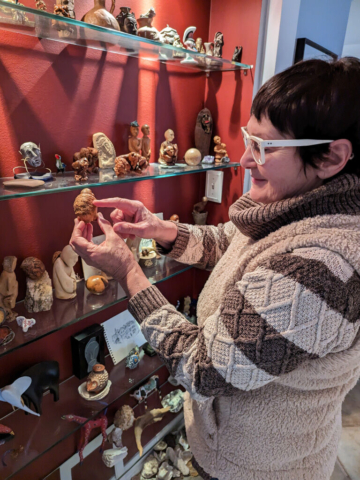
But part of the appeal is that she was already creating “small stuff” — meaning the wood sculptures that fit easily in the hand and are on display in her home.
The first of these small elegant figures was created when she was a teenager living in Almaty, Kazakhstan. “I made one of pine tree bark. I bought a surgical knife and started doing it.
“I didn’t call it art. I never thought of myself as an artist. It was something I loved to do in my spare time. I had a close friend who was a real wood artist, so I saw what he did. We had a different view. He knew what to do, but I don’t draw first.”
Decades later she continues to carve, but her recent interest in puppetry has brought new considerations and new work.
“They’re kind of frozen in the position in which they’re carved,” says Gobernik of the sculptures. “But puppets are definitely something that I have to plan. (Puppetry) is more demanding. I cannot just follow ideas. I need to follow the proportions or I won’t be able to make them play. There are more limitations.”
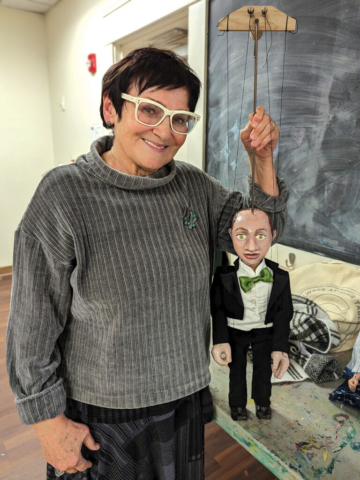
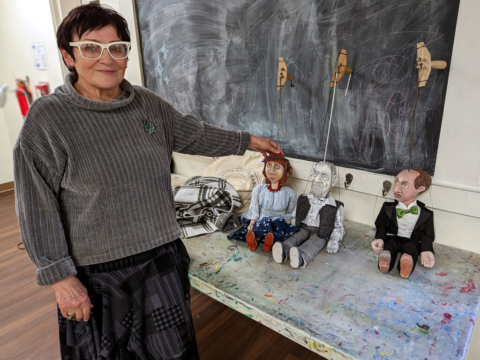
Showing off her small spare workshop in her home’s garage, Gobernik says she has been making five puppets a year. And while some are characters, others are something new: portrait commissions for a gallery owner in Boston.
Gobernik shows a few such portraits created for the Pucker Gallery in Boston. They include octogenarian Sam Bak, a Polish-born American artist who lived under Soviet and Nazi occupation (and shared a mutual friend with Gobernik), and the son of the gallery owner.
Sharing some insight into her thinking, Gobernik says of the latter puppet, “This guy is young. It is hard to make him interesting. He doesn’t have the wrinkle. He doesn’t have something that I could exaggerate a little bit. I wasn’t happy with this guy. The puppet itself came out okay.”
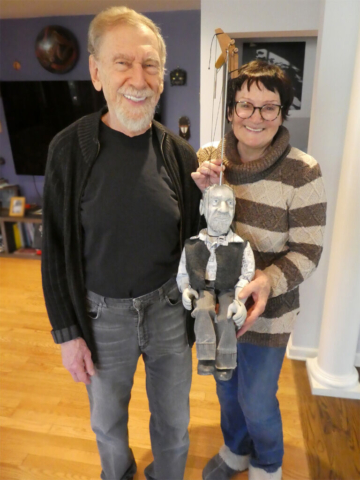
A more than “okay” puppet is that of her husband, Leonid (aka Leo) Vayn, a retired mechanical engineer turned start-up entrepreneur whom she met through a mutual friend. To reflect Vayn’s work in black and white fine arts photography, Gobernik created his puppet portrait in various gray tones.
Since portraits require some telegraphing of the subject’s physical and personal characteristics, Gobernik says they can take a month or more to create, especially if she hasn’t met the subject.
On the other hand, creating puppet characters for shows is easier. That’s because the figures are types that can be designed in the mind and carved out in 10 or 12 days.
Gobernik’s reflections on art seem to contrast her career in mathematics. “I was good in math and I was participating in a lot of competitions,” she says about her choice.
The daughter of a Soviet military colonel and a teacher who met during World War II, she says, “My father dreamed of me as an architect, but I thought if I followed the advice of my father, I’d be a bad architect, which is worse than being a bad mathematician.”
Her interest led her from her home in Kazakhstan to Novosibirsk State University in Siberian Russia — a place she liked after visiting during a math competition.
“Novosibirsk was founded in 1963 as a new scientific center, and that was a piece of freedom. It was so far away from (Moscow). They were doing whatever they wanted. It was a scientific center that the university was part of it. We had professors who were working at the center. There was a very special spirit there. It kind of influenced all my life.”
That includes eventually moving to Princeton, where, she says, “I saw a lot of the same spirit — science and art theaters and people, not so practical.”
Yet before Princeton there were several other stops and starts. After marriage and a divorce, she “went to Israel first in 1999 with my daughter and (five-month-old) grandson. We stayed there for about a year. I understood that I wouldn’t be able to find a job there. I was 50 years old.
“I had an offer from a company in the United States. Markov Processes in Summit. A Russian guy ran the company software for financial analysis. They developed mathematical models for that. They needed someone who could work in math and algorithm and product development.”
The job came from a university advisor who had emigrated in the 1990s and was working at Rutgers. “He recommended me to a company. They made me an offer. I worked with them in Summit for nine years and met my second husband, Leo. I said that was enough for me, I didn’t like working in finance.”
She says after getting a green card she moved to another company and then made an abrupt change, the Dalet Gallery. Its name comes from the Hebrew letter that signifies a door and how it “symbolically represents the choice to open ourselves to the hope of our dreams.”
About its founding, the puppeteer notes, “One of our friends in Philadelphia said, ‘Let’s open a gallery and that will be your work. We opened the gallery on Second Street — between the Clay Studio and the Fireman’s Hall Museum. It is a beautiful area. We had a very interesting time for four years, 2009 to when we closed in 2013. We had excellent exhibitions. We had very good space and created moving walls for different configurations. We had good artists from Europe and local artists from Philadelphia and around New Jersey and the West Coast. We had good reviews. We didn’t have in mind to make money, just to balance. But we were losing money and had to close.
“In the gallery we started doing concerts and reception night first Fridays, and we invited musicians. When we closed the gallery, we just moved this activity here to our home. We have a great piano, a Steinway 1880. It is a good size, and musicians like our piano.”
With a mailing list of nearly 700 people, Gobernik says she and her husband produce a monthly event. “Mostly, it is musical. Sometimes it’s for Russian speakers, poetry and political discussions, especially right now because of the oppression and the war.”
The current Russian invasion of Ukraine is also a concern.
In addition to connecting Gobernik to the Artists For Ukraine fundraising event, it is also part of Gobernik and Vayn’s efforts to support Ukrainians during the invasion. “We did a concert here for Ukraine. We collected $7,000.
“We have connections with Ukraine. My husband’s grandparents were killed during the World War II when they killed Jews there. They lived in small town in Ukraine, and Germans came and killed the family. (Vayn’s) mother was in Russia and wasn’t killed.”
She says that several years ago, Vayn and a few associates developed a project to commemorate Nazi-murdered Jews by creating interactive maps of kill sites and listing the names of victims.
“They still continue the project,” she says. “They made the first of two documentaries, ‘Jews in Ukraine.’”
She adds that in 2019 she accompanied them to Ukraine and notes another connection.
“My mother was born and had lived in Kyiv and in Odessa till 1942. My grandparents lived in Kyiv until 1965. I visited them as a child. When I came to Kyiv in 2019, I found their house — my childhood memory was revived. So Ukraine is not just a geographical place for me.
“It was very natural that we should help Ukraine as much as we could. Jews look at Ukraine with some hesitation, because of antisemitism in Ukraine. But most of the people we saw with our own eyes are different. And they were not born to be killed by Russia.”
When not raising funds or making portraits, Gobernik continues working as a math teacher for the (national education program) Art of Problem Solving Academy — or as she puts it, “Teaching kids who are bored at school.”
Hopefully, helping such students to understand that, “Math is a language and tool, yet it exists by itself, outside of people. That was what I found attractive.”
She also notes that the teaching is also “just for me to keep my mind working.”
Although that mind already seems to be in overdrive when she turns back to puppetry and says she is experimenting with oil paint — rather than fast-drying acrylics — to create different effects and subtleties. She also recently learned to sculpt from plasticine to create more realistic portraits and get a better understanding of anatomy to construct more effective bodies.
And now she’s creating her first puppetry workshop that, she says, “will not include carving. I will prepare all the parts of the puppets. The design will be simplistic. Puppets on wire. For flexibility. Four strings and one wire that goes through the head. I will prepare all this. The students will finish it with sandpaper. Then they will assemble it, which is important. They will paint it and using acrylic paint so it dries right away. And if they have time, they will also make cloths.”
She also hopes participants may find something of the mystery that she experienced when she first encountered puppetry.
“I am 70-plus,” she says, again smiling in her seat. “This is something new in my life. It is something that brings me a new horizon. It is something with the creator, and, even if no one sees what I am doing, it is some creation. Even if it is destroyed, it existed. And I created it. I brought something to this world.”
Puppet Making Workshop, West Windsor Arts Council, 952 Alexander Road, Princeton Junction. Saturday, January 21, 1:30 to 5:30 p.m. $200 includes workshop, materials (including a take-home puppet), and a $70 donation to nonprofit Direct Relief International to provide humanitarian relief for Ukrainians — especially refugees, children, and women. 609-716-1931 or westwindsorarts.org.
To donate in support of the Artists for Ukraine initiative, visit directrelief.org.