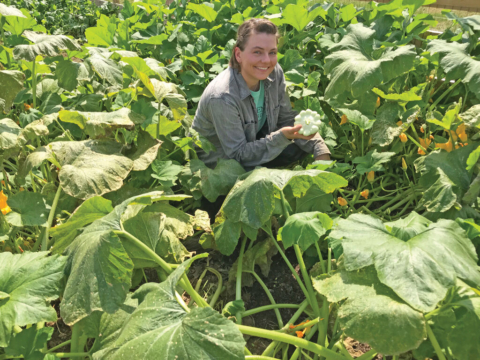
“It’s been a tough year to start a garden,” D&R Greenway Garden Steward Lara Periard readily admits.
As gardeners and farmers throughout the U.S. 1 region are keenly aware, it was a spring of cold, unrelenting rain and a summer of searing, dry heat. But thanks to the effort of historians, architects, and dozens of volunteers, the Bonaparte Garden at Point Breeze in Bordentown is thriving and will host an opening celebration on Saturday, October 1, at 2 p.m.
The garden produces vegetables grown at the time when Napoleon’s older brother Joseph, former king of Naples and Spain, was known as King Joseph of Point Breeze. After his brother’s Waterloo defeat, Joseph made his way to America and in 1816 he bought and eventually created an estate in Bordentown. It is said to have been the center of society — both political and social — throughout the East Coast.
It was this history and magnificent setting that led to the property being listed on the National Register of Historic Places in 1977. And then, it more or less sat there.
Enter the D&R Greenway. Working with the City of Bordentown and partnering with the New Jersey Department of Environmental Protection, the remaining 60 acres of the estate were acquired in late 2020. That, alas, was at the height of the COVID years.
Linda Mead, the Greenway’s president and CEO, has explained that the long-range plan for the acquisition envisions constructing a Discovery Center in which historic photos and maps will illustrate how the landscape and garden were developed throughout history. COVID ensured that this goal had to be delayed because there was little person-to-person contact work that could be done.
With the pandemic settling in, it was decided that creating the garden was the best way to move forward. As an outdoor project, it is less susceptible to the spread of viruses among participants. Throughout 2021, there was much planning activity. Val Sassaman, a member of the Bordentown Historical Society, got to work and put together a list of crops grown at Bonaparte’s estate. Bill Flemer, retired D&R site manager, volunteered to till the land for the 90-foot-by-40-foot garden.
Recognizing that throughout history, fences have been an integral part of outdoor plantings as deer, rabbits, squirrels, and other predators ravaged plantings, David Seiler, D&R’s Land and Property Steward, made a significant contribution. Using his background in historic renovations, he designed a historically accurate wooden fence and then volunteered to build it.
By early 2022, with preliminary planning accomplished, a garden steward needed to be found. This would be a person not only to research and design the plantings but also to physically work — doing a lot of weeding while getting sweaty and bug-bitten and setting up watering schedules.
Lara Periard is excited to be that steward, signing on last April. A Virginia Tech graduate with a degree in science and technology in society, she had worked at Pennington’s Chickadee Creek organic farm for the past five years managing field crops and irrigation.
“My family liked to spend time hiking, camping, or fishing,” she says about growing up in Northern Virginia, “so I grew up enjoying being outdoors, and that love has carried on my whole life.”
The Hunterdon County resident adds, “I find farming to be very rewarding. You really get to see a plant’s life cycle from start to finish, and you can see the direct results of your labor in how abundant the harvest is … or not. If the latter, there’s an excitement in the challenge of what went wrong.”
Periard is quick to give credit. “Once the rain finally stopped, Bill Flemer towed a tractor all the way from Hopewell to till the ground. With that done, D&R land steward Rich Allen joined Seiler in building the fence. They worked at the height of summer’s heat wave,” she notes, “and it was not an easy job to be out there in the 90-degree weather.”
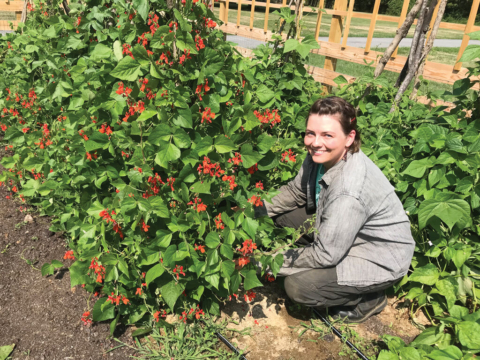
Sassaman alerted her to McMahon’s American Garden Calendar, published in Philadelphia in 1830. “Luckily,” Periard explains, “McMahon kept detailed records of popular varieties. Using that list, I scoured heirloom seed websites to find vegetables such as scarlet runner beans that are still around today.”
“Our most successful crops,” she reports, “have been the beans and the summer squashes. Two beet varieties that are still offered by organic farms today did well: Chioggia, a candy cane-colored beet and Golden, not surprisingly, a yellow beet.”
As with every garden, it was not all successes. “We lost the fennel to the brutal heat wave. Some particularly hungry armyworm caterpillars destroyed the kale and cabbage crops.”
Periard emphasizes the importance of volunteers and how wonderful they have been in making the garden a reality. She cites Becca Flemer, Bernie Miller, Destyne White, Ericka Taylor, Judy Craig, Kevin Borah, Mona Watnick, and Val and Dean Sassaman. “Their help was and is invaluable in getting the garden started and keeping it flourishing into fall.”
While the produce in Bonaparte’s garden was used to feed wealthy elite, today it nourishes those who are hungry and in need. The vegetable harvests are donated to Bordentown’s Christ Church. There, under the supervision of Reverend Matthew Tucker, known to all as Father Matt, and his wife Huynh, the food is distributed to local people.
Periard is already doing research for next year’s crops. “Because of our late start in getting the garden up and running, we were only able to grow fall crops. Next year the planted area will increase and artichokes, asparagus, cucumbers, eggplants, onions, and peas will be planted.”
“Should any wonder at the absence of tomatoes,” she explains, “these vegetables were considered poisonous during Bonaparte’s time and did not become part of American cuisine until shortly before the Civil War.”
“It is my hope,” Periard says, “that in connecting to the history of this place, from the Lenni-Lenape people who were here first, to Bonaparte’s time, to the present, people will feel a relationship not only to this area but also to its ecosystem. And thus be inspired to become — or continue to be — active in supporting conservation and restoration efforts.”
“This project,” she concludes, “is unique.”
Historic Bonaparte Garden Free Opening, 101 Park Street, Bordentown. Saturday, October 1, 2 to 3 p.m., with introduction and speeches by Linda Mead and Lara Periard. Pre-registration required at info@drgreenway.org.