Fintan O’Toole is a man of his word — make that words, and too many to count.
In addition to being a Princeton University faulty member and chair of the Fund for Irish Studies, the Dublin-raised opinion columnist for the Irish Times is also the author of more than a dozen books dealing with theater, Irish culture, and social-economic issues.
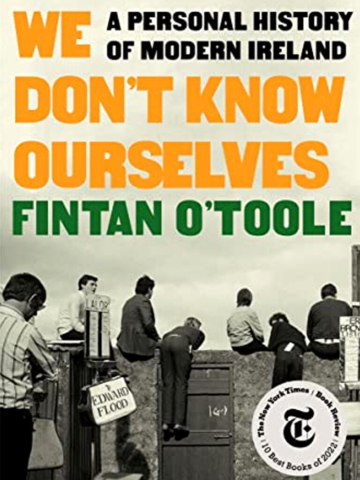
That includes his latest, the critically acclaimed “We Don’t Know Ourselves: A Personal History of Ireland Since 1958.”
Starting with the year of the author’s birth and following his nation’s trajectory from seemingly unbreakable past to a dizzying present, the paperback edition just released in U.S. weighs in at a hefty 620 pages.
If that’s not a persuasive indication of verbiage, mix in a tall stack of theater reviews penned over decades for Irish and American publications — more on that later — and his regular contributions to the New York Review of Books.
Then page through some current magazines and linger over some topically fresh articles like “Beware Prophecies of Civil War,” The Atlantic piece based on his own experiences of living in a divided and fearful nation and the power of self-fulfilling beliefs; “Cancel Culture Is Turning Healthy Tensions Into Irreconcilable Conflicts,” the Prospect magazine examination of an issue jeopardizing democracy; and “John le Carré’s Final Twist: Dying as an Irishman,” a story on the British novelist’s expatriation for the Guardian.
Now, those wanting to get a fresh word or two or even more from the writer will have the opportunity to do so when the author speaks up during two upcoming Princeton events.
The first is his Friday, March 31, lecture for Princeton University’s Fund for Irish Studies, “Uneasy Peace: The Good Friday Agreement 25 Years On.”
The talk examines the brokering and aftermath of the April 1998 political deal that ended the Troubles — aka the 30-year period of struggle and violence between the Unionists supporting a British-controlled Northern Ireland and the Irish Republican Army calling for a completely unified and British-free Ireland.
It was an important chapter in the human history of an island that had been colonized and repressed by the English for centuries.
While the agreement and O’Toole’s talk focus on a historic Irish issue, the topic has broader political applications: The agreement was a model for abating long seated civil conflicts that involve borders and identity.
It is also fresh news: England’s decision to leave the European Union has reawakened the specter of a partitioned Northern Ireland and tensions between states and intracommunal hostilities within the North.
During a recent interview at Small World Café in Princeton, O’Toole tells me there was a very deep sense of despair about the conflict before the Good Friday Agreement.
Seemingly previewing his talk, he says, “The feeling was that it could be forever. The British never seemed to develop a peace plan. The IRA would react. Their argument was that they had to resort to violence. It just felt it could go for a long time. It had reached an acceptable level of violence — there was a lot of horrible background noise.”
However, he continues, “What we didn’t see at the time [was that] an opportunity was going to develop. John Hume, who was the elder in the North, kept saying you have to just ask the question: How do you think about the way that people can retain their identities and live together? They started using politics in order to have a real political path. The British and Irish governments were working together. Then the Americans got involved and helped.
“There was a kind of moment. And if you spoke with people who were involved with the IRA, you realized they were getting older, they had kids, and there was an opportunity that was generational. It was a lucky moment and the stars were aligned.”
Reporting on the mood in Dublin at the time, O’Toole says, “It was fascinating. It was high drama. It was an ecstatic moment of history. It felt like a miracle.
“As a journalist, you’re supposed to be skeptical and neutral. As an Irishman, though, I saw it as an historic turning point. It was a moment when things changed.”
Now, with Brexit, there is another change.
And while O’Toole doesn’t think the majority of Irish and Northern Irish people want to return to past troubles, there are some Unionists and IRA loyalists “who want to return to tribal violence” and are “praying for the border to return.”
Then using his clear and direct manner, O’Toole sums up the situation with, “Brexit is so unthinking. They — the Brexiters — didn’t think about Northern Ireland,” and “it was reckless and a return to the colonial attitude.”
He notes that there are documents clearly showing that then-British prime minister Boris Johnson could go in either direction with Brexit but chose to use it for political advantage.
The choice benefited British hedge fund investors made who “make money through uncertainty,” and to the extremists on the political right, who saw leaving the European Union as the first step in eliminating labor unions and environmental and economic regulations.
While O’Toole says those factions got what they wanted, he also notes that “there is no real political constituency for that radical right” in Britain and that many of the nation’s “fantastic people” are seeing a downturn in the stock market and economy.
“If I were Scottish or Northern Irish, I’d be angry. They didn’t vote for it,” he says.
And while O’Toole feels that Brexit is a “lost cause” for England, he says there was a winner of sorts: “It was the first time in the problems between Ireland and England that Ireland was on the stronger side.”
He says the Irish government demonstrated a “brilliant” proactive diplomatic strategy and engaged the European Union in the negotiation of trading between Northern Ireland and the Republic — and avoided a return to portioned borders and stops.
“The British were shocked. Ireland said, ‘We’ not negotiating with the Brits. All negations are going to Europe.’”
O’Toole’s other public presentation is at Labyrinth Books in Princeton on Wednesday, April 12. He will lead a discussion with the Institute for Advanced Study’s Wendy Brown on her new book, “Nihilistic Times: Thinking with Max Weber.”
The book picks up on the German Weber’s humanistic approach to examining society, politics, and economics.
According to promotional materials, the book “analyzes the nihilism degrading and confounding political and academic life today and proposes ways to counter nihilism’s devaluations of both knowledge and political responsibility.”
Taking up the topic of nihilism and politics during our discussion, O’Toole says, “The two great problems of our time are climate change and inequality. Both tell us you have to have very strong public institutions. If you let market forces run by themselves, you’re all done. We have to develop a version of capitalism that is restrained for the common good. It doesn’t happen out of the blue. The only thing that can do that is democracy.
“The great lesson of the 20th century is that you can’t authorize equality,” a reference to the atrocities produced by Stalin and Mao.
O’Toole then points to the growth of inequality in the United States that began to accelerate during the presidency of Ronald Regan and says, “The U.S. is a wonderful place, but you’re struck by the levels of inequality.”
Demonstrating a pragmatic optimism, the father of two grown sons, as well as a grandfather, says, “I’ve become interested over the years about the science of early childhood. So much of our potential and personalities is formed in the first few years of their life. If you give kids some security and some love, they’re resilient. The science is kind of scary to show how those years affect us. It you invest in early childhood and make changes, the rewards are staggering. Every dollar you spend on early childhood, it gives you back more” — including people who earn more and pay more taxes.
Additionally, he says, there is a need to support the middle class and provide opportunities.
To illustrate that point, O’Toole says, “I write because when I was young, there was a move toward equality.”
The son of working-class parents who saw few opportunities for social mobility, O’Toole says “I get to do things because I was the beneficiary of good political decisions.”
That includes funding for public education — he graduated from University College, Dublin, with a BA in English and philosophy.
Also important is support for the arts. And in O’Toole’s case, support for theater — an art form that shaped O’Toole’s career as an internationally known writer.
The story starts like this:
O’Toole’s father was both a conductor on a Dublin bus and a lover of books and theater. A woman regularly using the bus noticed him reading between stops, struck up a conversation, and learned about his interests. She also happened to be the press manager for the Abbey Theater and offered him free tickets for nights when the house wasn’t full. O’Toole, then 13, decided to accompany him.
“I couldn’t believe that they were doing this,” he says of seeing the actors perform. “And I started writing about it.”
He was also editing and writing for student newspapers and eventually became the theater reviewer for In Dublin magazine in 1980. Eight years later he joined the Irish Times as a reviewer and columnist. And, thanks to being recruited by noted New York City journalist and editor Pete Hammill, O’Toole came to the U.S. in late 1990s to review theater for the New York Daily News, then returned to Ireland.
“It was a great training,” O’Toole says of his shift from theater reviewing to political opinion writing. “People think of it as something marginal. But it is a complex thing. You try to give a sense of what is going on and evaluating it. It is actually harder than another form of writing.
“In Dublin, it was also developing a thick skin. It was very intense. People hate you. But it was a very good training. I’m not writing for them. I am writing for my readers, and I’m trying to do my best. I’m very grateful for it. It was a way of finding a voice — a public voice. And I stand with what I write.”
Additionally, he says, “Theater has always been close to politics. And visa-versa. We live in a time of political performance. There was always an element of that. Creating a character becomes crucial to politics.”
Points of reference include Donald Trump’s showing his show biz chops playing a celebrity mogul and Boris Johnson using clownish antics to crafty intents.
“If we were’ stuck with the politics of performance, we need a critic,” he says.
Another element of theater that has found its way into his writing is the orality of storytelling — both on the stage and in the community.
“I don’t want to romanticize, but people do tell stories all the time. When I grew up, everyone was telling stories. My mother’s family were country people. They were hilarious, they would tell you stories about things that were banal and make them romantic.
“I think we’re conversational animals. Of course, it is an illusion that writing is the same as people speaking. But Ireland is a very oral culture, so I try to write in a way that has the immediacy of speech.
“My point is to get the reader to read to end of the column. This was true in the 1980s and now it’s more important. You have to seduce your reader into the illusion they’re going to learn something. “
Part of O’Toole’s seductive appeal is wit. “Maybe it is in the Irish tradition,” he says. “Wit is concentrated expression, capturing a thought in a highly concentrated phrase.”
It is also something that keeps the reader buoyant, especially when a serious subject gets too grim and people “can’t take all the grimness without the surrealism and absurdity” that comes with life.
O’Toole, who was invited to join Princeton by Irish-born poet and Princeton professor Paul Muldoon in 2012, says he is spending the remainder of 2023 in Princeton, overseeing the fund, teaching, and researching the subject of his next book, the late Nobel Prize-winning Irish poet Seamus Heaney.
And while he and his wife, English teacher Clare Connell, are happy to be in Princeton, he says the stays usually last a semester and he misses being part of the give and take of everyday Ireland.
“One of the great things about Ireland is if you’re writing, you have a sense of who your audience is. People in Ireland still stop you in the street and say, ‘That was a stupid thing to write.’ Because of the intimacy, you know the people who are reading it, and you’d better be able to look them in the eye. If you are going to be saying things that are uncomfortable, you have to understand that discomfort.”
O’Toole then sums up his business with “It is a public activity,” one he links to the definition of journalism offered by the fictional Irish bar keep Mr. Dooley, who having his own way with words, said, “The job of the newspaper is to comfort the afflicted and afflict the comfortable.”
Uneasy Peace: The Good Friday Agreement 25 Years On, Fund for Irish Studies, James Stewart Film Theater, 185 Nassau Street, Princeton. Friday, March 31, 4:30 p.m. Free. fis.princeton.edu.
Nihilistic Times: Thinking with Max Weber, Labyrinth Books, 122 Nassau Street, Princeton. Wednesday, April 12, 6 p.m., in person and online. Free. www.labyrinthbooks.com.
O’Toole will also host and lead discussions for the following Fund for Irish Studies programs:
• Friday, April 14: Elizabeth Boyle, of the University of Maynooth, lectures on “Fierce Appetites: Lessons from My Year of Untamed Thinking.”
• Friday, April 21, Mary Burke, University of Connecticut, lectures on “Race, Politics, and Irish America: A Gothic History.”
Both sessions are at 4:30 p.m., 185 Nassau Street, Princeton. Free. fis.princeton.edu.