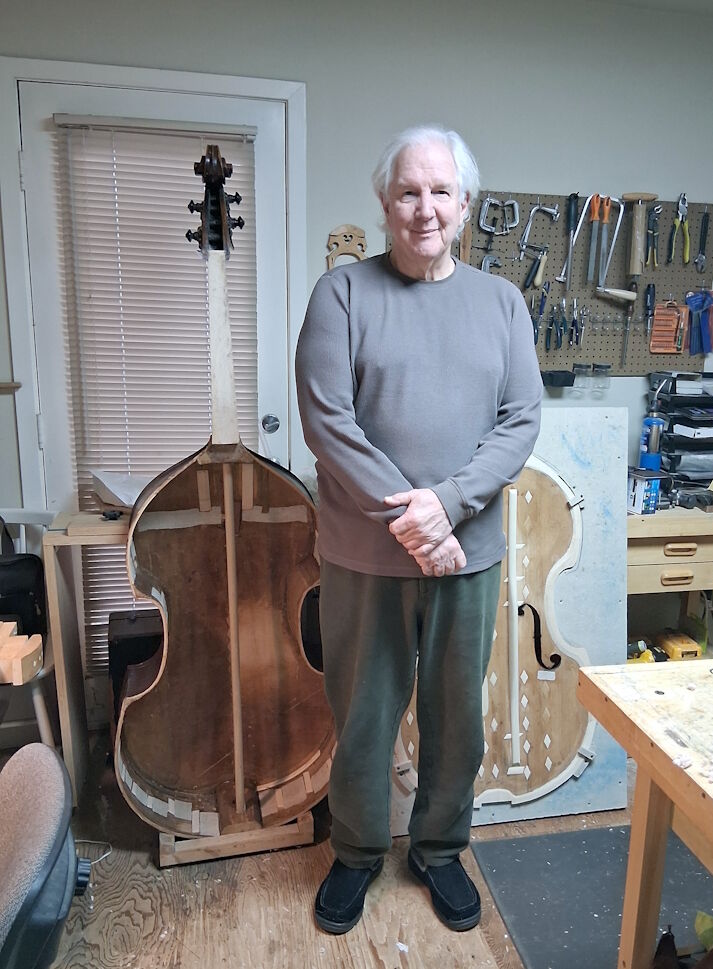
Before we began our conversation, Jack Hill graciously led me on a tour of his tastefully appointed Lawrenceville home, made all the more intriguing by the 18 or so stand-up basses lined up along the walls like sentinels, or servants awaiting orders from the master of the house. The instruments were either available for purchase or awaiting repairs by Hill, the owner of JD Hill Music in Lawrenceville.
“This is a bass a woman brought in that had belonged to someone in her family,” Hill notes, pointing to one of the instruments. “It was here for a couple of years and started falling apart, and I realized that it was probably stored improperly after the owner had died. The glue was failing. So I had to re-glue a lot of it, and there were cracks to be repaired.”
That’s typical of the mission that Jack Hill has been on at JD Hill Music since he opened for business nearly 20 years ago, but his interest in becoming a musician and eventual segue to repairing and selling stringed instruments began many years before.
“I remember hearing the Beatles for the first time,” he says. “I was attending a Lutheran parochial school where I was singing, but I really wanted to play bass. I finally got a bass and joined my first band in junior high school, a popular rock band with a horn section.”
In Hill’s telling of his journey as a musician in the Upper Peninsula of Michigan where he was raised, what followed were stints singing and playing bass guitar in a choir, as a bass guitarist for his school’s jazz band, and learning to play the Sousaphone.
“I remember Karrying it (the Sousaphone) home,” he recalls, “killing my shoulder. I put it next to the piano so that I could pound out notes and make sure that the notes I was fingering were coming out correctly. I’d show up for marching band practice, not yet knowing how to play the instrument properly, plus I had to learn marching band steps and formations. As I continued playing I figured out the fingerings, and by the end of my sophomore year I was the principle tuba player!”
Hill notes that it was his orchestra director who introduced him to the double bass (or string bass), which is tuned like the bass guitar Hill was already familiar with. “I went to Northern Michigan University, where I finally had lessons in tuba and double bass,” he says. “I attended for two years and then transferred to Berklee College of Music in Boston, intending to be a jazz major.
“I really didn’t like the school that much,” Hill continues. “It seemed like kind of a factory to me. I was getting more interested in classical music at that time and playing in orchestras, so I dropped out and studied privately for a couple of years with Gary Karr, probably the most famous double bassist in the world, who was teaching at Hartt College in Hartford, and then studied with Henry Portnoi, who was the principal bassist for the Boston Symphony Orchestra.”
Alas, Hill found that his passionate pursuit of music was, at least for a time, running second in a competition with the need to earn a living. “I always had summer jobs in tech and was selling cables for anything from tanks to satellites for a cable company,” he explains. “I got a job after I graduated that I thought would be another summer job. They wanted me to do a lot more than I had been doing before and started paying me a lot of money, so for 20 years I was working in tech as a technician and then as an engineer.
“In 1998 my wife got job in Princeton and we moved to Lawrenceville in 2000-2001. There weren’t any tech jobs here for me, and trying to get my foot in the door as a freelance musician was difficult, being the new player in town, so it took me a while to find a number of orchestras to play with and make a living. For a while I was working as a brewer at Triumph. I was the first brewer at their new facility in New Hope. I worked there for a couple of years, then quit that job and needed something to do.
“A friend who lived locally at the time was a bow maker,” Hill continues. “That interested me, because it didn’t require a huge investment in tools and equipment. He offered to mentor me, so I enrolled at the University of New Hampshire for instruction in violin making, as well as bow making, repair, and restoration.”
Thanks to Hill’s growing connection to the classical music community in Princeton and beyond, word spread about his newly acquired skill. “As soon as people found out I was a bow maker, they started bringing me their instruments to repair,” he says. “I was solely a bow maker at that time, but a lot of repair requests that came to me were simple things like open seams and other things I would repair on my own bass that I had learned when I was in college, the proper type of glue to use and so forth.”
The opportunity to repair stringed instruments triggered an Aha! moment for Hill. “When turning away work that was more complicated, I soon realized that there was more potential in repair and restoration than there was in bow making,” he says. “I still make bows and I’ve sold bows, but now most of my work is repair and restoration.”
When it comes to making a bow, Hill reveals that crafting the bow is not the most challenging part of the process. “Making a bow consists of taking a piece of wood and then planing it to the proper thickness and bending it,’” he says. “The hardest part is hairing, or in the case of repair, re-hairing it. The hair comes from a horse’s tail and comes from China, where horse meat is food. The tails are sold to brokers who then sell them to bow makers and repairers.
“Sometimes I get a bow that’s made in a particular way, and every hair must be the exact same length, and parallel, and perfect. That’s really tough, and the most difficult part of bow making for me, but I think I’m getting the hang of it now,” he adds with a chuckle.
Hill notes that the scarcity and the resulting spike in the cost of woods used for bow making have significantly raised the cost of making a professional quality bow. He says that, despite conservation efforts, over harvesting in Brazil of both pernambuco (commonly known as brazilwood and used for violin bows) and ipe (used for bass bows) have driven his costs skyward.
“If I need to buy a pernambuco stick, I now have to pay $250 for it,” he laments. “To make a bow, you have to rough out the shape, which generally takes a day or two, then heat the stick over a flame to bend it. At that point you might break it, and if you do you have a broken handful of sticks and have lost $250 worth of wood.”
Despite these and other challenges, Hill continues to hone his craft. “After I learned bow making I began to get more requests for repairs,” he says. “I decided to go back to the school where I learned bow making and spent a whole summer learning repair and restoration. I still continue to learn, attending a summer-long seminar on violin repair and bow making at Oberlin College, and week-long seminars on bass repair and restoration.
“Usually two or three highly regarded makers will be there as mentors, and we share ideas on how we do different kinds of repairs. It’s a never-ending quest to learn everything you can about repair, restoration and the making of an instrument.”
In such a specialized field, how does Hill connect with musicians in need of his skills? “I belong to an organization called the International Society of Bassists,” he explains. “I write their Luthier’s Corner column on the repair and maintenance of basses, and I advertise in that. That’s probably the biggest one, most bass players belong to the ISB. We have a convention every year. You get a thousand bass players showing up, and there are concerts, recitals, seminars, people building basses in workshops that we auction off at the end of the week.”
Examples of Hill’s rescue of stringed instruments from neglect or accidental damage are detailed on his website. One he shared during our conversation involved an elderly gentleman who came to Hill with his cherished violin. “He told me that he had tripped and fallen on it,” Hill says. “He had gotten some pretty expensive estimates for repairs and I offered to do it cheaper, just because I wanted to work on a violin. After a lengthy process of restoration I returned it to him, and he told me that it sounded better than it did before.”
That’s not an unusual outcome, says Hill. “People are put off by cracks, although the most expensive basses I have here have lots of cracks, but they’ve all been repaired properly. I have a colleague from Poland who plays cello in a lot of the orchestras I play in, and he told me that in Europe he’s talked to the Roma, the gypsies, and they’ve told him that when they get a new violin the first thing they do is smash it against a tree and restore it, because it’s going to sound batter afterwards. But I don’t recommend it!”
And Hill notes that the success of his business has enabled him to continue as a working musician.
“When I first got here, a good friend who was conductor of the Princeton University Orchestra also conducted the Delaware Valley Philharmonic in Pennsylvania,” he explains. “I’ve played with them and other orchestras in the area. I also teach bass and chamber music at Princeton University. I’d say that I spend about a third of my time teaching, a third of my time playing and a third of my time in the shop doing repair work. That works out pretty well for me.”
My final question for Jack Hill concerned the origin of the distinctive image that appears on his website, and the meaning of the phrase in Italian that appears underneath, “Al Mio Basso Ballate.”
“That icon, the devil playing the bass, came from a friend and colleague of my wife, an American living in Rome who was engaged in scholarly research on dance and came across a document on dance from the 17th century that had that image in it,” he explains. “What it means in Italian is the devil is saying ‘To my bass, you all dance.”
JD Hill Music, 3 Old Bridle Path, Lawrenceville. 609-671-0098. jack@jdhillmusic.com. Hours: Call (do not email) for an appointment.