The region’s stained glass has been a recurring topic over the past decade, one that reflects an omission and a mistake.
The omission is neglecting to highlight the glass found in area synagogues.
The reasons are related to timing, competing obligations, and COVID, social tensions, and staffing issues making it difficult for an outsider to visit places of worship.
However, the arrival of Hanukkah provides an opportunity to look at some non-Christian glass that has connections to the region.
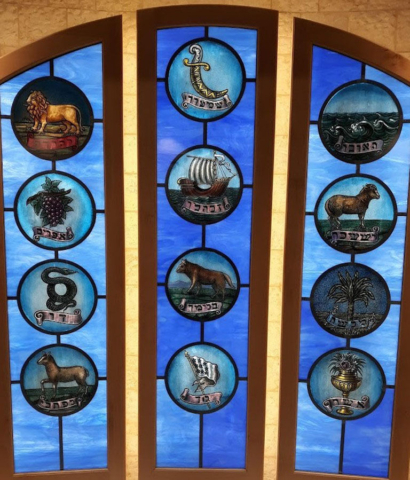
One is a panel of 12 colored medallions greeting congregants and visitors at the entrance of Adath Israel in Lawrenceville.
The three rows of four sets of symbolic images reminding congregants of the past and the need for perseverance and strength are connected to the birth of the congregation in Trenton.
As reported in the New Jersey Jewish News, “The first glimmer of what today is Adath Israel Congregation was in November 1920, when Samuel Levin and Sol Phillips-Perlman recognized the need for a Conservative synagogue on the growing west side of Trenton.
“By October 1925, a cornerstone had been laid for a building on Bellevue Avenue, designed by Louis Kaplan, the famed architect who designed the Trenton War Memorial.”
The Philadelphia-born Kaplan began working with Trenton architects Kelmann & Fowler in 1912 and became chief draftsman after graduating from the University of Pennsylvania in 1917. In addition to teaching at the School of Fine and Industrial Arts in Trenton, he created his own practice in 1924. In addition to the above-mentioned buildings, he also designed Har Sinai Temple.
Although other glass works in regional synagogues have yet to be written about, two close-proximity centers in Elkins Park, Pennsylvania, are worth re-mentioning for the season.
Keneseth Israel offers a full wall of work by the late Jacob Landau, a nationally known illustrator and painter who had lived in Roosevelt, New Jersey.
Commissioned by the Reform Congregation Keneseth Israel to commemorate the occasion of the synagogue’s new building in Elkins Park, the series of 24-foot-by-5-foot windows reflects Landau’s combination of flowing imagery and powerful statement and a dynamic and changing evocation of the readings of the prophets Abraham, Elijah, Amos, Hosea, Isaiah, Jeremiah, Ezekiel, Second Isaiah, Job, and Malachi.
It was Landau who proposed the subject matter in order to explore God’s decree that humans live justly and the human struggle to deal with evil and pain.
Landau’s only stained glass work, the work featuring 30,000 pieces with 100 colors was fabricated in Philadelphia by the Willet Company. One of the premier American stained glass companies, Willet also created glass for Trinity Church in Princeton and Princeton University Chapel. The company, now Willet Hauser, has relocated to Minnesota.
Landau’s collaborator was Benoit Gilsoul, an internationally known Belgian-born stained glass maker who created for Willet as well as with his own studio. In addition to designing the glass for universities and churches, Gilsoul also created the artistically etched glass walls for the Hughes Justice Center in Trenton.
For more on Keneseth Israel, visit www.kenesethisrael.org.
Beth Shalom Synagogue is Frank Lloyd Wright’s only synagogue design and offers mainly an architectural tour in which glass is a contributing detail.
The National Historic Landmark, built between 1953 and 1959, is a pyramid-like mountain of glass rising atop a foundation marked by triangular protrusions rising up to surround half of the building. The building fulfills Wright’s promise, “Your temple will be ‘Mount Sinai cupped in the hands of God.’” He also suggested that the raised roof reflected ancient tent structures.
Designed in cooperation with the congregation’s Rabbi Mortimer J. Cohen, the building emphasizes the use of triangles that appear and reappear in various places and even creates Stars of David in lighting fixtures. The main sanctuary uses a sand-colored sloped floor that suggests the Biblical desert while overhead is the metaphoric and literal heaven, with the glass and plexiglass covering bringing light to the sanctuary’s ceiling and letting it change with the day.
Beth Shalom Synagogue, 8231 Old York Road, Elkins Park, Pennsylvania. Tours Sundays, 10 a.m. to 3 p.m., or by appointment, $12 to $15. 215-887- 1342 ext. 157 or www.bethsholompreservation.org.
Now for the clarification. In a former article the reporting suggested that the stained glass over Princeton University Chapel’s main entry was created Boston designer Charles Connick.
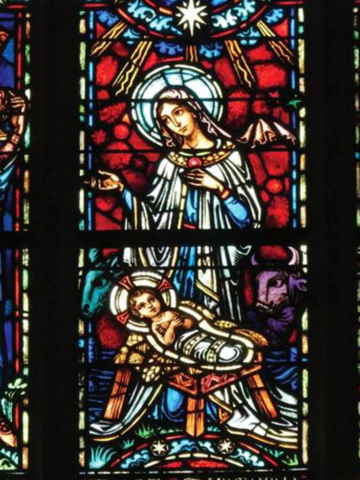
The correct attribution is Nicola D’Ascenzo. The work is “The Second Coming of Christ,” which includes a nativity scene to indicate the first coming.
As reported in the Princeton University alumni magazine in 2020, D’Ascenzo was one of many Italian craftsmen who helped build the University, including stonemasons and landscapers. He was born in Italy and came to the United States in 1882 when he was 11 years old. D’Ascenzo became a stonecutter and woodworker’s apprentice and took formal painting lessons in the evenings before beginning a career as a decorator, later becoming interested in stained glass. He completed his first stained glass commission in 1904, and by the time he died 50 years later, his studio was known for producing some of the finest stained-glass works in the country. He designed more than 7,800 windows for places including the National Cathedral and the Folger Shakespeare Library.
“The stained-glass window is more than 700 square feet and was assembled at D’Ascenzo’s studio before the artist transported large sections to Princeton for its installation on the entrance on the west side of the Chapel, facing East Pyne,” the alumni magazine article states.
The article adds that D’Ascenzo’s work is one of four large windows in the main sanctuary and that the “Chapel has 27 stained-glass windows by different artists, adding up to about 10,000 square feet of art.”
The article concludes by saying, “The Chapel’s stained-glass windows celebrate four major themes: endurance, teaching, love, and the second coming of Christ. Amid the religious iconography, D’Ascenzo gave a nod to the Chapel’s construction by including images of the architect, the organist, and the glassmaker himself.”
And reasons to remember color and light at this time of the year.