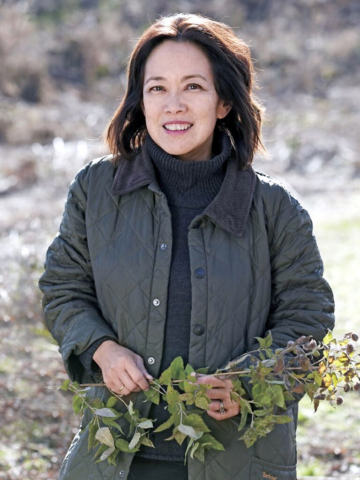
“We believe in the power of nature: to heal, to feed and to connect us with each other.” — These words, along with others found on her website, sum up the philosophy of Tama Matsuoka Wong, a self-described forager, weed eater, meadow doctor, lawyer, and mother of three.
And that barely begins to describe this cookbook author, James Beard Award nominee, New Jersey Forest Service Steward of the Year, sought after speaker, lecturer, and supplier of foraged plants to some of the top restaurants in New York.
And, there’s also a degree from Harvard Law School and a 25-plus year career as a financial services attorney in Tokyo, New York, and Hong Kong.
The story of this self-described “failed gardener” is both convoluted and fascinating.
“I definitely didn’t plan it,” Wong says. “We moved back here from Hong Kong. I was still working for Merrill Lynch (as an attorney), commuting into the city. They also had offices in Princeton and Hopewell, so it was three days in the city and the rest of the time in another office.”
Wong and her husband purchased a rustic farm house in Hunterdon County, surrounded by meadows and woodland. “This is actually the first house we were ever in,” she says. “After living in Hong Kong, Tokyo, and New York, living here was so different. I was born in New Jersey and grew up in Princeton and Basking Ridge, where my dad was a scientist for Bell Labs. After being away for so long in a very urban environment, it was like coming home. You just re-appreciate New Jersey. When you’ve seen the rest of the world you realize how lucky we are.
“My mom, who died during COVID, was a plant woman,” Wong continues. “She’s Chinese, born in Hawaii, and my dad was born in Japan. I was raised by this weird combination of a Hawaiian New Age mother and a scientist father who has this poetic feeling about nature, as Japanese people tend to have.”
Even before settling in back here, Wong was concerned about preserving the natural landscape. “My mom knew everything about plants, but I didn’t pay as much attention as I could have,” she admits, “because if I needed to know something I’d just ask her. Fortunately, there are lot of people living nearby who are naturalists. We bought this place while we still lived in Hong Kong and rented it out, and every year we’d donate to organizations like the New Jersey Conservation Foundation because we wanted the land to be protected. When we moved back here, they remembered us because we were the only people from Hong Kong who ever donated to them.”
Wong notes that introductions to some like-minded folks soon followed, including people like Leslie Sauer, a founder emeritus of Andropogon Associates, author and pioneer in the field of restoring and managing native landscapes. “Leslie walked the property with us,” Wong says, “and I learned that ‘all green is not the same.’ I learned about invasives like knotweed, which she said we had to get rid of before it took over everything.
“I’m not a fastidious gardener,” she says. “I’ll never be giving tours of my place. I have my work and three daughters to raise, and any time I planted anything it died. While removing the invasives I started to appreciate the native plants because I didn’t really have to do anything, and they’re beautiful, so I learned to appreciate what was there. The short answer is that I started as a failed gardener.”
Wong says visitors from Japan caused her to see “invasives” in a different light. “When it came to the invasives, my dad had professors visiting from Japan over for dinner, and I’d mention removing invasives, especially the Japanese knotweed,” she says. “They told me that in Japan they call it Tiger Stick and in the spring they eat it as part of a tasting menu, kaiseki-ryōri, a traditional multi-course Japanese dinner of hyper-seasonal ingredients.”
“During the period between winter and traditional farm agriculture, gathering knotweed and other plants we consider invasives for a traditional Japanese meal is a huge part of the culture. And a lot of that is based on foraging. I thought this is great, it’s so exciting, I don’t have to think of myself as a failed gardener!”
Wong says that encounter sent her off on a period of learning and discovery. “I got all these foraging books,” she says, “Peterson’s guides, Ewell Gibbons. But all the recipes were the same, like ‘boil three times to reduce bitterness.’ So when I tried to make this stuff for my family they were not pleased. My kids grew up eating major meals of dim sum nearly every weekend. So, I knew I needed to find better recipes.”
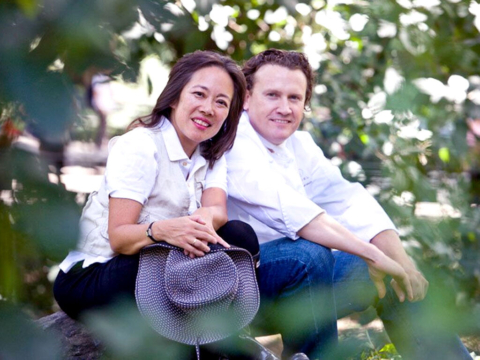
And find them she did, through a quirky chance encounter with the Chef de Cuisine at a world-class Manhattan restaurant about 15 years ago. “We enjoyed good food but we didn’t follow chefs or anything,” Wong says. “Foodie friends of ours in Princeton knew I was trying to find recipes for my family for all these invasives, and they were going to the restaurant Daniel and invited us to come along.
“And they said, ‘By the way, stop by there in the morning with stuff from your meadow and tell them you want it for dinner.’ I thought that was kind of pushy, but they said to mention their name, that the restaurant knew them because they’d been there a number of times.
“I had some anise hyssop, a native plant that’s easy to grow. I brought some to the restaurant in the morning and said that if they couldn’t make anything with it that it was OK to throw it out. They called down to their executive chef, Eddy Leroux, who turned out to be kind of the ‘spice savant’ for Daniel, and he said ‘Oh, yeah, we can work with this.’ And he and the pastry chef, Dominique Ansel, created off-the-menu concoctions for our dinner.”
That could have very well been the end of Wong’s tale, but it turned out to be just the beginning. “After the meal, we went into the kitchen to say thanks, and Eddy Leroux asked me, ‘What else do you have in your meadow, Ms. Wong?’ I told him that I have about 225 different plants and asked what he was looking for? and Eddy says, ‘Everything, bring me everything. I will pay you.’”
“I told him that I didn’t want him to pay me, just give me recipes,” she recalls. “And he said ‘OK, sure, a little weird,’ but he agreed to give me recipes. That’s how it started. I just happened to be in the right place at the right time, and then this whole kind of challenge began. I started bringing him everything edible, and he’d try it five different ways and build this dossier of recipes. We didn’t call it foraging then, we just called it ‘The Project.’ It was before the whole foraging thing caught on.”
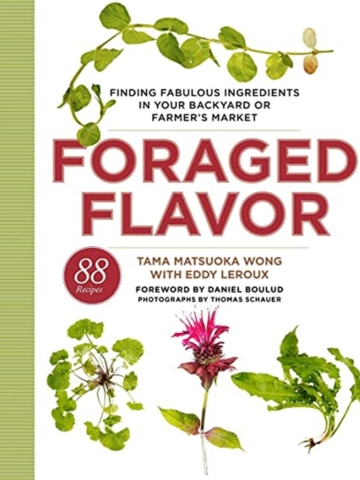
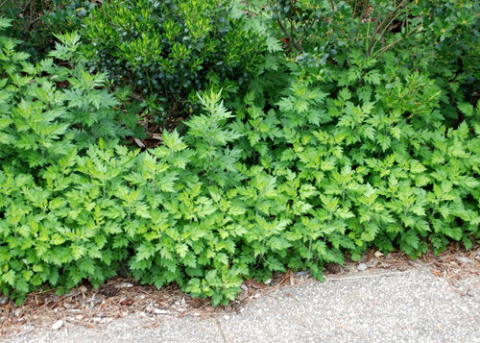
One thing led to another, and Wong eventually collaborated with Eddy Leroux on a cookbook, “Foraged Flavor — Finding Fabulous Ingredients in Your Backyard or Farmer’s Market” (Clarkson Potter, June 2012). It features 88 seasonal recipes, a guide to plant identification, notes on foraging sustainably, and a list of additional resources, as well as a forward written by Daniel’s superstar chef, Daniel Boulud. “The mugwort soup recipe is really good!” she says.
As Wong says, the term “forager” was not yet part of her vocabulary when “The Project” began. “Melissa Hamilton (an owner-chef at Canal House Station restaurant in Milford) was one of the first persons to clue me in,” she says. “We were talking about what I was up to, and Melissa said, ‘You know what you are? You’re a forager!’ Before that I’d stop by the restaurant (Daniel) and they’d ask how the foraging was going, and I really didn’t know what they were talking about.
“It started completely organically, around the concept of plants and stewardship, it’s what you’re doing with the land that’s ecologically sustainable. And when you’re infested with weeds you don’t have to throw up your hands, you can eat them!”
Wong says that, following the publication of the cookbook, her foraging began to take her working life in a new and completely unexpected direction. “After the book came out, a lot of people started asking for foraged stuff,” she explains. “They’d go to Eddy Leroux and ask for my email address, and then people started asking me for things like nettles, which were hard to get at the time.
“I was still working as an attorney,” she continues, “and yet I’d find myself bringing these huge garbage bags full of nettles through the PATH turnstile into the city. The security guards would ask me what’s inside, and I’m warning them not to touch them because they’re going to get stung. They thought I was weird, but they let me through. After a while I dialed back working at my ‘normal’ job to only in the winter, and then foraging just took over.”
As foraging took over and her reputation spread, Wong says that in addition to Daniel the roster of restaurants seeking her foraged ingredients grew to include an impressive list of innovative New York establishments, such as Aquavit, Gramercy Tavern, Dirt Candy, and others. Many of her ingredients also found their way into “bespoke” cocktails. “There’s a bar called Sugar Monk in Harlem that uses my ingredients,” she says, “and at one point I was providing ingredients for (spirits purveyor) Rémy Cointreau. They have an excellent gin called The Botanist, a key ingredient in a Spruce Tip cocktail.”
Increasing demand for foraged ingredients meant increasing the supply, as well as increasing the number of people on her team, both hands-on foragers and advisors, who are prominently listed on her Meadows and More web site.
As to where she obtains ingredients beyond the boundaries of her meadow? “I only forage with permission,” she says. “I have earned permission to take non-native plants from a number of properties. The owners know that I know what I’m doing and that I’m going to be supervising the people I’m with. If you understand a plant’s behavior, its personality, and how it grows, you can to harvest it sustainably.”
She also cautions that foraging plants or seeds on public parkland is illegal, and that foraging anywhere without permission invites legal action as well.
She has also found a more efficient distribution channel for her ingredients than the hours she used to spend at farmer’s markets. “I do a lot of business with Fresh Direct,” she says. “They’ve been so supportive of me. It’s very difficult for a small-scale company like mine to get retail shelf space, packaging and distribution, and make a reasonable profit. With Fresh Direct I don’t have to deal with any of that. It’s plain and simple.”
As her expertise and reputation has grown, Wong has also found herself in demand as a lecturer/educator at conferences, most recently giving talks at the Morris Arboretum and the Madison Garden Club of New Jersey in March, and a hands-on Invasive Plant Foraging Workshop at Duke Farms Nature Preserve in Hillsborough. Her 2013 TEDx talk may be viewed on YouTube. A new book is in the works for 2024 as well.
So what’s the first thing that aspiring foragers should know? “I always tell them to start with the plants in their own backyard and not to try to learn everything all at once,” she says. “Really get to know a plant, see how it grows. From my point of view, most people don’t know that much about food, about how and when to pick it. And it’s important to know the area where you’re getting your plants, especially that they haven’t been sprayed with toxic sprays.”
Wong says perhaps the biggest benefit to be gained from foraging is simply getting outdoors. “Nature and natural light are so good for you. There are so many studies that say that being out in nature is calming, and when foraging you’re really interacting with nature.
“When you’re foraging, you’re usually out there early in the morning, even if you don’t feel like it. And you’re getting the benefits. It’s great!”
For more on Wong and foraging: meadowsandmore.com.
A Sampling of ‘Foraged Flavor’
Forager Tama Matsuoka Wong shares her bounty in her book “Foraged Flavor – Finding Fabulous Ingredients in Your Backyard or Farmer’s Market.”
With a forward by chef and New York City restaurateur Daniel Boulud, the book includes 88 seasonal recipes, a guide to plant identification, notes on foraging sustainably, and a list of additional resources.
To get a taste of Wong’s approach, here’s a sample recipe:
Artemisia (Mugwort) Soup*
This easy soup shines the spotlight on the mildly herbal mushroomy taste of young artemisia. It is a lovely start to a meal.
Serves 4
1 medium onion or 3 small spring onions, sliced3 tablespoons unsalted butter2 garlic cloves, minced10 medium white mushrooms (2½ ounces), sliced1 large or 2 medium Yukon Gold or russet potatoes (10 ounces), peeled and cut into 2-inch chunks6 cups low-sodium chicken stock or broth, or vegetable broth4 ounces (8 cups) tender artemisia leaves1 cup heavy creamTabascoSalt and freshly ground black pepper
1. In a large pot, sauté the onion in the butter for 2 minutes, or until softened. Add the garlic and mushrooms and cook for 3 minutes, or until softened. Add the potatoes and chicken stock and bring to a boil. Add half of the artemisia leaves, turn the heat down to low, and cook until the potatoes are tender, about 20 minutes.
2. Add the cream and the rest of the artemisia to the pot and simmer for 10 minutes. Remove from the heat. In a food processor or blender, working in batches if necessary, puree until smooth. Season with Tabasco, salt, and pepper.
*From Foraged Flavor – by Tama Matsuoka Wong with Eddy Leroux, Clarkson Potter Publishers. Copyright © by Tama Matsuoka and Eddy Leroux, Used with permission of the author.