They’re not just big clocks.
Many are almanacs and, in their time, were used for scientific experiments. Many are striking works of art, both figuratively and literally.
And all were New Jersey made. They feature in “Striking Beauty: New Jersey Tall Case Clocks, 1730–1830,” a first-of-its-kind exhibition at the Morven Museum & Garden in Princeton running from this Friday, April 21, to February 18, 2024.
Just as these free-standing, pendulum- and drop weight-driven time pieces were usually the result of collaborations between skilled metal crafters and woodworkers, the show was made possible by the collaboration of scholars, historians, museums, and collectors.
Some 50 tall case clocks are on view, the work of nearly as many different clockmakers. Of these about two-thirds have never previously been on public view and will return to private collections after the show’s final chimes are struck.
Not only were only New Jersey clocks solicited for the exhibit, there was an even stricter requirement.
“We’re not showing any clocks that are not signed,” reveals Elizabeth Allan, Morven deputy director and “Striking Beauty” exhibition curator. “Without the signatures, it’s not always clear when and where the clocks were constructed. And there are enough surviving clocks signed that indicate a specific person.”
The signings might be in the form of a paper label glued inside the clock, or engraved on the pendulum or, especially when the craftsperson had what amounted to a clock factory, on the faces of the clocks themselves along with the name of the town in which it was located.
Owners of such clocks in those days were also typically owners of large farming tracts or merchants who needed to keep track of the seasons as well as the hours in order to appropriately plant, cultivate, and harvest. As clock making became more technologically advanced, aesthetically embellished, rotating, almanac-inspired moons-phase dials were added.
Tall case clocks would usually run eight days on one winding up of their drop weight-and-chain powering mechanisms, representing the seven-day week plus an extra day of uninterrupted function should the usual winding day be missed.
In the 1700s American clock makers typically ordered metal and mechanical components from England, then assemble these in locally made wood cases. But soon they became skilled in fabricating their own parts (a great help in avoiding then-weighty British import tariffs).
A tall case clock’s “bonnet” — the detachable wood-and-glass crowning enclosure containing the device’s face, hands, and gearing system — is indicative of its era and region. Some bonnets are rather plain. Others are topped with decorative finials of wood or brass.
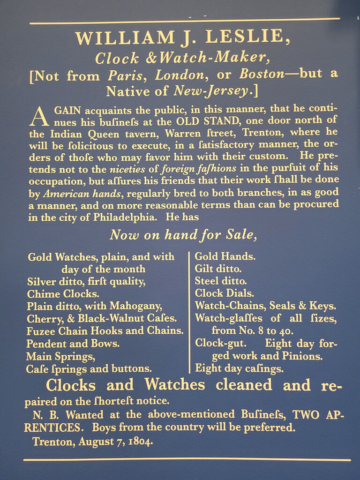
An especially charming and often supremely informative feature of the exhibit’s design involves wall reproductions of late 18th and early 19th century newspaper advertisements. Clockmakers present as selling points the pleasing aesthetics, reliable mechanics, and sturdy constructions of their wares; and — in at least one example — their locations.
An 1804 advertisement (placed, quite fittingly in a Trenton newspaper called The True American) proudly declaims that local clock and watchmaker William J. Leslie was “Not from Paris, London or Boston – But a Native of New-Jersey.”
“The ads here are really fun to look at,” Allan says. “They give you an extra sense of the clocks’ histories.”
After the War for Independence, America experienced new pride and new prosperity, and New Jersey alone contained dozens of craftsperson-entrepreneurs vying for the growing market in tall case clocks. As “Striking Beauty” attests with its objects and interpretive signage, the clocks were often collaborations between highly skilled metal workers and cabinet makers.
But as a practical matter, there were still not enough prosperous buyers for these craftspeople to survive on clock sales alone. So the creators or assemblers of these mechanisms typically traded as well in a profound inventory of metal objects: tools, eating utensils, eyeglass frames, and more.
When not making the cases, woodworkers busied themselves on a variety of tables, chairs, doors, and cabinetry. And given the elongated dimensions and sturdy bracing of the tall clock cases, it’s no surprise that their creators also kept busy making coffins.
“So you’re making these beautiful clocks and then you’re putting together coffins,” says Allan.
Among the small village of collaborators needed to raise a tall case clock were sometimes enslaved persons, as “Striking Beauty” acknowledges and documents.
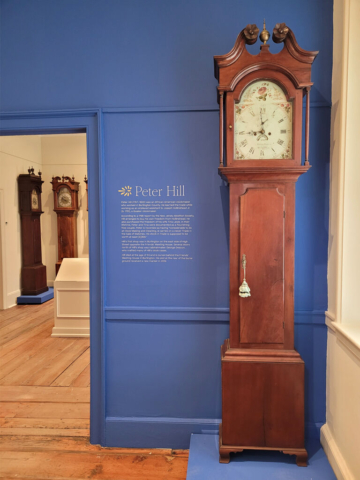
Greeting visitors at the entry to the show’s first gallery is the story of Peter Hill (1767-1820) and a towering example of his fine craftsmanship. Hill had been enslaved to a clockmaker in Burlington. During this time, Hill thoroughly learned the art and science of tall case clock construction. He prospered enough to purchase his freedom and that of his wife, Tina Lewis. As the exhibit signage notes, “In their lifetime, Peter and Tina were documented as a flourishing couple.
The internal workings of tall case clocks are testaments to the scientific and industrial revolutions of the 1700s and 1800s. As mechanical systems advanced, these clocks came into their own as multi-purposed instruments telling not only hours and minutes, but time ranges from seconds to monthly lunar cycles. And their aesthetic appeal grew visually in their case appointments and decorative faces as well as sonically in the chimes and distinctive melodies played during hourly strikings.
Mechanics and aesthetics worked together. As Allan notes, the heavy interior weights, suspended on brass chains, not only powered the delicate time keeping and sounding systems above them: Their very weight helps the tall case clocks stand upright.
The show is organized by regions. Grouped in this way, distinctive styles become especially obvious. “There are regional styles,” Allan says.
The “Striking Beauty” exhibit fills five gallery spaces on Morven’s second floor. Beauty and ingenuity abound in the work of craftspersons from Burlington, Elizabeth, Flemington, Newark, Salem, and other New Jersey towns.
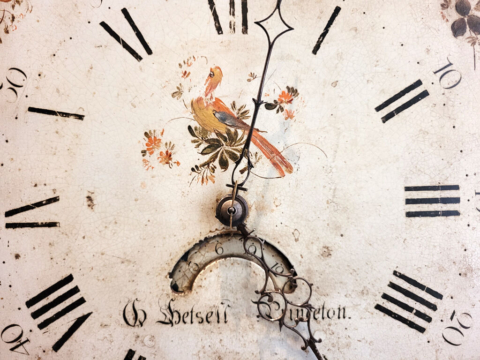
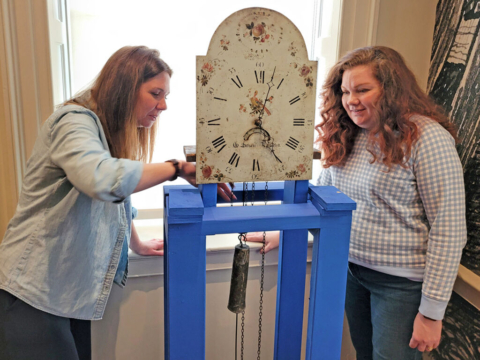
This includes Princeton, of course. Featured in “Striking Beauty” is a clock locally constructed by George Hetsell, who was born in 1809 and seems to have eventually moved to Boulder, Colorado (perhaps marketing his clocks to the newly rich owners of gold and silver miners). Its bonnet was removed be so that visitors can see its complex — and still beautifully functioning — mechanisms.
This relatively small 30-hour clock (based on a 24-hour day plus six reserve hours) was typically wound every day. “Now we’ll have to wind it every day!” says Allan.
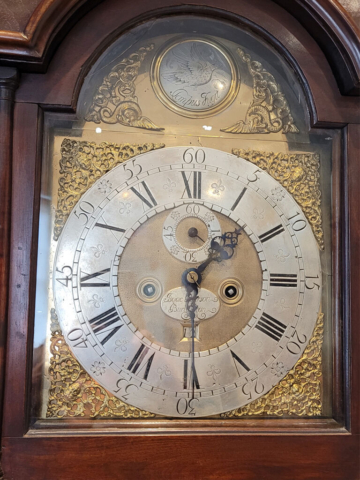
A brass face typically indicates an early clock. Later faces were made of enameled sheet metal, typically hand painted with decorative flowers and birds.
“This one came all the way from Maine. That’s how much we wanted it.”
The face of one clock from 1812 has red-white-and-blue flag-shield decorations in its corners. This was during America’s War of 1812 with Britain, so such patriotic flourishes are not surprising.
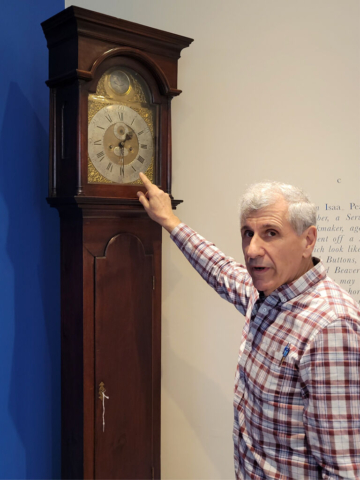
Allan emphasizes that “Striking Beauty” has been brought to its highly successful assemblage thanks to Morven’s dedicated staff, notably assistant curator and registrar Jesse Gordon, and also the staunch involvement of tall case clock expert and exhibition advisor Steve Petrucelli.
“The clocks we’re exhibiting were also important for farming and science,” he says, noting that every college with significant science instruction (known in those days as “Natural Philosophy”) had one.
“You could use them for science experiments,” he says. “There are a lot of subtleties to these things.”
Petrucelli is a retired engineer who bought his first antique tall case clock in 1969 while still a youngster. He subsequently purchased the Adams Brown Company, which lays claim to being not only a venerable clock repair and sales entity, but the country’s oldest horological bookseller. (adamsbrown.com/wordpress1).
“Time is the fourth dimension,” he adds, noting that, fittingly, Morven is only a few blocks from the home of Albert Einstein, who revolutionized scientific thinking about time.
He is clearly taking a quiet but intense joy in the “Striking Beauty” show’s assemblage. “We could have had another 50 or 100 clocks and still not have any duplicates,” he declares.
“These weren’t cranked out from a factory,” says Petrucelli. “The artisans who created them were making every decision.”
And he adds a truth soon abundantly clear to most anyone experiencing the “Striking Beauty” exhibition: “When you start looking at tall case clocks, they all look the same. But once you’ve started studying them, none of them look the same.”
To Petrucelli, each tall case clock is worthy not only of exhibition but of preservation. Many other surviving examples around the country “suffer from benign neglect,” he says.
He hopes that some show visitors will be inspired to acquire and restore tall case clocks as a serious hobby, or more. “Somebody needs to take care of these,” he says.
“We’re only here for a short period of time,” says Petrucelli.
Striking Beauty: New Jersey Tall Case Clocks, 1730 – 1830, Moven Museum & Garden, 55 Stockton Street, Princeton. On view Friday, April 21, through Sunday, February 18, 2024. On Sunday, April 30, at 2 p.m., Steve Petrucelli presents “Perspectives in Identifying New Jersey Clocks” (offered in-person and virtually, $5 to $10 with discounts for Morven members and students). 609-924-8144 or www.morven.org.