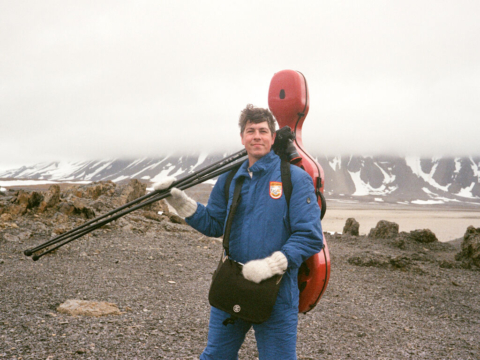
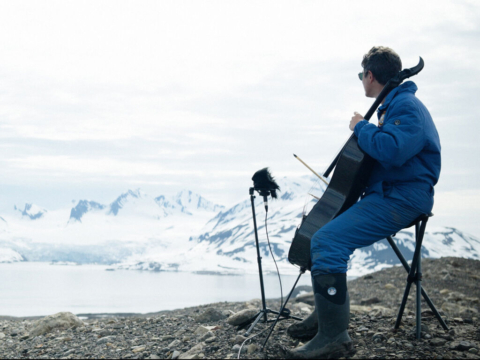
This past summer, Justin Wright heard the call to go north and traveled above the Arctic Circle, not too far from the North Pole. He took his cello along to the northern climes.
The destination was an archipelago of islands off Norway, near Svalbard — Old Norse for “Cold Coast” — home to fjords, aurora borealis, glaciers, and a summer sun that never really set.
“It was part of a residency,” says Wright. “There were about 30 of us on a sailboat near the North Pole and Norway,” he says. “Most were visual artists, with a couple of other musicians.”
His project was, in fact, more visual than musical, to capture himself in this remote environment playing music, interacting with the wind, sea, and terrain. “I took my carbon fiber cello and filmed myself giving improvisations on top of a glacier,” he says. “I made a short film of this while traveling in the Arctic, and that’s my next project. I have a ton of footage to sort through.”
Wright is back in his current home in Princeton and will be making his debut at the Unruly Sounds festival, Sunday afternoon, October 1, at Hinds Plaza, adjacent to the Princeton Public Library on Witherspoon Street.
Founded by area musician/percussionist Mika Godbole, the informal afternoon of music is designed for all kinds of listeners to come and listen, wander around Princeton a little, have a snack or drink, come back for more music, and even participate at times.
Unruly Sounds features a wealth of regional and national composers and performers, many of whom are part of the PhD program in composition at Princeton University. In addition to Wright, other first-timers this year include violist Kennedy Taylor Dixon and a special collaboration between So Percussion, Princeton University Music Department chairman Dan Trueman, and Philadelphia-based tap dancer Michael J. Love.
Look for the duo alba par to return to the festival, as well as steel pan player Kendall Williams, local favorites Owen Lake and the Tragic Loves, harpist Jacqui Kerrod, Damsel (Monica Mugan and Beth Meyers), as well as cellist Dan Kassel with Daniel Johnson on tabla.
Wright will perform toward the end of the fest, about 4 p.m.
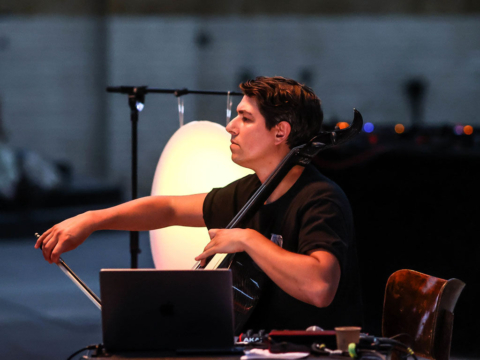
He really is an intriguing one-man event in himself, not just performing original music and improvisations on cello, but also blending synthesizers, loops, his own mini films and other visuals, and even spoken word. His work has been described as falling somewhere between indie and contemporary classical music.
Hopefully, Wright will play something from 2022’s album “A Really Good Spot” (co-release with First Terrace Records). He performed excerpts from the evocative album in February, as part of the Princeton Sound Kitchen’s series of concerts, and the overall experience was an ethereal, multi-sensory trip.
He flashed bits and pieces of original video on a round surface, which hung just to the side of where Wright sat with his cello, laptop, and various electronics. He calls it the Video Gong, and it lit up with changing images as he tapped it with the end of his bow.
“I’ve gotten into so much DIY stuff, and I’m always looking for something else to learn, for example the Video Gong,” Wright says. “I made all of those short films, as well as the projection screen controller device, it’s my own invention.”
“A Really Good Spot” had been a long-term project, and Wright completed the album with instruction from Princeton-based composers Trueman, Donnacha Dennehy, Steve Mackey, and Juri Seo.
“I was working on it for about five years on and off, mostly in Montreal when I lived there,” Wright says. “I did the mixing and stuff at Princeton during my first year here, and it was released in the summer of 2022.”
“When I first started writing tracks for ‘A Really Good Spot,’ I didn’t have much in mind other than wanting cello, wanting synthesizers, and feeling like I was long overdue for writing new material,” he writes, explaining a process that sounds more like “no-process.”
“But once I got started, I was having so much fun coming up with new methods for writing that I wondered: what if ‘procedurality’ could appear on a spectrum, just like dynamics or tempo? Why is process something we try to cover up?”
It’s remarkable that the Montreal native has made such inroads in contemporary composition and performance, as his career path had been completely dissimilar, with little formal compositional education.
Growing up in Montreal, with musically inclined parents working in academics, Wright did take private lessons on the cello, but he never went to music school and never considered a career in modern classical performance or composition. He was more into playing in electronica bands, collaborating with DJs, at one point trying to make instrumental hip-hop.
“I was mostly tagging along with any indie band that might want a cellist and contributed to come song writing,” he says.
Wright was also pursuing a degree, but again, in far different subject matter than music.
“My academic focus was actually in biology,” he says. “I did my bachelor’s and master’s work in molecular biology at Concordia University in Montreal, then had research assistant jobs on and off, but I wanted to give music more of a shot and completely stopped doing science.”
“I couldn’t find science jobs that allowed me to do (more with music), so I got a job at a book and record store,” he adds. “It was minimum wage, but my boss was very understanding and gave me so much flexibility. If I needed to go on tour with a band for a few months, it was OK. I would come back and my job would still be there.”
Then came a residency at the Banff Center for the Arts and Creativity in Banff, Alberta. Wright became fascinated with the venerable institution after visiting there with one of his bands.
“I was really taken by it and wanted to come back on my own,” he says. “I borrowed the cello from Banff Center and a synthesizer from my friend, had no idea what I was going to do, but somehow I came up with original pieces.”
During this time in Banff, Wright recorded his debut LP, titled “Music for Staying Warm,” (Sleepless Records and First Terrace), which translated aspects of ambient drone music for small string ensembles. The album caught the attention of composer Peter Broderick, who released an EP of piano reworks of Justin’s tracks titled “Peter Broderick Plays Justin Wright.”
Another of Wright’s works includes “Drone Garden,” a virtual reality piece exhibited at Montreal’s PHI Centre, and a short film collaboration with Olympic equestrian Naïma Moreira-Laliberté and fashion designer Denis Gagnon.
Wright also met Pulitzer-winning composer Caroline Shaw at the Banff Center, as he was experimenting with cassette loops during a residency. Shaw pushed him to apply for Princeton University’s selective PhD program in composition with her recommendation, and he was accepted even with little background in the field.
“I didn’t even know this program existed, but (Shaw) suggested I apply here (to Princeton), so I looked at the program and the pedagogical approach and thought, ‘this is tailor-made for me,’” he says. “I applied twice and got in on the second try.”
“It’s a general PhD program, not strictly classical, and very open to different approaches,” he adds. “When you go to one of the Princeton Sound Kitchen concerts, it’s the PhD composition folks trying out their recent works.”
Wright slipped into the composition scene easily and was invigorated by his new life in Princeton when he arrived.
“I came here as the pandemic was waning, and Montreal had been pretty restrictive,” he says. “It wasn’t like living in a normal city. I had been living an isolated lifestyle.”
“I’m in my middle 30s, when it’s not always easy to make friends. So, coming back to school at this age, I was suddenly in contact with many people like me, with similar interests,” he says. “I felt at home very quickly in Princeton, there really was no culture shift. It felt really good.”
Unruly Sounds Music Festival, Hinds Plaza, Witherspoon Street, Princeton. Sunday, October 1, noon to 5 p.m. Free. Rain location, Community Room, Princeton Public Library. 609-924-9529 or www.princetonlibrary.org.