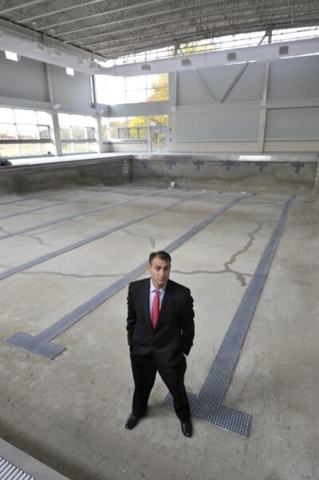
This is a story about faith and sleepless nights. About the difference between what you want and what you get; between what you have and what you hope for.
The sleepless nights are partly courtesy of Matt and Staci Wilson’s newest addition, one-year-old Shayna, and of a much bigger, more expensive baby that neither expected to have — the multi-million-dollar building and tract of land that was supposed to be the JCC Princeton Mercer Bucks’ Jewish Community Campus, but instead has become a question mark nestled on 50-plus acres at 99 Clarksville Road in West Windsor.
“We never anticipated we’d be the owner,” Wilson says. “This was something not expected or wanted.”
The short version of the story is this: Wilson, an investor and former Wall Street financier, and his wife, Staci, a former mergers and acquisitions lawyer in New York, loaned $11 million to the JCC of the Delaware Valley (now JCC Princeton Mercer Bucks) to help it build a 81,000-square-foot community center on 80 acres on Clarksville Road. The JCC could not pay Wilson back, and he and his wife took over the property to keep the JCC from formally defaulting on the loan. A settlement was reached and no one can discuss the terms.
The longer version goes back about 12 years, when the JCC, headquartered at 4 Princess Road, started raising money to erect its new community campus in West Windsor. In 2006, due to declining membership, the JCC sold its property in Ewing (the building became the Ewing Senior Center). A year later West Windsor Township approved the JCC’s plans to build a community center complete with a pool, manicured grounds, and indoor recreation and dining facilities. The plan was to cost $28 million and be completed by the end of 2012.
The JCC approached Wilson in 2010 to help it reach its goal. A native of Yardley, Wilson grew up with the JCC. He had attended its Ring Nursery School and Abrams Day Camp and, as he told the New Jersey Jewish News in 2010, the JCC had shaped much of his identity. He wanted to give something back to the organization and decided to lend it money — reportedly at a very favorable interest rate — toward completing the construction of the Princeton Junction site.
The JCC remained publicly optimistic. Drew Staffenberg, the executive director of the Jewish Community Campus Development Council, said at the time that the Wilsons’ help meant that the campus would definitely be built. But in private, donations from the members of the region’s Jewish community weren’t happening the way they should. There were pledges aplenty, but many were not honored in a timely manner. In November of 2011 the JCC sold 27.6 of its almost 80 acres to West Windsor Township as an open space deal that netted the organization $1.38 million.
By the middle of 2012, however, the president of the Jewish Community Campus Council, Howard Cohen, admitted publicly that despite Wilson’s generosity only a miracle would allow the JCC to meet its deadline and its funding goals. By mid-October, just two months before the campus was scheduled to open, Costanza Construction of Cherry Hill ceased work on the site when the funds to pay the company ran dry. Wilson, the main lender to the project, would not be paid back in full. The JCC turned the deed over to Wilson to avoid default. Jewish Community Campus would definitely not be built after all.
The Wilsons would have been willing to lend the JCC more money, but it quickly became apparent that they wouldn’t get their investment back. “You can’t just keep borrowing, you need a plan to pay it back,” he says. “We’re in a very, very unenviable position.”
This is where Wilson’s faith comes in. And where it melds with hard-headed practicality. He and his wife are the owners of an empty, almost-finished building and the expensive parcel of ground it sits on. By some estimates, construction of the JCC campus was 90 percent done. But as many an almost-completed project has shown, “Empty, partially constructed buildings don’t age well,” Wilson says. “After three years we’d probably have to knock it down, and we didn’t want to do that.”
So far the Wilsons have put about $16 million into the project. He expects to add another $2 million to see it through its rebirth as a community facility of a more general kind. Work on completing the buildings and grounds kicked off again around Labor Day, after an eight-month hibernation. Costanza Construction is back on the job and working daily, Wilson says. “Costanza has been terrific to work with since construction resumed. Costanza has been successful in getting all of the sub-contractors to return to the project to complete the remaining construction, despite a more than eight-month window when the project sat idle.” Wilson expects the building to be complete by the middle of December.
“We really didn’t have a choice,” Wilson says. “There likely would be no buyers for an incomplete building. You can’t have any tenants in an incomplete building.”
The question, then, is not whether the building will be finished, but what to do with it. The building boasts an enviable array of features — a banquet hall with a commercial kitchen, a school area with its own separate entrance, three office spaces totaling 12,000 square feet, a cafe, a dance studio, and an athletic complex with an Olympic-sized pool (outfitted for salt water operation, the cutting edge alternative to chlorinated pools).
An attractive mix of amenities, yes. A well-located plot of land on Clarksville Road a short distance from Quakerbridge, and almost next door to the former American Cyanamid campus that is now owned by the Howard Hughes corporation and targeted for possible mixed use development. But the former community center site is not necessarily easily marketable to a single buyer. The complex, after all, is not retail, residential, or office space, it is designed to be a gathering place for the community. But which community organization or groups could take it over?
Were he sitting on a building full of office space, Wilson would not be nearly so worried. “You can find 20,000 companies for office space,” he says. And while he may be exaggerating, the counterpoint is sober truth: There are far fewer schools and community organizations than corporations able to buy a 77,000-square-foot building in West Windsor.
Wilson’s dream buyer is a school or community organization that will buy the complex outright. He especially likes the idea of a school because the campus, though easily accessible, is tucked nicely back from the buzz of Clarksville Road.
His next preferred option is to sell the complex in parts. A school could buy part of the building. The dance studio has plenty of potential. The banquet hall, Wilson says, is getting the most interest. He and his wife are talking with a lot of potential buyers and renters who very much covet the banquet hall space for weddings and other special events.
Wilson hasn’t ruled out the idea of renting space at 99 Clarksville Road. But the Wilsons don’t want to be landlords unless there’s no other way to get their investment back. Right now the couple is focusing on the dream buyer who will buy the whole property outright and let the Wilsons get back to work on developing tech companies and managing their other business deals.
“We’re going to have a very big party when this is done,” he says.
Wilson remains an optimist, even if a tired one. He has zero animosity toward the JCC — “they tried very hard, they did the best they could” — but the idea of a multi-million-dollar question mark is daunting. “I don’t think I’ve slept more than three hours a night since we took this over,” he says. “This is [exhales] a big project.”
Part of the sleeplessness, remember, is Shayna, the youngest of four Wilson children, and no parent of a one-year-old ever gets that much sleep anyway. The three other children — sons Ari (11) and Noah (7) and daughter Sari (5) — were to be the namesake of the JCC campus teen lounge.
Wilson grew up in Yardley and attended the JCC and Pennsbury school system. He says both of his parents, who are now retired, were involved in entrepreneurial activities. And his sister, Shara Aaron, also has an entrepreneurial bent: She co-owns a communications company specializing in nutrition issues and she recently published the “Don’t Break Your Heart Cookbook — Reduced Sodium Recipes for a Healthy Heart.”
Wilson went to Emory University, where he earned his bachelor’s in finance and marketing in 1995. He worked in the equity derivatives group of JPMorgan Chase until 2004, picking up his MBA in finance from Penn in 2003.
Wilson’s first personal foray into business investment came in 2000, when he joined the board of directors as an investor in Seamless.com, now the country’s largest online restaurant food ordering service. The company was sold in 2006 to Aramark of Philadelphia for an undisclosed amount (and later sold to Spectrum Equity Investors for $50 million). “I was a very early stage investor,” he says of the Seamless deal. “It was a grand slam home run.” Wilson then became a brokerage director at Bank of America before starting a series of firms to help tech companies get off the ground.
Staci earned her bachelor’s from Penn’s Wharton School of Business and later her law degree from New York University (where she met Matt through mutual friends) before starting her career as an M&A attorney. She traded her career for that of a stay-at-home mom in Pennington when Ari was born, but lately she has had to turn many of her mom duties over to her and Matt’s parents while she tries to find the right buyer for 99 Clarksville Road.
All four grandparents are retired, but all were entrepreneurs in various ventures. Wilson says that Staci’s father may have been the most directly influential in recent years in business terms. “He was a CPA, he’s given me a lot of accounting advice.” All have stepped in to free up Matt and Staci to meet with potential buyers and renters, and there has been plenty of that happening lately.
Wilson is glad to have all the help. “This has been one of the most challenging projects I have encountered in my professional career,” he says. As a private investor Wilson has taken on projects involving real estate before, including single-family houses and apartment buildings in New Jersey and in Michigan, but nothing like the JCC campus.
Asked what lessons he has learned, Wilson says, “when you extend a loan, you typically think of your maximum cash outlay, exposure, and risk to be limited to the amount of money loaned. However, this experience has forced us to learn that there are scenarios when you may be put in a position where your risk exposure may grow significantly beyond the amount initially lent. You may be compelled to take on significantly more risk in order to realize the potential value of the underlying collateral.
“Given the alternatives, we decided that taking on more debt and completing construction was the best path. It was a difficult, but valuable lesson,” he says.
There are plenty of nibbles, just not yet the dream-candidate single-buyer/tenant Wilson is hoping for. “The interested parties have been from a wide range of groups, including schools, community centers, ethnic and religious groups, corporations, fitness companies, caterers, chefs, hotel and spa operators, architects, camps, real estate investors, and visionary entrepreneurs,” Wilson says in a follow-up E-mail.
“We have also spoken with several consultants and potential operating partners about operating a phenomenal world-class fitness center and athletic complex on the property focused on a wide range of indoor and outdoor family activities, sports, and leagues for both children and adults. The combination of the brand-new Olympic-sized salt-water swimming pool, two indoor basketball courts, multitude of group exercise classrooms, a large fitness and cardio floor and the vast outdoor space with a pond provide a unique setting to create a destination fitness complex that does not currently exist in this area.”
The couple has filled up its month ahead with meetings, talking to potential buyers in hopes of finding the right fit. Wilson says they will give this avenue a try for about a month before turning to plan B, which is looking for separate buyers who each want a piece of the property. If that fails, the Wilsons will turn to the far less-favored plan C and rent out the space to individual tenants.
“We’re spending 100 percent of our time on this,” Wilson says. Other business deals and issues are entirely on hold until the Wilsons can figure out what to do. “It’s all Staci and I have been talking about. And it’s knowing when to switch gears. When do we give up looking for the single tenant?”
Wilson says they will know whether someone is serious just by talking with them — a level of insight made possible by talking with so many potential startups this past decade. The Clarksville Road project is not his first attempt at business development, nor his first venture into commercial real estate. He and Staci own some commercial properties that they have considered selling off to generate some liquidity.
“We’re not in the position we expected to be in, but we’ll figure it out,” Wilson says. “We’ve interviewed tenants for parts of the building, we would provide owner financing. We’re pretty flexible.”
While there has been plenty of interest, Wilson cannot say who is actually nibbling. For the record, he would love to see part of the place actually go to the JCC in some capacity, but he can’t talk about any potential buyers, clients, or renters.
Wilson still wishes there were a way for the JCC to build its community campus. “We were hoping every second, right up until the end, that the JCC would find a way to make it work,” he says. “We really felt the community would benefit from a vibrant JCC.”
But that’s the past and Wilson is, if anything, a forward-thinker. He dislikes rehashing what he considers an old story about the failure of the JCC and instead likes to talk about possibilities. What’s good for him is that he has many of them. He is aware that his dream buyer might not come through. Aware that his plans to sell the campus in pieces might take longer than he wants to come through. Aware that he and Staci might just be landlords who oversee a diverse mix of community organizations.
But that faith of his, despite the sleepless nights, holds him together. “We’ll figure it out,” he says again. And then they will have the party. And then they will get some sleep.
Arnosa Properties, Box 608, Pennington 08534. 609-903-9400.